AWS Marketplace Strategy: Billing Rail, Co-Sell, or Both?

What is AWS Marketplace strategy?
Short answer: AWS Marketplace strategy is the set of strategic decisions an ISV makes about whether and how to use AWS Marketplace as part of their go-to-market motion. It covers strategic intent, listing model, pricing approach, channel design, and operational stack, and the answers shape everything from your pricing page to your partner program.
It is the question most ISVs answer by accident. The team listens to a few peer stories, picks a Marketplace tooling vendor, ships a public SaaS contract listing, and then spends 18 months trying to figure out why Marketplace revenue is flat. The strategy decision got made implicitly at the tool selection meeting, which is the wrong meeting for that decision.
A working AWS Marketplace strategy has three properties. First, the strategic intent is explicit and written down (is Marketplace a billing rail, a co-sell channel, or both). Second, the listing model and pricing approach follow from that intent, not from a generic best practice. Third, the operational stack and the internal owner match the level of investment the strategy implies.
Adjacent terms worth pinning down: a Marketplace listing is the product page and metering setup. CPPO (Consulting Partner Private Offers) is the channel model where a consulting partner resells your software through their Marketplace listing. A private offer is a custom-priced contract between you and a single buyer. These are listing mechanics, not strategy.
Why AWS Marketplace strategy matters in 2026
Three forces sharpened the question this year. Enterprise procurement teams now ask the Marketplace question early in the buying cycle, so the strategy decision shows up in your sales process whether you are ready or not. AWS continues to push Marketplace as a primary co-sell venue, with field comp and partner program tiers structured around it. And a wave of mid-stage ISVs that listed in 2023 and 2024 are now hitting the wall of “we have a listing and no motion,” which has made the strategic question impossible to ignore.
The three-layer operating case is the right way to think about this. Layer one is the buyer, who increasingly wants Marketplace as a procurement path for EDP burndown, consolidated billing, and faster legal review. Layer two is the AWS field, which gets compensated on Marketplace-transacted, ACE-accepted revenue at a higher rate than direct partner deals. Layer three is the ISV, which has to decide how much operational investment the Marketplace motion deserves relative to direct, channel, and self-serve.
This is operating reality, not a future-state planning exercise. ISVs that make the strategy decision explicitly tend to overinvest in the right layer and underinvest in the layers that do not move their business. ISVs that drift into Marketplace because everyone else is on it tend to spread investment evenly across the stack and get mediocre returns from all of it. The compounding difference shows up in 4 to 6 quarters. For broader industry context, see AWS Marketplace Management Portal documentation.
How AWS Marketplace strategy actually works
The strategy is mechanical, even if the conversations around it feel philosophical. It runs through five decisions, in this order, and the order matters because each decision narrows the option set on the next one.
- Strategic intent: transaction velocity, co-sell motion, or both: Decide whether you are using Marketplace primarily as a billing rail (faster procurement, easier contracts), as a co-sell channel (AWS field selling alongside your reps), or as both. Most ISVs that succeed in Marketplace go all-in on one of these, then add the other later. The “both at once” path requires materially more operational investment.
- Listing model: SaaS contract, metering, CPPO, or free trial: The listing model follows from intent. SaaS contract listings suit annual contract software with predictable pricing. Metered listings suit usage-based products. CPPO suits ISVs with a strong reseller motion. Free trial listings suit self-serve products with a paid upgrade. Picking the wrong model creates ongoing operational friction.
- Pricing strategy: public list, private-offer-only, or hybrid: Public list pricing on Marketplace creates pricing transparency that some ISVs accept and some refuse. Private-offer-only keeps enterprise pricing opaque but limits the self-serve flywheel. Hybrid (public list as anchor, private offers for enterprise) is the most common working pattern but requires careful pricing page coordination.
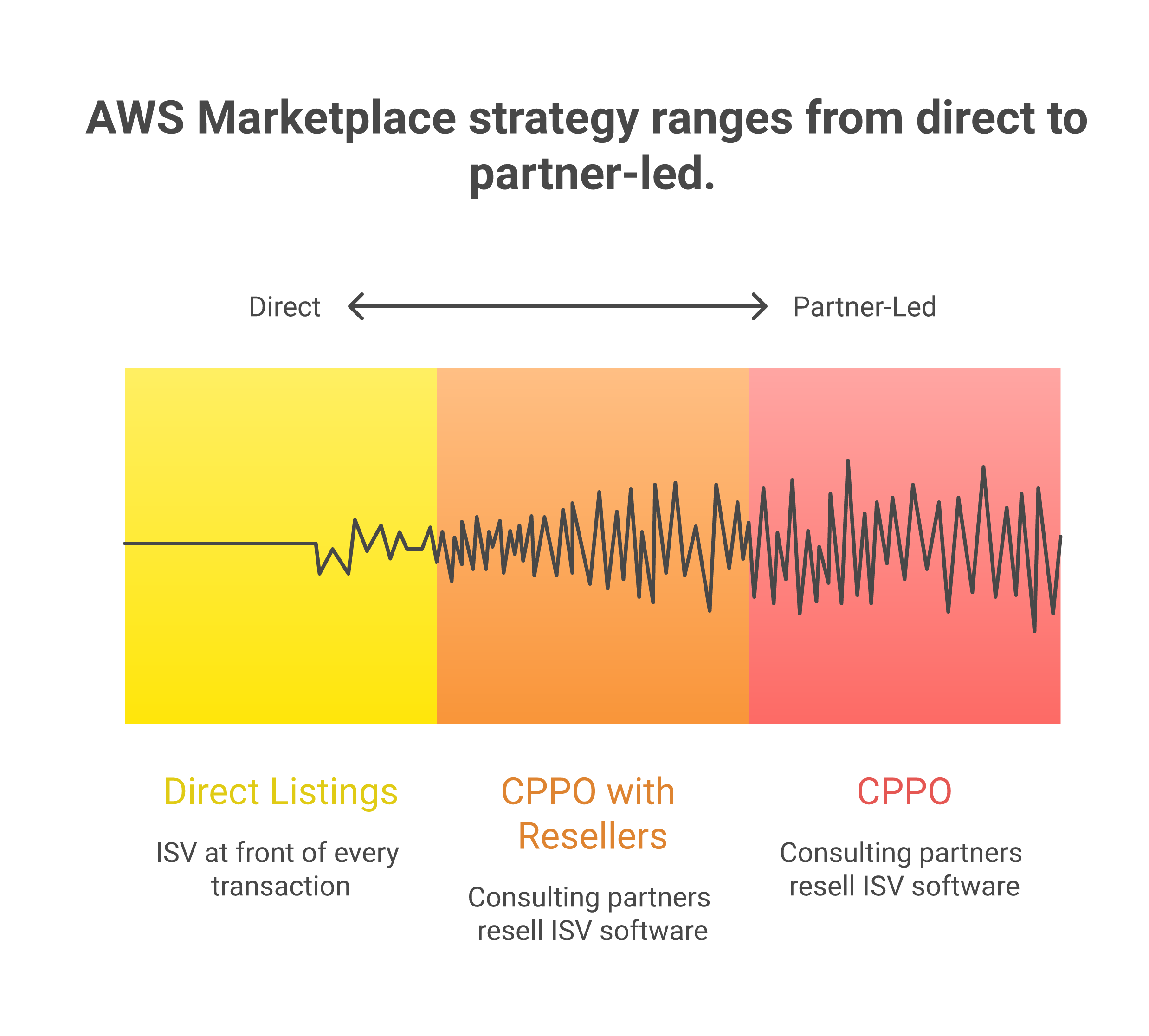
- Channel strategy: direct, CPPO with resellers, or both: Direct Marketplace listings put the ISV at the front of every transaction. CPPO lets consulting partners resell your software through their own Marketplace listings, which can accelerate certain enterprise motions but requires resellers who actually run a Marketplace practice. The choice should reflect your actual partner ecosystem, not aspiration.
- Operational stack: Marketplace tooling, co-sell tooling, RevOps integration: The final layer is the tooling and ops choices. Marketplace tooling (Tackle, Labra, Suger, Clazar) handles listing and private offer management. Co-sell tooling (ACE, Crossbeam, Pocus, Common Room, Introw, Euler, Impartner, PartnerStack, Channelscaler) handles overlap and joint pipeline. RevOps integration ties Marketplace and ACE data back into Salesforce. Match the stack to the intent.
The cadence is the operating reality. ISVs with a working AWS Marketplace strategy revisit the five decisions at least annually, often quarterly in the first 18 months. The strategy is not a one-time document. It is a set of choices that get refined as you learn what Marketplace actually does for your business, and the teams that treat it as static lose ground to teams that treat it as a live operating decision.
Common pitfalls
These show up in nearly every Marketplace strategy diagnostic we run.
- Skipping the strategic intent question entirely: The team picks a Marketplace tooling vendor first and assumes the strategy will emerge from the implementation. It does not. The strategy gets made implicitly through tool defaults, and the implicit strategy almost never matches the explicit one the team would have chosen.
- Copying a peer’s listing model without copying their motion: A peer ISV runs a metered listing successfully, so the team ships a metered listing. The peer has a usage-based product, a self-serve PLG motion, and a billing system that meters cleanly. Your team has annual contracts, an enterprise sales motion, and a billing system that does not meter. The listing model does not transfer.
- Treating Marketplace pricing as the same as direct pricing: The team puts the same public list pricing on the Marketplace listing as on the public pricing page, with no thought for how AWS fees, partner discounts, or private offer terms interact. The pricing math breaks the first time a large customer asks for a custom deal.
- CPPO without a real reseller motion: The team enables CPPO because a consulting partner asked for it, then spends a quarter building the operational plumbing for a reseller who closes one deal. CPPO requires a reseller who runs a real Marketplace resale practice, not a partner who is dabbling.
- No internal owner for Marketplace strategy: The listing sits with a product manager, the contract sits with legal, the pricing sits with revenue ops, and the AWS field relationship sits with partnerships. Strategy decisions require all four orgs and there is no forum where they meet. The decisions get made by whoever cares most that week.
Tools and examples
The tooling decisions fall out of the strategy decisions, not the other way around.
| Layer | What it does for AWS Marketplace strategy | Examples |
|---|---|---|
| Marketplace listing and private offer operations | Manages listing setup, metering, private offer construction, contract terms, CPPO mechanics | Tackle, Labra, Suger, Clazar, AWS-native Marketplace Management Portal |
| Co-sell motion and overlap intelligence | Surfaces account overlap with AWS, manages ACE opportunity flow, tracks joint pipeline | ACE itself, Crossbeam |
| Revenue ops and attribution | Syncs Marketplace, ACE, and partner data into Salesforce, attributes partner-sourced and partner-influenced revenue, reports on Marketplace contribution | Salesforce with APN and ACE sync, CRM partner attribution layers, RevOps data warehouses |
A worked example to make the numbers concrete. Take a mid-stage ISV deciding between “Marketplace as billing rail” and “Marketplace as billing rail plus co-sell channel.” The billing-rail-only path tends to produce a single-digit percentage lift in AWS-influenced ACV after 4 quarters, mostly from existing customers migrating their billing. The both-at-once path, with a named owner, a weekly ACE cadence, and a PDM relationship, typically lifts AWS-influenced ACV by 40 percent or more in the same 4 quarters, with a meaningful chunk of that coming from net-new logos. The strategy decision is the leverage point, not the tooling choice.
Forecastable’s POV
Most “AWS Marketplace strategy” content skips the strategy and jumps straight to listing mechanics. You will read 3,000 words on which listing model to choose, which Marketplace tool to evaluate, and which contract terms to negotiate, and at no point will anyone ask the strategic question first. We think this is backwards, and we think it is the single biggest reason ISVs are disappointed with their Marketplace results.
The contrarian position is straightforward. Step one of AWS Marketplace strategy is to decide whether Marketplace is a billing rail, a co-sell channel, or both. Different answers produce different listing models, different pricing strategies, different channel choices, and different operational stacks. Doing this in the wrong order (picking the tool first, then backing into a strategy) is what produces the wall of disappointed mid-stage ISVs that we see every quarter.
The second contrarian position: most ISVs underinvest in the “both” path because the operational lift looks intimidating. It is intimidating, but it is also the path with the largest payoff. The teams that go all-in on Marketplace as both a billing rail and a co-sell channel, with an internal owner who can credibly sit at the partnerships, sales, RevOps, and product table, get outsized returns. The teams that pick one path and run it cleanly do well. The teams that try to do both at half-effort do worst of all.
The third position worth defending publicly: the tooling vendors in this space are not the strategic decision. We are agnostic on whether you choose Tackle, Labra, Suger, or Clazar for listing operations, and on whether you choose Crossbeam, Pocus, or Common Room for co-sell intelligence. The vendors all work. What we care about is whether your strategy decision came first and the tooling decision followed, or whether the strategy is whatever the tool defaults produced. That sequencing question is the leverage point.
Forecastable is an independent third-party professional services company. Our evaluations of AWS Marketplace strategy are based on publicly-available information as of May 2026 and our own client experience.
Frequently asked questions
Should every ISV be on AWS Marketplace?
No. ISVs with a target customer base that does not run on AWS, with deal sizes that do not justify the operational lift, or with a sales motion that does not benefit from procurement acceleration can reasonably skip it. The honest assessment is that Marketplace is high-leverage for ISVs whose customers have meaningful AWS spend and procurement teams that prefer AWS as the buying venue. For others it is a distraction.
What is the difference between a listing and a strategy?
A listing is the product page and the metering setup. A strategy is the set of decisions about why you have the listing, what the listing is supposed to do for your business, and what operational investment you are willing to make to get the result. You can have a listing without a strategy (most ISVs do) but you cannot have a strategy without a listing if you want it to produce revenue.
When should I use CPPO instead of a direct listing?
When you have a real reseller motion with a consulting partner that already runs a Marketplace practice. CPPO is not a substitute for an absent partner motion; it is a mechanism that amplifies an existing one. If your reseller is not closing direct deals already, CPPO will not make them start.
How does AWS Marketplace strategy connect to APN tier?
APN tier criteria include Marketplace-transacted revenue, ACE-accepted opportunities, certified architects, and customer references. So your Marketplace strategy is also implicitly your APN tier strategy, which is also your AWS field access strategy. Treating the three as separate produces unforced errors. Treating them as one connected decision tends to produce better outcomes.
What is the right operational owner for Marketplace strategy?
There is no single right answer, but the owner has to credibly sit at the table with partnerships, sales, revenue ops, product, and finance. The most common working model is a senior partnerships leader who has direct authority over the AWS relationship and matrixed authority into RevOps and product. What does not work is leaving the ownership distributed across multiple orgs with no decision forum.
How long does it take to see meaningful Marketplace results?
With a clear strategy, a named owner, and a working PDM relationship, you should see operational momentum in 1 to 2 quarters and material revenue movement in 3 to 4 quarters. Without those three, the timeline stretches indefinitely. The teams that move fastest are not the ones with the biggest budgets; they are the ones with the clearest strategy decision.
Should I evaluate Marketplace tooling vendors before or after deciding strategy?
After. The strategy decision narrows the tooling shortlist meaningfully. Going to a Tackle, Labra, Suger, or Clazar demo before you know whether Marketplace is a billing rail or a co-sell channel for your business means the vendor frames the strategy for you, which is the wrong way around.
Next step
If you are about to invest in AWS Marketplace and have not made the strategic intent decision explicitly, that is the work to do first. A two-week sprint with the right cross-functional team can produce a written strategy that drives the next 18 months of investment, and it will save you from the much more common path of spending those 18 months retrofitting a strategy to a set of decisions that were made implicitly at a tool selection meeting.
Talk to our team about your AWS Marketplace strategy →
The co-sell hub holds the broader context on how AWS Marketplace strategy fits inside a complete hyperscaler co-sell and partnerships motion.
Uncover Your Growth Potential
Schedule a Discovery Call