Partner Manager Skills: A 2026 Operating Profile

What partner manager skills predict performance in 2026?
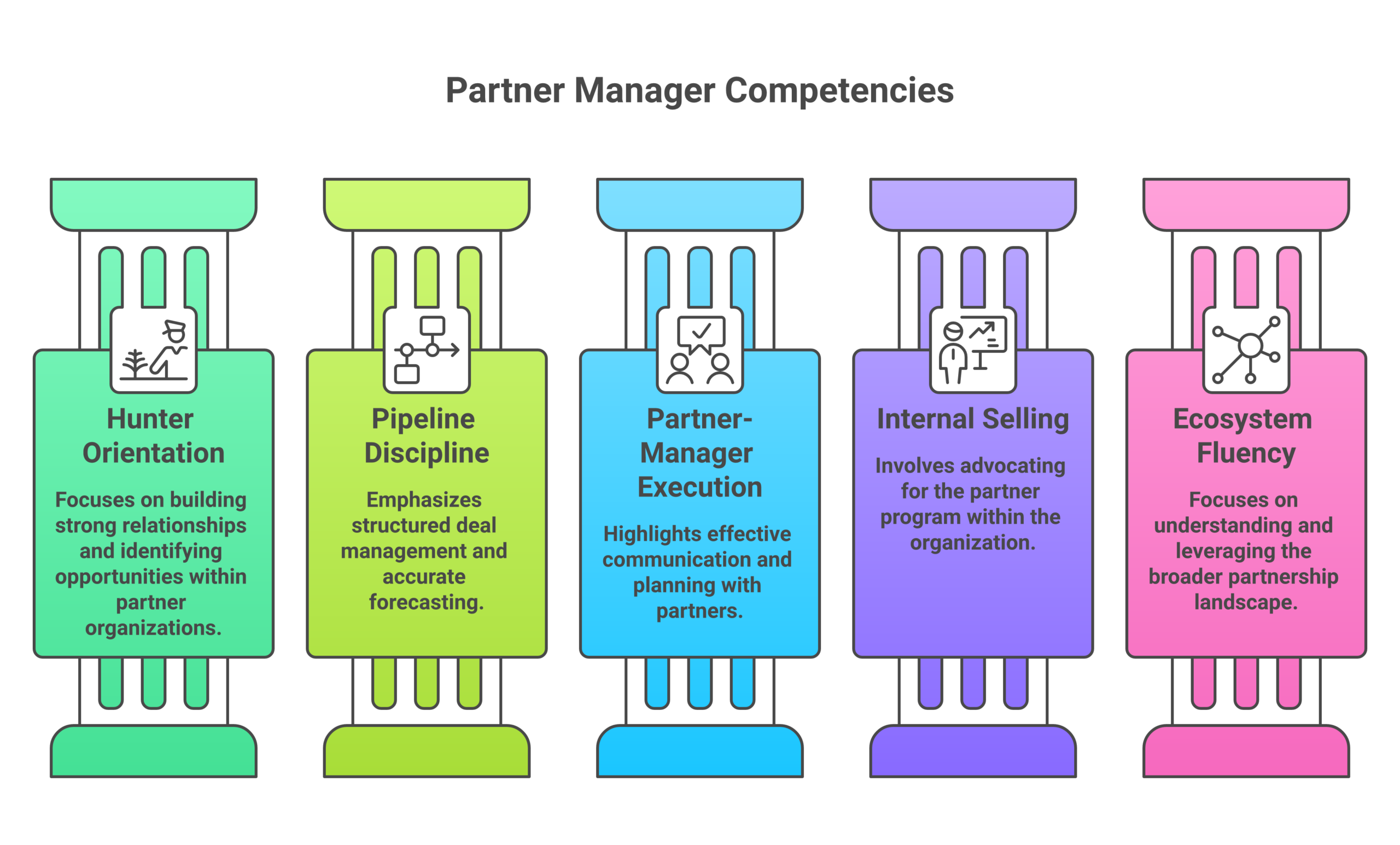
Short answer: partner manager skills are the operational competencies a partner manager needs to produce partner-sourced and partner-influenced pipeline at scale, hunter orientation, pipeline discipline, partner-manager execution, internal selling, and ecosystem fluency. In 2026, these five competencies determine whether a partner manager produces deals or produces meetings, and they differ materially from generic relationship-management competencies.
The partner program hub holds the broader operating context. A working partner-manager profile has three properties. It is sales-grade: the partner manager runs CRM-grade pipeline discipline that matches the direct sales team’s standard. It is operationally complete: all five competencies are present, not just two or three. And it is measured on pipeline: the partner manager is held to partner-sourced and partner-influenced pipeline output, not to partner-engagement activity.
Three adjacent profiles get conflated. Channel manager is the older, sales-heavy variant focused on a single channel type (reseller or VAR); partner manager is broader and includes tech ISV, MSP, agency, and SI motions. Alliances manager is the strategic-partner-focused variant; partner manager covers the broader range. Ecosystem manager is the newer, signal-and-data-focused variant; partner manager remains the most common operating title in B2B SaaS.
Why partner manager skills matter in 2026
Partner manager skill profile is the single biggest predictor of partner program performance. Programs with a partner manager team built on the five-competency profile produce partner-sourced pipeline at structural rates; programs built on relationship-only profiles produce activity that does not convert.
Three forces sharpened the question in 2026. First, finance leadership now treats the partner number as a forecast input rather than a side metric, which exposes the gap between partner managers who run a real pipeline and partner managers who run relationships. Second, sales leadership increasingly expects partner managers to operate at AE-grade rigor, which surfaces the skill-profile gap in any partner team built on the older relationship-only model. Third, the partnerships category has matured to the point where the five-competency profile is a known operating standard, and partner managers without it are no longer competitive in the market for roles.
The operating case has three layers. Companies that hire the five-competency profile build partner teams that compound, and the team produces more pipeline each quarter than the quarter before. Companies that hire relationship-only build teams that produce meetings and not deals, and that have to be rebuilt every 18 to 24 months. And partner managers built on the five-competency profile become the candidates for head-of-partnerships and CRO-adjacent roles; partner managers built only on relationships hit a structural ceiling at the senior manager level.
How the five competencies actually work
Five competencies compound into a high-performing partner-manager profile. The order matters: hunter orientation is the foundation, pipeline discipline is the operating layer on top, partner-manager execution is the cadence, internal selling is what gets the program credit, and ecosystem fluency is what keeps the program current. Skip a competency and the partner manager reverts to a relationship-only operating model.
- Hunter orientation: the partner manager treats the partner relationship as a sales motion, not as account management. They prospect into the partner organization, build a champion, navigate the partner’s internal politics, and run a sales cycle against the partner’s commitment.
- Pipeline discipline: the partner manager runs a CRM-grade pipeline of partner-sourced and partner-influenced deals, with stage definitions, deal mechanics, and forecast accuracy that match the direct sales team’s standard.
- Partner-manager execution: the partner manager runs the operating cadence, weekly deal review with the partner, monthly partner business review, quarterly joint pipeline planning, account-mapping refresh on a published cadence.
- Internal selling: the partner manager sells the partner motion inside their own company, to the direct sales team, to sales leadership, to marketing, and to finance.
- Ecosystem fluency: the partner manager understands the ecosystem-data layer, the co-sell mechanics, the attribution model, and the broader partnerships landscape (Crossbeam, Reveal, PartnerTap, the analyst literature, the category-defining playbooks).
The five competencies have to coexist. Partner managers strong on hunter orientation and pipeline discipline but weak on internal selling produce strong individual pipeline that the company does not credit because the attribution story is missing. Partner managers strong on execution and ecosystem fluency but weak on hunter orientation produce well-organized friendly relationships without deal output. The combination is what compounds.
Common pitfalls
Five repeating failures show up in partner manager hiring and development. All five are hiring-and-coaching issues rather than tooling issues.
- Hiring for relationships, not for sales mechanics: the job description emphasizes channel experience and communication. The interview rubric tests for relationship skills. The hired profile produces friendly partnerships without forecastable pipeline.
- No pipeline discipline expectation: the partner manager is not held to CRM-grade pipeline standards. The partner pipeline lives outside the main CRM in spreadsheets and Slack. Sales leadership does not read it; finance does not trust it.
- No internal selling cadence: the partner manager does not have a weekly or biweekly cadence with the direct sales team. Partner-sourced opportunities do not make it into the seller’s workflow. The motion stays siloed.
- No ecosystem fluency baseline: the partner manager does not engage with the broader partnerships literature (Crossbeam research, ELG content, analyst reports). The motion stays in 2019-era playbook execution while the category moves on.
- Missing the hunter orientation gap: the leadership team assumes hunter orientation will emerge with tenure. It does not; it is a profile trait, and partner managers without hunter orientation usually stay in account-management mode regardless of coaching investment.
The fix for most of these starts at the hire. Hiring rubrics that explicitly test the five competencies produce partner manager teams that compound.
What this looks like in practice
A high-performing partner manager runs a recognizable weekly cadence. The shape of the week separates partner managers who produce pipeline from those who produce activity.
a mid-stage SaaS company hires a partner manager from an AE background and onboards against the five-competency profile. The partner manager runs a weekly partner deal review with each of the top three strategic partners, joins the direct sales team’s Tuesday standup as a recurring guest, owns champion-building inside one named strategic partner, and reports partner-sourced and partner-influenced pipeline weekly. Within two quarters, the partner-sourced share of new pipeline crosses 20%, and the AE team starts looking for partner-warmth as a first-class signal. The hire pays back inside two quarters because the rubric tested the right things at the door.
Forecastable’s POV
The honest test for a partner manager profile is whether the individual produces forecastable partner-sourced and partner-influenced pipeline at scale. Programs that hire and coach against that test build partner teams that compound; programs that hire for relationships and tenure build teams that have to be rebuilt every 18 to 24 months.
The most common failure I see is the inverse, programs that hire on relationships and channel experience, then wonder why the partner number stays flat. The diagnosis is usually misread as “we need more partner managers” or “we need a better PRM.” The actual issue is the operating skill profile of the people in seat. The fix is not to add more of the same profile; the fix is to rewrite the rubric and rehire (or coach) against the five competencies.
The second move is to measure partner managers on pipeline number, not on engagement activity. Programs that measure partner managers on number of partners enabled, marketing dollars deployed, or co-sell calls held produce activity. Programs that measure partner managers on pipeline number produce pipeline. The choice of metric is the choice of operating model, and the wrong metric is what locks the program into the wrong skill profile.
The third move is to invest in coaching against the five competencies rather than against generic “leadership development.” A partner manager who needs to develop hunter orientation needs different coaching than one who needs to develop internal selling. Generic leadership programs do not move either competency. Coaching has to be specific to the gap, and the gap has to be diagnosed against the rubric.
Forecastable is an independent third-party professional services company. Our evaluations of partner manager skill development are based on publicly-available information as of May 2026 and our own client experience.
Frequently asked questions
What is the most important partner manager skill? Hunter orientation. Without it, the rest of the competencies produce friendly relationships that do not convert to pipeline. Hunter orientation is the foundation; the other four compound on top of it.
Can a partner manager be a former AE? Yes, and former AEs are often the strongest partner manager hires because they bring hunter orientation and pipeline discipline by default. The development edge is usually partner-manager execution and ecosystem fluency, both of which can be coached.
How do you test for partner manager skills in interviews? Test all five competencies explicitly. Ask for a partner-sourced deal walkthrough (hunter orientation), a pipeline view from a recent quarter (pipeline discipline), an operating-cadence description (execution), an example of selling the partner motion internally (internal selling), and a current-events take on the ecosystem (fluency).
Is partner manager a sales role or a marketing role? Increasingly a sales-adjacent role with a quota or quota-equivalent. In 2026, most leading partner programs treat partner managers as quota-carrying or quota-supporting, not as a marketing or partner-ops function.
How do you develop partner manager skills? Coaching against the five competencies, weekly pipeline review with sales-grade rigor, ecosystem-literature reading, and direct exposure to the direct sales team’s operating cadence. Skill development is a multi-quarter investment, not a workshop.
Should we hire partner managers internally or externally? Both work. Internal hires (often from AE or CSM ranks) bring sales mechanics and company context; external hires bring partner-program experience and ecosystem networks. The hiring rubric matters more than the source.
Next step
Audit your current partner manager team against the five competencies before redesigning the program. If two or more of the five are weak on the average partner manager, the program is not going to produce a forecastable partner number regardless of platform or program design choices. Rewrite the hiring rubric first, then coach the team you have, then rehire to fill the gaps.
Talk to our team about hiring and developing partner managers who actually produce pipeline →
The partner program hub holds the broader context on where partner manager skills fit inside program design.
Uncover Your Growth Potential
Schedule a Discovery Call