Partner Manager Job Description: What to Include

What is a partner manager job description?
Short answer: a partner manager job description is the hiring document that defines the role’s scope, owned outcomes, and operating cadence, written specifically enough to filter candidates accurately and pay the role correctly. In 2026, the JDs that produce strong hires are concrete (name the partner relationship and the pipeline target); the ones that produce mis-hires are generic (“manage strategic partnerships”).
The partner manager salary work pairs with the JD to attract the right candidate at the right comp, and how to hire a partner manager covers the sourcing and interview design that match the JD’s structure. The JD is the upstream artifact; everything downstream depends on it.
A working JD has three properties. It is named: it specifies the partner type, partner roster, or partner motion the hire will own. It is measurable: the success metrics are explicit and pipeline-anchored. And it is operational: the JD describes the weekly cadence the role will run, not just the philosophical scope.
Why a partner manager job description matters in 2026
The cost of a mis-hired partner manager is high: roughly two quarters of activity that produces no measurable pipeline, plus the opportunity cost of the right hire not having been made. Most mis-hires are upstream of the candidate; they are JD problems.
Three forces sharpened this. First, partner-sourced revenue moved onto the board deck, which means a partner manager’s contribution now gets measured against a real number. Second, the partner-manager talent market split into a relationship-coordination tier and a sales-minded tier, and the same generic JD cannot attract both, see the partner manager salary breakdown. Third, AEs in the broader revenue org expect partner managers to bring deal-stage rigor; a relationship-only profile no longer fits.
The mechanical case is simple. A specific JD that names the partner relationship, the pipeline target, and the operating cadence attracts candidates who can produce against those terms. A generic JD attracts a broad applicant pool with no consistent signal, and the hiring process spends weeks filtering on instinct rather than fit. The JD does the filtering work or the interview process does, and the interview process is far more expensive to run repeatedly.
This is also an internal-alignment issue. A JD that the partnerships team writes alone tends to drift away from what the sales org needs. The strongest JDs are co-written with sales leadership so the role is set up to work with the field from day one.
How a partner manager job description actually works
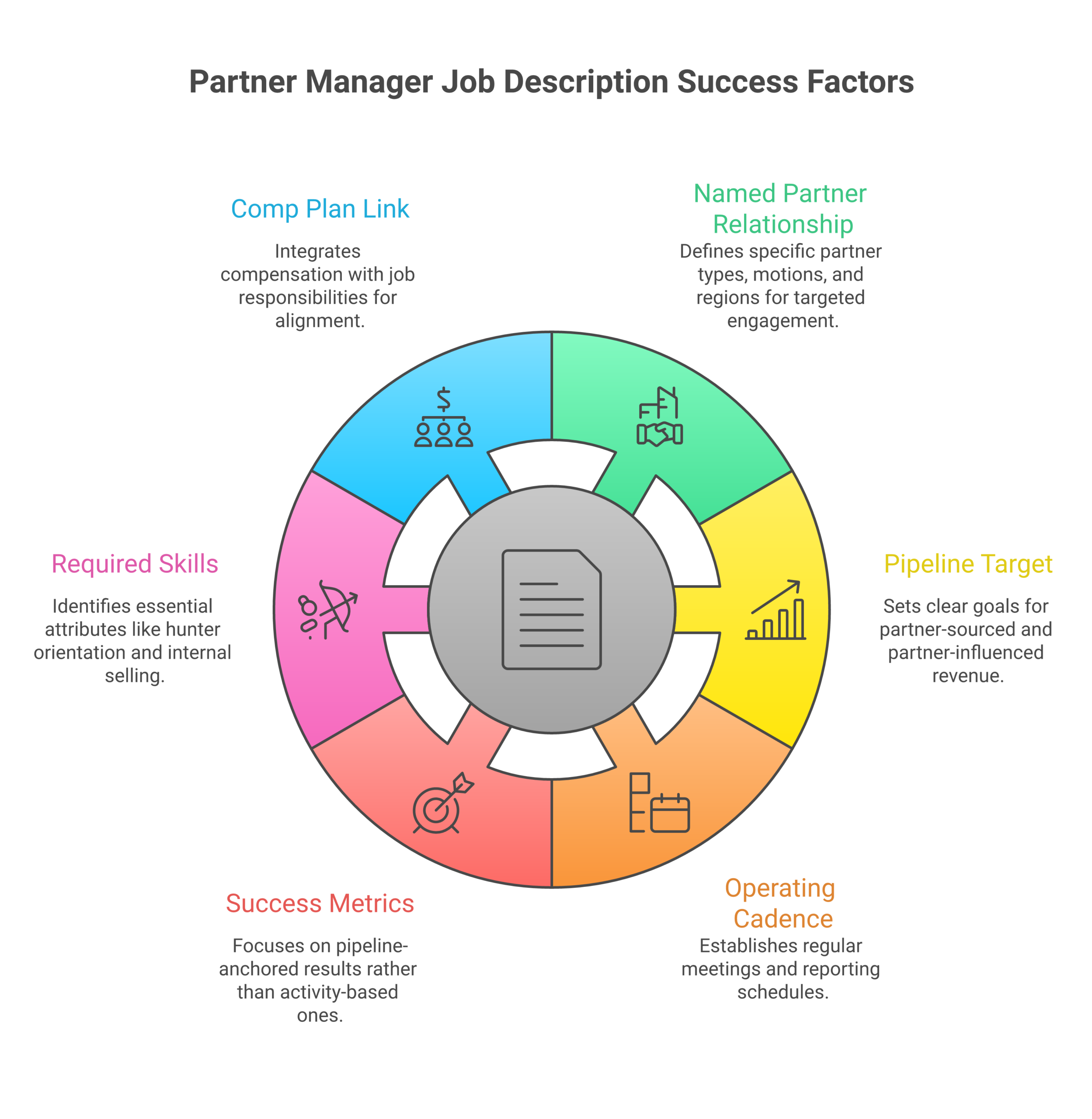
Five components make a JD specific enough to filter candidates accurately and pay the role correctly. The order matters: the scope before the metrics, the metrics before the cadence, the cadence before the comp.
- Name the partner relationship or motion the role owns: “manages partner relationships” filters nobody. “Owns the joint motion with three named strategic partners, with a focus on the tech ISV co-sell motion” filters precisely. Specificity is the first signal of a real hire.
- State the pipeline target explicitly: the role should carry a number, and the number belongs in the JD. “Partner-sourced pipeline target of $X annually” tells candidates what to optimize for and tells finance what the role is supposed to produce. See partner-sourced revenue for how to define the target.
- Describe the operating cadence the role will run: weekly one-on-ones with the partner-side counterpart, monthly QBR, weekly joint pipeline review with the company’s AEs. The cadence is the job; describe it.
- Pair the JD with the comp plan: see the partner manager salary breakdown. If the role is a sales-minded hire, the comp is 50/50 with accelerators. If it is a coordination hire, 70/30 to 80/20. The JD signals which one through scope and metrics, and the candidates self-select accordingly.
- Co-write the JD with sales leadership: a JD the sales VP did not contribute to will produce a partner manager the sales VP does not support. Get the sales side in the room when the JD is written; the role’s effectiveness depends on the field accepting it.
JDs that include all five components produce filtering at the application stage and hires that ramp inside a quarter. JDs that skip the named partner relationship or the explicit pipeline target produce broad applicant pools and slow ramps.
Common pitfalls
Four repeating failures show up across partner-manager JDs. All four are easier to fix in the JD than to recover from after a mis-hire.
- The generic “manage strategic partnerships” JD: produces a broad applicant pool and a hire who interprets the role however they want. Specificity is the cheapest filter; use it.
- A JD with no number attached: a role without an explicit pipeline target cannot be held accountable and cannot defend its budget. Even if the number is provisional, name it.
- A JD with metrics that pay for activity: “QBRs delivered” and “partners onboarded” produce a busy partner manager and a flat partner number. Anchor metrics to pipeline or revenue, not motion.
- A JD the sales VP did not co-write: the role’s success depends on field cooperation. A JD written in isolation by the partnerships team produces a hire whose work the sales team never adopts.
What this looks like in practice
Writing a partner-manager JD draws on three references, each of which already exists inside the company.
a mid-stage SaaS company writes the JD for a sales-minded partner manager opening. The JD names the three strategic partners the role owns, the $4M partner-sourced pipeline target for year one, the weekly cadence (Monday partner sync, Tuesday joint pipeline review with company AEs, monthly QBR with each partner), and the 50/50 comp structure with a 1.5x accelerator. The JD is co-authored by the VP Partnerships and the VP Sales. The applicant pool tightens to candidates with AE backgrounds and ecosystem fluency, and the hire is made in seven weeks instead of fourteen.
Forecastable’s POV
A partner-manager JD is the cheapest, highest-leverage hiring artifact in a partner program, and the one most teams write last. Recruiters need specifics to filter; candidates need specifics to self-select; the sales VP needs specifics to know what they are getting. The JD is the document that delivers all three.
The most common failure I see is the “manage strategic partnerships” archetype. The JD sounds reasonable, attracts a wide candidate pool, and produces a months-long hiring process during which the team tries to define the role through interviews rather than the JD itself. The interview process is far more expensive than rewriting the JD. Define the role in the JD; let candidates self-select.
The second move is to write the JD around the specific partner motion the role will run, not around the general concept of partnerships. “Partner manager” is one title for several distinct jobs, strategic alliance lead with one or two flagship partners, partner manager owning a tier of named accounts, co-sell ops manager running cadences for 100+ partners. Pick the job. The candidate for each is different, the comp structure is different, the success metrics are different. A generic JD that tries to describe all three produces a hire who fits none of them.
The third move is to co-write the JD with sales leadership. The role’s effectiveness is downstream of how well the company’s AEs adopt the partner motion. A JD written by the partnerships team alone, even a strong one, produces a hire whose proposals the sales team treats as suggestions. A JD that the sales VP helped write produces a hire whose work the sales VP has already endorsed at the design stage. The political work happens at the JD step, not after the hire.
Forecastable is an independent third-party professional services company. Our evaluations of partnership-role JDs are based on publicly-available information as of May 2026 and our own client experience.
Frequently asked questions
What should a partner manager job description include? The specific partner relationship or motion the role owns, the pipeline target, the weekly operating cadence, the success metrics anchored to revenue or pipeline (not activity), and the comp structure (50/50 for sales-minded, 70/30 to 80/20 for coordination).
How long should a partner manager JD be? Long enough to be specific, short enough to be read. One page is the right length for most: a paragraph naming the scope, a list of owned outcomes, a list of operating responsibilities, a paragraph on qualifications, and the comp range.
Should the JD include a pipeline target? Yes. A role without a number is a role without accountability. Even if the target is provisional, name it. The number tells finance what the role is supposed to produce and tells candidates what to optimize for.
What should success metrics look like in a partner manager JD? Partner-sourced pipeline, partner-sourced revenue, advancement of named partner deals through stages, certified-rep growth on the partner side. Activity metrics (QBRs delivered, partners onboarded) produce activity, not outcomes.
Should the partnerships team write the JD alone? No. Co-write with sales leadership. The role’s effectiveness depends on field cooperation; the JD is the upstream artifact that aligns sales to the partner motion before the hire is made.
How is a partner manager JD different from a sales JD? A partner manager JD describes a role that produces pipeline through partners rather than direct outbound. The structure can mirror a sales JD (named accounts, pipeline target, operating cadence), but the accountabilities are partner-side rather than direct-customer-side.
What is the most common mistake in partner manager JDs? Genericism. “Manage strategic partnerships” filters nobody. Name the partner relationship, name the number, name the cadence, specificity is the cheapest filter and the strongest signal of a real role.
Next step
Pull your current partner manager JD and check three things: does it name the specific partner motion, does it state an explicit pipeline target, and did the sales VP co-write it? If any answer is no, the rewrite is the first hiring fix.
The partner program hub holds the broader context on where this role sits inside the program design.
Uncover Your Growth Potential
Schedule a Discovery Call