Alex Buckles
Forecast Collaboration: A 2026 Cross-Functional Playbook

Forecast collaboration is the operating practice of producing a single forecast number across sales, partnerships, customer success, and finance through a recurring joint cadence rather than four parallel ones. It turns a contested forecast into a defensible one. Companies that run it cleanly compound accuracy quarter over quarter.
Most SaaS organizations produce forecasts the way committees produce camels. Sales builds a number on rep commits and management overlays. Partnerships builds a number on partner-influenced pipeline. CS builds a renewal projection. Finance builds the consolidated plan. The four numbers rarely match, the variance gets debated quarterly, and the CFO ends up reporting a fifth number that none of the operating teams will defend. The fix is not better dashboards. The fix is forecast collaboration as a recurring operating discipline.
This piece covers what forecast collaboration actually is, why most SaaS organizations underweight it, the four-stage cadence that produces a single defensible number, the failure modes that explain why most cross-functional forecast meetings degrade into attribution debates, and the connection to broader forecastability. For the upstream operating model, see the forecastability overview and the executive alignment guide. For the partnership-side mechanics, see the partnerships overview and the co-sell guide.
What is forecast collaboration?
Forecast collaboration is the joint operating practice through which sales, partnerships, customer success, and finance produce a single forecast number for a defined period, supported by a shared deal-mechanic gate, a shared attribution model, and a shared review cadence. The output is one number that all four functions will defend. The opposite is four separate numbers that the CFO reconciles and nobody owns.
The category is often confused with three adjacent practices. Forecast review is the recurring meeting where leadership reviews the existing forecast; review is necessary for collaboration but does not equal it. Pipeline collaboration is the day-to-day coordination on individual deals; pipeline collaboration is necessary but operates at the deal level, not the forecast level. Forecast consolidation is the finance-led act of rolling up multiple inputs into a single number; consolidation is the output, not the operating practice.
The unit of forecast collaboration is the joint commit. Each function commits to a number for the period, with the underlying deals or accounts that support it, and the joint cadence reviews variance against that commit weekly. Without commit, the meeting becomes status reporting. With commit, the meeting becomes operating discipline.
There are two practical depths. Light collaboration is a recurring cross-functional review where the four numbers are surfaced and reconciled. Heavy collaboration adds a shared deal-mechanic gate (a deal cannot enter the forecast unless it meets the four forecastability conditions) and a shared attribution model (sourced, influenced, assisted, locked with finance before launch). Light collaboration is suitable for early-stage SaaS; heavy collaboration is the standard for mature companies with material partner-touched revenue.
Why forecast collaboration matters
Forecast collaboration produces a single defensible number that the CFO can plan against and the board can trust. The economic case is structural: companies whose four operating teams disagree on the forecast carry a credibility tax that compresses valuation multiples, slows hiring decisions, and undermines strategic investment. The companies that get this right run with materially less internal friction and materially tighter forecast accuracy.
The financial case has three layers. Plan defensibility: a forecast that all four functions will defend survives board review and investor calls; one that gets renegotiated quarterly does not. Capital efficiency: companies with predictable revenue can hire ahead of demand and invest in multi-year programs (product, partnerships, market expansion); companies without it run a stop-start cycle that compounds cost. Multiple expansion: Bessemer’s State of the Cloud research and analyst commentary from Gartner consistently show that companies trading at premium SaaS multiples carry forecast credibility as a structural input to valuation.
In practice, the operating case is more durable. Forecast collaboration converts internal political debates into operating discipline. The attribution argument that most companies have quarterly (sales claims sourced revenue, partnerships claims influenced revenue, CS claims expansion at renewal) gets resolved up front when the joint cadence locks the attribution model with finance. Once that’s locked, the meeting stops being a negotiation and starts being a forecast.
The downside, real and common, is that forecast collaboration done badly produces theater rather than discipline. A weekly cross-functional meeting with no commit, no shared gate, and no locked attribution is just a status meeting that consumes leadership calendar without improving the forecast. The fix is operating discipline applied to the cadence, not the cadence itself.
How forecast collaboration works: the four-stage cadence
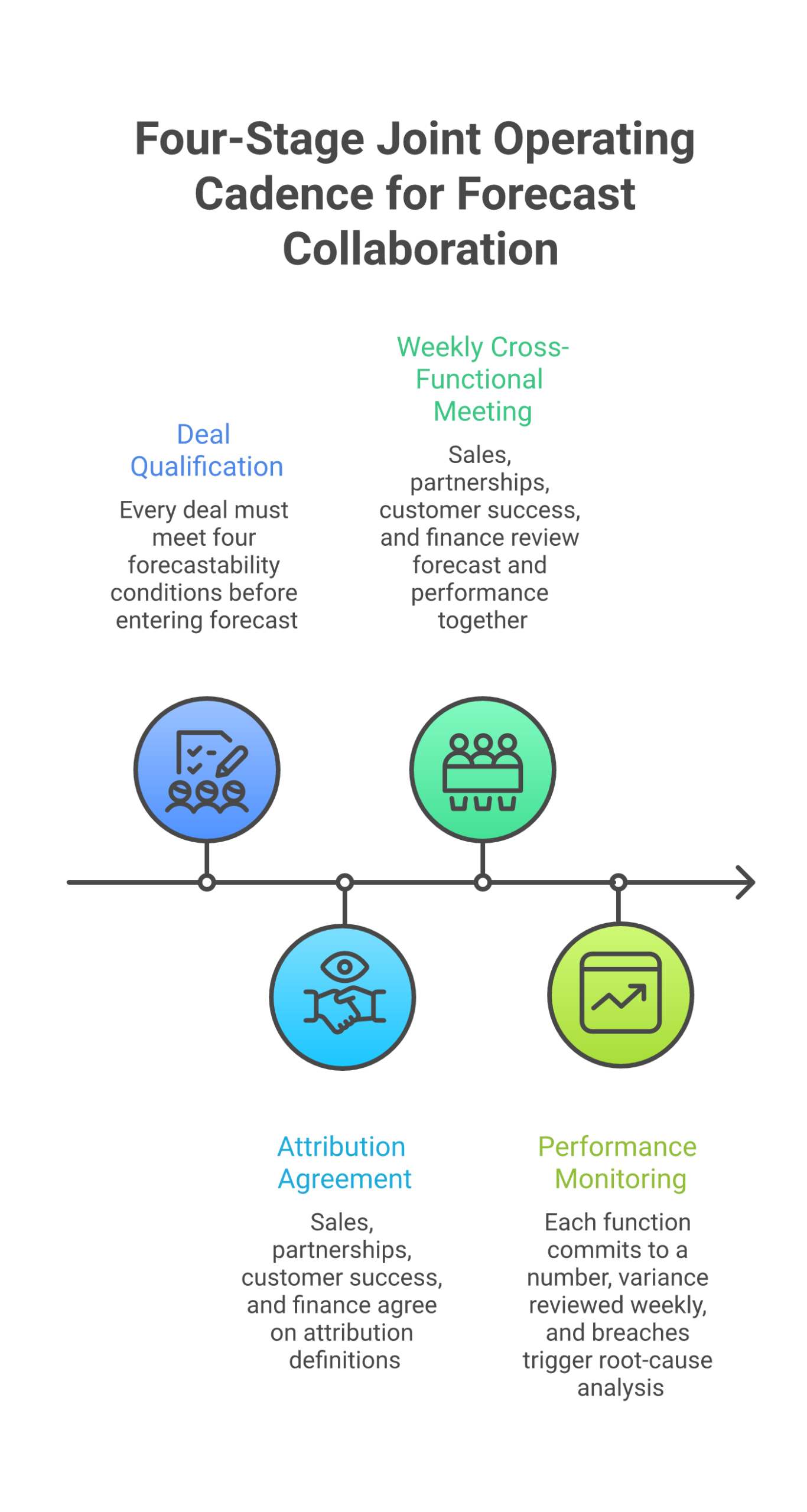
Repeatable forecast collaboration runs on a four-stage cadence: shared deal-mechanic gate that defines what enters the forecast, locked attribution model that defines who gets credit for what, joint operating review that surfaces drift in the period, and joint commit-and-variance discipline that holds the number to account. Skip a stage and the meeting reverts to status reporting.
The stages
The four stages, in order:
Why the cadence is the system
The cadence is the system. Most cross-functional forecast meetings that underperform have stages 3 and 4 covered (the meeting happens, a number gets reported) and skip 1 and 2. Without a shared gate and locked attribution, the meeting devolves into the same political debate that the forecast was supposed to resolve.
Common pitfalls in forecast collaboration
Forecast collaboration efforts fail at predictable points. The five recurring failure modes account for most of the underperformance, and most are operating-model issues rather than tooling issues.
The recurring failure modes
The recurring failure modes:
The fix
The fix for most of these is the same: treat forecast collaboration as the work, not as the meeting. Companies that get this right see materially tighter forecast accuracy and materially less internal political friction. Companies that don’t run a cross-functional motion that performs in good quarters and breaks under stress.
Tools and platforms for forecast collaboration
Forecast collaboration tooling spans four categories: deal-mechanic gates (CRM with required-field validation), attribution and reporting (CRM dashboards with finance-signed model), forecast and revenue-management platforms (Clari, Boostup), and the joint operating cadence (typically a recurring meeting plus a shared dashboard). The right stack matches operating maturity, not analyst tier.
A pragmatic snapshot of the stack:
| Collaboration maturity | Deal-mechanic gate | Attribution | Forecast platform | Operating cadence |
|---|---|---|---|---|
| Early | CRM required fields | Sourced/closed-won | Spreadsheet | Monthly joint review |
| Mid | CRM stage gates | Sourced + influenced | CRM forecasting | Biweekly joint review |
| Mature | CRM + forecast platform | Sourced + influenced + assisted | Forecast platform | Weekly joint review |
| Strategic | CRM + signals + AI | Closed-loop attribution | Revenue intelligence | Multi-cadence (deal, function, exec) |
The mistake most companies make is buying mature-stage tooling at early-stage operating maturity. A revenue-intelligence platform run on contested attribution produces precise wrong numbers. The companies that get the most leverage out of these tools start with a clean operating cadence in a CRM and a spreadsheet, prove the joint discipline, then layer the platform.
Forecastable’s POV
My take is that forecast collaboration is the most important operating practice in SaaS that nobody trains for. Sales leadership trains on forecasting. Partnership leadership trains on attribution. CS leadership trains on retention. Finance trains on consolidation. Almost nobody trains the four functions on how to produce a single defensible number together. That gap is structural, and it is where most of the forecast variance lives.
The pattern that compounds
The pattern I watch compound is forecast collaboration run as system-design first, meeting cadence second. The system has four parts: a shared deal-mechanic gate, a finance-locked attribution model, a joint operating review with all four functions in the room, and a commit-and-variance discipline that ties to comp. Build the system and the meeting becomes operating discipline; ship the meeting first and hope for collaboration, and the meeting becomes status theater.
What I push customers on
Here’s what I tell every CRO and CFO who asks: stop running the four functions as parallel forecasting motions and reconciling the deltas at the end. Run them as a single joint motion from the start of the period. Lock the attribution before launch, write it into comp, get finance in the room every week, and hold each function to a commit. The companies I see do this redesign their operating calendar, not their forecasting tool. The companies that don’t keep buying forecasting platforms and wondering why the political variance is unchanged.
The other position
The other position I push at Forecastable is that partnerships should be in every forecast meeting, not just the partner-pipeline review. Partner-touched accounts behave differently throughout the cycle and at renewal; if the partnership leader is only in the room for the partner-pipeline meeting, the joint forecast misses the lift partnerships add to the broader business. The companies running this cleanly treat partnerships as a peer to sales and CS in the forecast meeting, not as a guest. That positioning compounds for years.
Frequently asked questions
What is the difference between forecast collaboration and forecast consolidation?
Consolidation is the finance-led act of rolling up multiple inputs into a single reported number. Collaboration is the joint operating practice that produces those inputs in alignment from the start. Consolidation cleans up after misalignment; collaboration prevents it.
Who should be in a forecast collaboration meeting?
At minimum: sales leadership, partnerships leadership, customer success leadership, and a finance partner. Mature programs add product leadership for product-led-growth signals and ecosystem leadership when partner-touched revenue is material. The CFO does not need to be in every weekly meeting, but a finance partner with decision authority does.
How often should forecast collaboration meetings happen?
Match the cadence to the operating tempo. Weekly during the active forecast period, biweekly at minimum. Quarterly is too stale; monthly is borderline. Programs that try to run on quarterly cadence almost always miss because variance compounds before the meeting can act on it.
What is the relationship between forecast collaboration and attribution?
Attribution is one of the two structural conditions that makes forecast collaboration possible. The other is the shared deal-mechanic gate. Without locked attribution, every meeting reopens the credit debate and the joint forecast cannot stabilize. Attribution must be locked with finance before launch and written into the comp plan.
Can a small SaaS company do forecast collaboration?
Yes, often more cleanly than larger ones. A 30-person SaaS with sales, partnerships, CS, and finance in the same room weekly can run forecast collaboration on a spreadsheet and a recurring meeting. The motion scales down better than it scales up because the joint cadence is what matters, not the tooling.
How does forecast collaboration affect partner attribution?
Locked attribution is the precondition. Once attribution is finance-signed and written into comp, partner attribution stops being political and starts being operational. The forecast meeting becomes about pipeline movement, not credit assignment. (See Crossbeam’s research on partner-touched deal performance for the underlying ecosystem evidence.)
Is forecast collaboration a CRO responsibility or a CFO responsibility?
Joint. The CRO owns the operating cadence and the deal-mechanic gate. The CFO owns the attribution model and the consolidated plan. Programs that assign forecast collaboration to a single role typically underperform because the operating layers don’t align. The strongest programs run with co-sponsorship from the CRO and the CFO.
How long does it take to build forecast collaboration discipline?
Most enterprise sales organizations need 2 to 3 quarters of disciplined work to build forecast collaboration: redesigning the operating cadence, locking attribution, training the field on the shared deal-mechanic gate, and shifting from quarterly review to weekly. The work is sequenced; rushing produces partial implementation that often makes accuracy worse before it gets better.
Next step
Forecast collaboration is the operating practice that produces a defensible joint forecast and ends the quarterly attribution debate. If your CRO, CFO, partnerships leader, and CS leader are producing four parallel forecasts that finance reconciles at the end, the gap is the joint cadence. Start by locking the attribution model with finance, defining the shared deal-mechanic gate, and putting all four functions in one weekly meeting.
For the broader operating model that wraps forecast collaboration, see the forecastability overview and the executive alignment guide. For the partnership mechanics that add forecastability to enterprise deals and lift net retention, see the partnerships overview, the co-sell guide, and neutral sales comp.
Forecastable is an independent third-party professional services company. Our evaluations of other vendors are based on publicly-available information as of May 2026 and our own client experience.
Talk to our team about installing the joint-forecast cadence →
By Alex Buckles
Uncover Your Growth Potential
Schedule a Discovery Call