Salesforce ISV Partner: Tiers, Path, and 2026 Playbook

A Salesforce ISV partner is an independent software vendor that builds a product on the Salesforce platform and sells it through the AppExchange. The motion combines product distribution, joint go-to-market with Salesforce account teams, and access to a buying audience the partner could not reach alone.
Most companies that pursue Salesforce ISV status think of it as a logo on the website and a listing on the AppExchange. The companies that compound treat it as a multi-year operating commitment, with engineering investment, joint pipeline mechanics, and an account-aligned co-sell motion that maps to Salesforce’s own selling cadence. The difference between the two postures is the difference between a $2M Salesforce-influenced book and a $40M one.
This piece covers what a Salesforce ISV partner actually is, the program tiers and how to qualify for each, the operating cadence that turns the badge into pipeline, and the failure modes that explain why most ISVs underdeliver against the program. For the broader role context, see the Head of Partnerships guide and the partner ecosystem overview. For tooling that powers the joint motion, see the PRM overview and account mapping.
What is a Salesforce ISV partner?
A Salesforce ISV partner is a software company that has signed Salesforce’s ISV partnership agreement and lists its product on the AppExchange. The partner builds on Lightning Platform, OmniStudio, or Salesforce-native APIs, and pays a revenue share to Salesforce for the customers it acquires through the platform. The relationship spans product, distribution, and joint sales.
The category sits inside Salesforce’s broader partner program, which also includes consulting partners (SIs that implement Salesforce projects), reseller partners (companies that sell Salesforce licenses), and tech partners (integration-only relationships without an AppExchange listing). The ISV path is distinct because the partner has its own product that lives inside Salesforce’s customer base and gets distributed through Salesforce’s commerce surface.
There are two flavors of ISV product. Native ISV apps are built on the Salesforce platform itself, using Apex, Lightning, and the metadata API; they install directly into a customer’s Salesforce org. Connected ISV apps run off-platform, integrate with Salesforce through OAuth and APIs, and appear on the AppExchange as connected listings. Native apps qualify for additional program benefits because they are deeper in the Salesforce stack; connected apps move faster and don’t require a Salesforce-shaped engineering team.
The unit of value for an ISV is the joint customer. Every customer that runs both products on the same Salesforce instance becomes a compounding asset, deeper renewal, larger expansion, and a reference for the next deal Salesforce closes in the same vertical. That compounding is the reason Salesforce ISV economics, when run cleanly, beat any other GTM channel a B2B SaaS company has access to.
Why being a Salesforce ISV partner matters
Salesforce is the largest distribution surface in B2B software, with 150,000-plus customers, an account-aligned global sales force, and an AppExchange that produces buying intent at the moment of need. Becoming an ISV partner gives a software company three things its direct-sales motion cannot replicate: distribution, co-sell with Salesforce AEs, and embedded product placement inside the customer’s system of record.
In practice, the economic case has three layers. Distribution at scale: a well-positioned AppExchange listing produces inbound demo requests at a fraction of the CAC of paid acquisition. Co-sell with Salesforce AEs: when an ISV product solves a problem a Salesforce AE cares about (typically because it unlocks a Sales Cloud or Service Cloud upsell), the AE will bring the ISV into accounts the partner could not reach alone. Embedded placement: products that install natively into a customer’s Salesforce org become harder to displace and easier to expand than standalone tools. (Crossbeam’s overlap research shows partner-influenced deals close at notably higher rates than direct equivalents at the same segment.)
The strategic case is more durable. Salesforce ISV partnership is a two-decade moat. Direct-sales pipelines are matchable; an ISV-led GTM motion built on top of the AppExchange, joint customer success, and AE co-sell is harder for competitors to copy because it depends on accumulated trust with Salesforce’s field, AppExchange ranking signal, and customer-side technical investment.
The downside, and it’s a real one, is that a Salesforce ISV motion that doesn’t get traction with the field never produces meaningful pipeline. The AppExchange listing is necessary but not sufficient; the listing without AE co-sell is a brochure, not a business. Companies that go ISV without an AE-engagement plan typically see 1 to 3% of expected pipeline and conclude, wrongly, that the channel doesn’t work.
How the Salesforce ISV partner program works
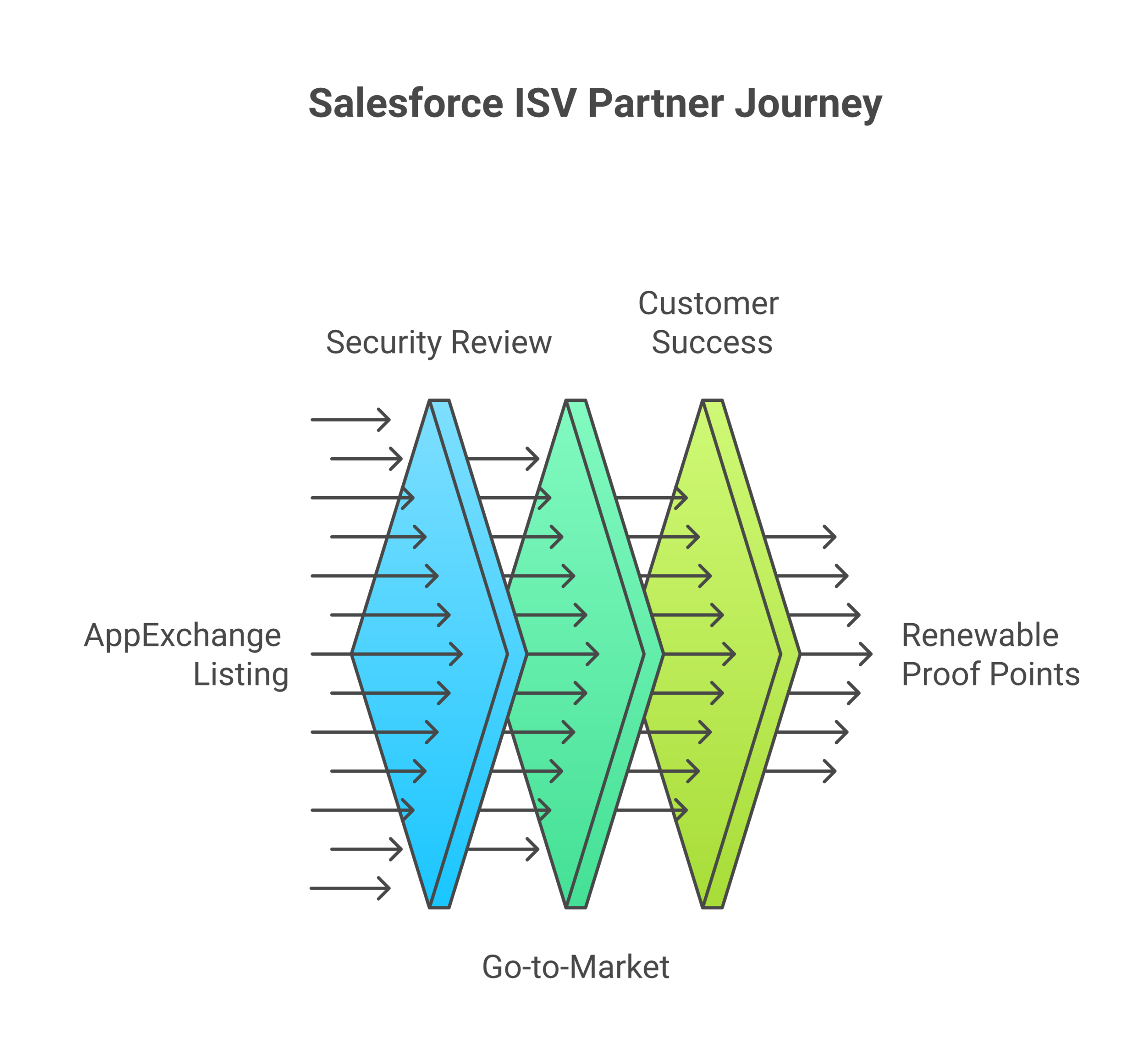
The program runs on three structural layers: AppExchange listing and certification (product), program tier and benefits (commercial), and field engagement and co-sell (motion). An ISV that operates only in the first layer gets a listing. An ISV that operates in all three gets a meaningful pipeline.
The four-stage path most Salesforce ISVs follow:
Why the cadence is the system
The cadence is the system. Most ISVs that underdeliver have stages 1 and 2 covered and skip stages 3 and 4. The listing is live, the tier is reasonable, and the field motion is missing. Without the field motion, the AppExchange becomes a passive lead source instead of a co-sell engine.
Common pitfalls for Salesforce ISV partners
Salesforce ISV programs fail at predictable points. The five recurring failure modes account for the majority of underperformance, and most are solvable with the right operating cadence inside the first 12 months.
The recurring failure modes
The recurring failure modes:
The fix for all five is the same: operate the partnership as a sales motion with field-level engagement, not as a marketing program with a listing. The companies that get this right see 5 to 10x the pipeline of the companies that don’t, at the same product quality level.
Salesforce ISV partner program tiers and benefits
The Salesforce ISV program rewards partners who produce revenue, customer count, and adoption depth. Tier benefits include AE engagement, account allocation, MDF, listing prominence, and program-led co-sell motions. Higher tiers carry meaningfully more pipeline leverage, but only for partners that already have field engagement working.
A pragmatic snapshot of the tier landscape (exact thresholds and benefit names shift; verify with the current Salesforce partner program documentation before planning):
| Tier | Typical entry point | Key benefits | When to pursue |
|---|---|---|---|
| Base | Listing live, security review complete | AppExchange listing, basic AE access, partner community | Day-1 ISVs and early connected apps |
| Ridge | Sustained customer growth, ~$M+ in Salesforce-influenced ARR | More AE engagement, basic MDF, regional events | Year-1 to Year-2 ISVs with traction |
| Crest | Strong adoption, deeper certifications, vertical traction | Account allocation in target verticals, product co-marketing, deeper field engagement | ISVs with a real co-sell motion in flight |
| Summit | Top-tier Salesforce-influenced ARR, multi-product, global reach | Strategic account access, dedicated alliance manager, executive co-sell motions | ISVs running a strategic alliance, not just an ISV motion |
The mistake most companies make is over-indexing on tier as a vanity metric. Crest is meaningfully better than Ridge, but only if the ISV’s field motion is mature enough to absorb the additional account allocation. An ISV that gets to Crest without a named-AE plan ends up with more allocation than it can run, and the program team notices. Match the tier to the operating maturity, not the brand ambition.
Forecastable’s POV
My take is that Salesforce ISV partnership is the highest-leverage GTM motion available to any B2B software company that fits the platform, and it is the most under-engineered motion in the typical SaaS playbook. Most ISVs we see run it as a marketing program. The few that run it as a sales motion build durable pipelines that compound for a decade. The difference is operating discipline at the field level.
The pattern that compounds
The pattern I watch compound is ISV partnership run as system-design first, listing second. The system has four parts: a clean account-mapping layer with the Salesforce AE territory, a named-deal joint plan tied to AE quotas, a recurring joint pipeline review in the AE’s cadence (not the partner’s), and a customer success motion that makes joint customers easier for AEs to renew than direct customers. Build the system and the listing turns into pipeline; ship the listing first and hope it produces pipeline, and the channel never stabilizes.
What I push customers on
Here’s what I tell every Forecastable customer who asks: stop treating Salesforce ISV partnership as a brand badge. The badge is the price of admission. The work that produces revenue is the field-level co-sell, deal by deal, AE by AE, named account by named account. Companies that internalize this run the ISV program with the same operating rigor they run their direct sales motion, with quotas, named accounts, weekly pipeline review, and a closed-loop attribution model. Companies that don’t keep relaunching the ISV motion every 24 months and wonder why the AppExchange isn’t producing.
The other position
The other position I push at Forecastable is that most ISVs are too broad with the AE field. Twenty AEs working five named deals each, with a real joint plan, beats two hundred AEs receiving a generic enablement deck. Cut the AE engagement to the AEs whose territories actually fit the product. Run the joint motion deeply with those few. Add AEs only when the operating cadence proves it can scale. Depth before breadth produces durable Salesforce pipelines; breadth before depth produces partner-program theater.
Frequently asked questions
What is the difference between a Salesforce ISV partner and a Salesforce consulting partner?
ISV partners build their own software products that get distributed through the AppExchange. Consulting partners are systems integrators that implement Salesforce projects for end customers without selling their own product. The two motions are complementary but operate on different commercial models, ISVs earn product revenue, consulting partners earn services revenue.
Do you need a Salesforce ISV agreement to integrate with Salesforce?
No. A connected app that integrates with Salesforce through APIs can be listed on the AppExchange as a connected listing without the deeper ISV agreement. The full ISV agreement is required for native apps that install into customer Salesforce orgs and for partners that want access to the higher-tier program benefits.
How long does the Salesforce AppExchange security review take?
Typical timelines run 8 to 16 weeks for a connected app and 16 to 32 weeks for a native app, depending on product complexity and how clean the initial submission is. Plan for the long end of the range and budget engineering capacity to address review feedback inside that window.
What revenue share does Salesforce charge ISV partners?
The standard revenue share for native apps is 15 to 25% of the ISV’s revenue from Salesforce-acquired customers, with the exact percentage tied to program tier and product type. Connected apps typically pay a different rate or a flat fee, depending on the agreement. Verify current terms with Salesforce’s partner program documentation before modeling the economics.
How do you become a Salesforce ISV partner?
Apply through the Salesforce Partner Community, sign the partnership agreement, build a product on the Salesforce platform or as a connected app, complete the AppExchange security review, and ship the listing. The full path from application to listed product typically runs 6 to 12 months for first-time ISVs.
Can a Salesforce ISV partner also be a consulting partner?
Yes, and the dual model is common at scale. Companies that ship a product and also offer implementation services around it run both programs in parallel. The two programs have separate qualification criteria and benefit structures, so the motions don’t fully share infrastructure even when the legal entity does.
What metrics do Salesforce ISV partners get measured on?
The core metrics are Salesforce-influenced ARR, customer count, AppExchange ratings, certification depth (AEs certified on the partner’s product), and joint pipeline closed in the period. Higher-tier programs add metrics like multi-product adoption, vertical penetration, and global reach. Match the metric mix to the tier you’re operating in.
Is the Salesforce ISV motion worth it for a Series A SaaS?
Usually yes if the product fits the Salesforce buyer, but the motion takes 12 to 24 months to produce material pipeline and consumes meaningful engineering and field capacity. Companies that pursue it before the core product-market fit is locked typically struggle. Companies that pursue it once PMF is locked and they have a credible field motion produce durable pipelines.
Next step
Salesforce ISV partnership is one of the highest-leverage motions in B2B software, and one of the most underexecuted. If you’re considering the program or already in it and not seeing pipeline, start by auditing the field engagement layer rather than the listing or the tier.
For the broader operating system that wraps a Salesforce ISV motion, read the partner ecosystem overview and the Head of Partnerships role guide. To see how account mapping powers the AE-aligned plan,
To see how account mapping powers the AE-aligned plan, see the account mapping guide.
Forecastable is an independent third-party professional services company. Our evaluations of other vendors are based on publicly-available information as of May 2026 and our own client experience.
Talk to our team about installing the AE-aligned co-sell motion →
By Alex Buckles
Uncover Your Growth Potential
Schedule a Discovery Call