Where Does Ecosystem-Led Growth Work Best?

Short answer: Ecosystem-led growth (ELG) is the partnership motion where partner relationships, partner data, and partner-led customer relationships generate or accelerate pipeline. ELG works best in three specific situations: when your buyer already runs a partner’s product, when partner overlap data shows your AE sitting on accounts a partner is already inside, and when the buying committee trusts another vendor more than they trust you yet. Outside those three situations, another motion usually moves pipeline faster.
Ecosystem-led growth, defined
Ecosystem-led growth is the term Crossbeam coined for the motion where partner relationships, partner data, and partner-led customer relationships generate or accelerate pipeline. It became a category in the last few years because the data infrastructure to run it became real. Partner overlap data, account-mapping platforms, and the systems that let two companies share customer signal without leaking customer lists made the motion operationable for the first time.
ELG is real. It also is not the right motion for every situation. The teams that get the most out of ELG treat it as one tool in the partnership toolkit, applied where the situation calls for it, instead of treating it as the new replacement for outbound.
The honest question for a partnerships leader is not whether ELG works. It is when.
The three situations where ELG moves pipeline
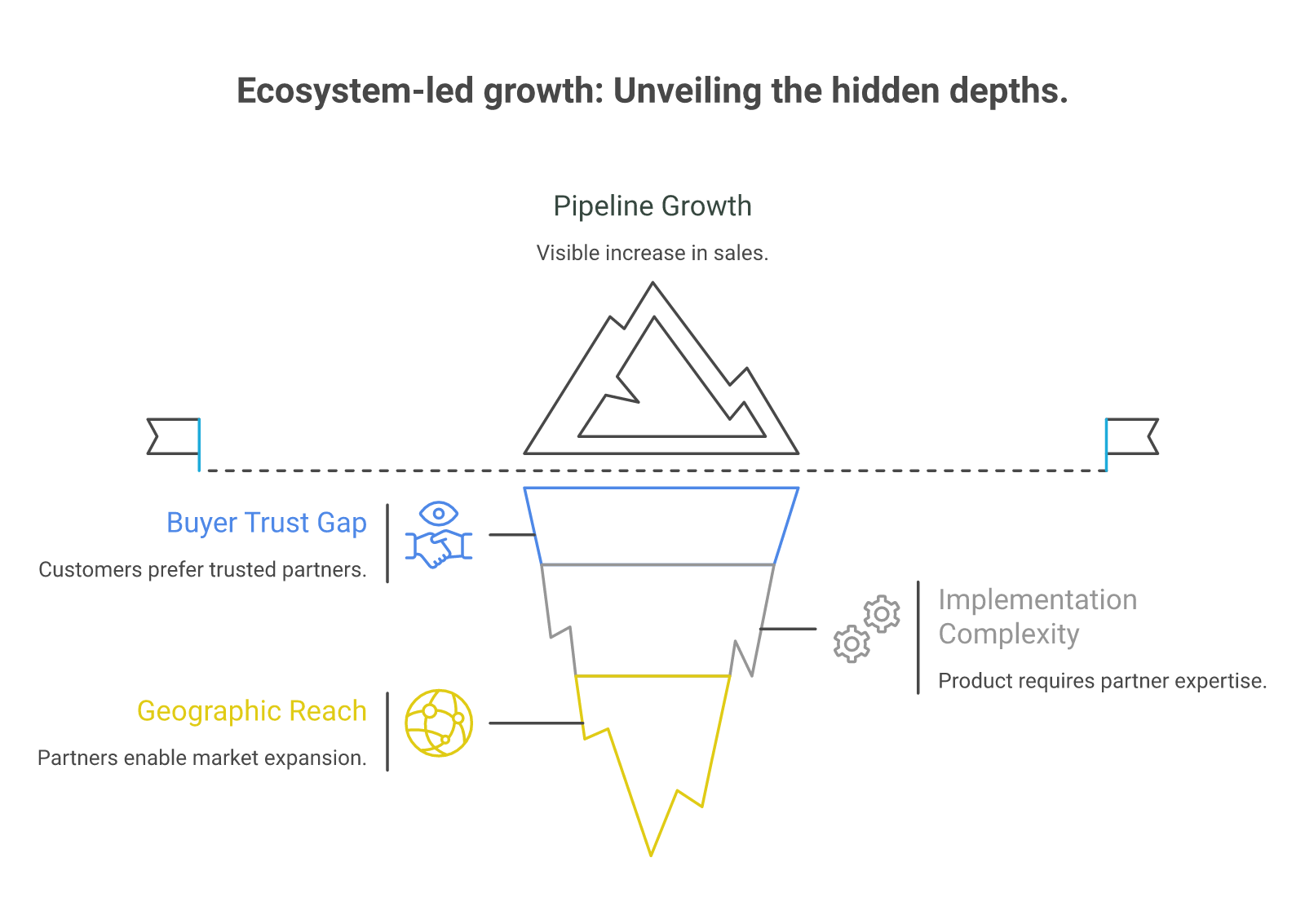
Across the programs we have installed, three situations consistently produce strong ELG results. When all three are present, ELG is the highest-ROI motion you can run. When only one is present, ELG works but slower. When none of the three are present, another motion will outpace ELG.
Situation 1: your buyer already runs a partner’s product
This is the cleanest case for ELG. Your prospect is an existing customer of a strategic partner. The partner’s customer success or account management team has standing relationships with people inside the prospect. A warm introduction from that partner CS lead lands in front of the right buyer with credibility you cannot manufacture cold.
The mechanics matter. The introduction has to be specific (not “you should talk to these folks at vendor X”). The partner has to have something at stake (not pure good will). The follow-through has to be tight (warm intros that sit unactioned for two weeks turn cold faster than cold outbound).
When this is in place, conversion rates from intro to first meeting run substantially higher than your average outbound conversion. Programs that operationalize this through Co-Sell Plans see partner-influenced pipeline growth in the first 60 to 90 days.
Situation 2: partner overlap data shows your AE sitting on accounts a partner is already inside
This is the classic Crossbeam-enabled play. Your AE has fifty target accounts. Partner overlap data shows that on twenty of those accounts, a strategic partner already has an active customer or active opportunity. Those twenty accounts are not random. They are pre-warmed.
Running ELG on these twenty accounts means a few specific things. First, the AE knows the partner is inside before the first outreach, so the message can reference shared context. Second, if the partner has agreed to make a play, the AE has air cover for a warm intro request. Third, the deal-stage acceleration is real. Partner-influenced deals close faster on average when the partner shows up at the right moment.
This is the situation where co-sell orchestration platforms produce the most measurable impact. Without orchestration, overlap data sits. With orchestration, overlap becomes pipeline.
Situation 3: the buying committee trusts another vendor more than they trust you yet
This is the most strategic situation for ELG and the most under-discussed. Some buying committees have not yet built trust in your category, your brand, or your product. They have built trust in a partner of yours. The partner’s recommendation carries credibility you do not yet have.
In this situation, the partner’s voice in the deal cycle is not just helpful. It is structurally necessary. ELG installed properly here means the partner has a defined role in the buying conversation, with permission and language and a clear reason to advocate. The deal closes when the buying committee transfers trust through the partner.
This works best with a partner whose customer base overlaps your ICP but whose product is complementary, not competitive. The clearer the complementarity, the cleaner the trust transfer.
When ELG isn’t the right motion
Outside those three situations, ELG slows down compared to other motions. Three common situations where another motion fits better.
Account-based outbound runs faster when you have a clear ICP, a tight account list, and the budget to run multi-threaded outbound campaigns. ELG can layer on top, but if you are spending the same dollar on ELG instead of outbound in this situation, outbound usually wins on speed.
Customer-marketing-led expansion runs faster when your existing customer base has expansion potential within accounts. ELG into net-new logos in the same situation produces slower returns than running the expansion play through customer success.
Direct selling runs faster when your buyer is decisive, the deal cycle is short, and the value proposition does not need third-party validation. Adding a partner to a five-week deal cycle that did not need one slows the cycle without adding value.
The pattern is situational. Pick ELG when the situation matches one of the three above. Pick another motion when it does not.
ELG versus nearbound
The two terms get used interchangeably and they are not quite the same.
| Concept | Definition | Relationship |
|---|---|---|
| Ecosystem-led growth (ELG) | The broader motion where partner relationships, partner data, and partner-led customer relationships drive pipeline | The category |
| Nearbound | A specific tactic where you reach a prospect through a partner already inside the account | One play within ELG |
Nearbound is the warm-introduce-through-partner-overlap tactic, particularly when the partner is already a customer of the prospect. It is one of the most effective ELG plays. It is not the entire category.
When you hear “nearbound,” think tactical. When you hear “ELG,” think strategic.
ELG versus account-based outbound
Most programs run both. The question is the mix and the trigger.
| Question | ELG | Account-based outbound |
|---|---|---|
| Is the partner already inside the account? | Yes (this is the trigger) | No (or unknown) |
| Does the buying committee need third-party trust? | Yes | Not necessarily |
| What is the conversion rate from first touch to meeting? | Higher per touch (when the partner is real) | Lower per touch, higher volume |
| What is the deal cycle length? | Faster on average when partner is active | Standard |
| When does it scale? | When you have 8+ active strategic partners | When you have list and budget |
Programs that run both well treat the partner overlap data as the trigger. Accounts where a partner is already active flip to ELG. Accounts where no partner is active stay on outbound. The dual-track approach beats either single track.
ELG versus customer-marketing-led expansion
When the goal is land-and-expand inside an existing account, customer marketing usually outpaces ELG.
| Question | ELG | Customer-marketing-led expansion |
|---|---|---|
| Is the prospect already a customer? | Sometimes | Yes |
| Who owns the relationship? | The partner | Customer success or account management |
| What is the unlock? | Partner-driven warm intro | Existing relationship + relevant new offer |
| When does it work? | Net-new logos, partner-warm | Expansion within existing accounts |
ELG inside an existing account is not wrong, just slower. The CSM already has the relationship. Use that.
How to know if ELG is working
ELG can take 60 to 90 days to produce pipeline. The metrics that tell you whether it is working in the meantime, before pipeline shows up.
- Partner-influenced pipeline percentage. What share of your pipeline has a partner participating in the deal cycle. Trending up means ELG is taking hold.
- Partner-sourced close rate. Deals where a partner originated the lead close at what rate compared to direct-sourced deals. Higher means the motion is producing quality, not just volume.
- AE warm-intro conversion rate. When a partner makes a warm introduction, how often does it land in a first meeting. Above 50 percent is a healthy signal.
- Partner-overlap actioning rate. What share of the overlaps your partner-data platform surfaces actually turn into a play. If this is below 10 percent, you have a co-sell orchestration gap, not an ELG gap.
If you are 90 days in and three of these four are not trending up, the motion is broken. The fix is rarely more ELG. The fix is usually that the partner-data, the orchestration cadence, or the partner-relationship layer is not installed.
How Forecastable installs ELG when it fits
We do not run ELG everywhere. We run it where the situation calls for it. When it fits, we install three things.
A Co-Sell Plan with the partner that names the shared accounts, owners, milestones, and economic split. A weekly cadence between your team and the partner’s team that turns the plan into action and surfaces blockers fast. A Co-Sell Alignment Specialist who handles the operational layer between the two teams so the partner manager stays focused on relationships and strategy.
The result is ELG that produces measurable partner-influenced pipeline within 60 to 90 days, in the situations where ELG is the right motion. We do not pretend it works everywhere. We install it where it fits and run something else where it does not.
FAQ
What does ELG stand for? Ecosystem-Led Growth.
Who coined ecosystem-led growth? Crossbeam coined and popularized the term. It became a category once the data infrastructure to operate it (account overlap, partner-data sharing) matured.
Is ELG the same as nearbound? Closely related but not identical. Nearbound is one tactic inside the broader ELG motion: reaching a prospect through a partner already inside the account. ELG is the category; nearbound is one play within it.
Does ELG replace outbound? No. ELG and outbound complement each other. Most programs run both, with partner overlap data as the trigger for which accounts flip to ELG and which stay on outbound.
How long until ELG produces pipeline? Typically 60 to 90 days when ELG is installed properly. Faster when partner-data and Co-Sell Plans are already in place. Slower when the partner-relationship layer needs to be built first.
Does ELG work for small partner programs? Yes, but only in the three situations identified. Pick ELG for the situation, not the category. A program with one or two strategic partners can run ELG well if the situation is right.
What is the difference between ELG and partner-led growth? Largely synonymous. ELG is the more durable industry term and the one Crossbeam helped establish. Partner-led growth is sometimes used to describe the same motion.
Bottom line
Ecosystem-led growth is real and it is situational. It moves pipeline best in three specific situations: when your buyer already runs a partner’s product, when partner overlap data shows your AE sitting on accounts a partner is already inside, and when the buying committee trusts another vendor more than they trust you yet. Outside those three situations, another motion usually wins. If your program is running ELG everywhere, your pipeline is not slow because ELG is broken. It is slow because ELG is being asked to do work it was not built for.
Talk to our team about installing ELG in the situations where it fits. forecastable.com/start-your-growth-journey-now →
Forecastable is an independent third-party professional services company. Our evaluations of other vendors are based on publicly-available information as of May 2026 and our own client experience.
Uncover Your Growth Potential
Schedule a Discovery Call