Working With Partner Sales Teams: The Operating Rules

What is working with partner sales teams?
Short answer: Working with partner sales teams is the day-to-day practice of getting another company’s sellers to spend their limited selling time on deals where you help them win, by being useful to their number rather than asking them to carry yours. It is a relationship measured in their pipeline, not in meetings held or agreements signed.
The phrase sounds soft, but the work is concrete. A partner’s reps have a quota that has nothing to do with you, a manager watching their pipeline, and a finite number of hours. Every minute they spend on your motion is a minute they took from something that pays them.
That is the whole game. You are competing for the attention of sellers who do not report to you and are not compensated by you, and you earn it by making their job easier and their deals bigger, not by reminding them that a contract exists.
Why working with partner sales teams matters in 2026
Most partner-sourced revenue is actually produced by individual sellers at the partner, not by the partnership in the abstract, and in 2026 the programs that win are the ones that treat those sellers as the real customer. A signed agreement at the top means nothing if the reps in the field never engage, and reps engage when there is something in it for their number.
The second reason is that buyers increasingly arrive through a seller they already trust at a partner firm. Capturing that motion means the partner’s rep has to know how and when to bring you in, which only happens if working with their sales team is a deliberate practice rather than an afterthought to the signing.
The third reason is leverage. A partner’s sales team can put you in front of accounts your own team would take quarters to reach, but only if those sellers see you as an asset to their deals. Working with partner sales teams well is how a small partnerships function reaches a market far larger than its own headcount could.
How working with partner sales teams actually works
The relationship produces revenue when you make yourself useful to the partner rep’s number and remove the friction that keeps them from pulling you into deals.
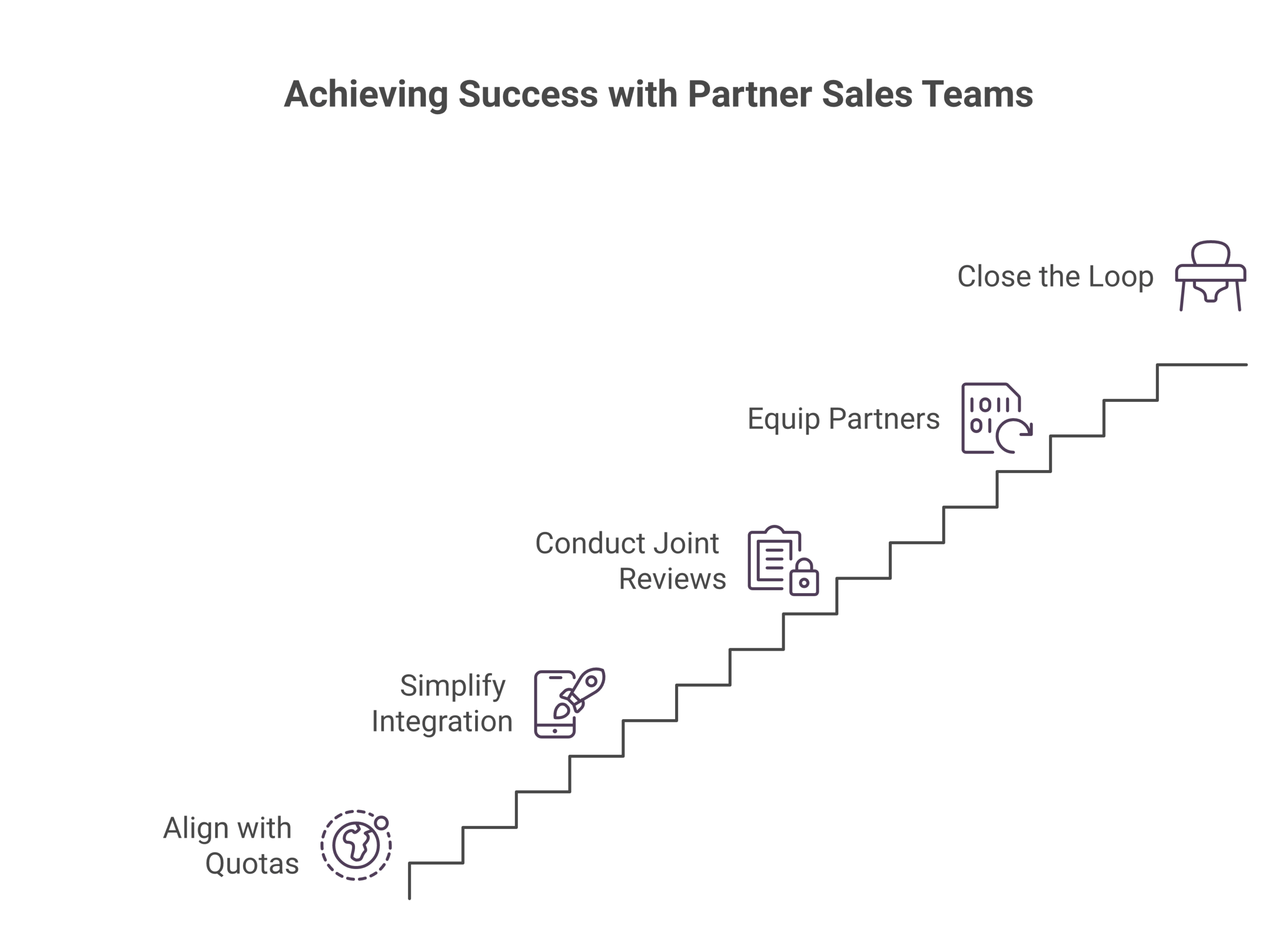
- Earn time by tying your motion to their quota: Show the partner’s reps exactly how working with you helps them hit their own number, larger deals, faster cycles, stickier customers, so engaging you is in their self-interest. A rep gives time to what pays them, not to what helps you.
- Make it effortless to bring you into a deal: Give the partner’s sellers a dead-simple way to loop you in, a single contact, a clear trigger, a fast response, so the cost of involving you is near zero. Friction at the moment of engagement is where most partner deals quietly die.
- Run joint deal reviews, not status meetings: Sit with the partner’s reps on actual live deals and help them advance the next step, rather than holding abstract sync calls. Working on real pipeline together builds the trust and the habit that a calendar invite never will.
- Equip them to sell, do not ask them to learn your product: Hand the partner’s reps the few things they need to position you in front of a customer, a crisp joint pitch and the one or two proof points that matter, instead of expecting them to absorb your full enablement. They are selling their thing and yours at once.
- Close the loop on every deal they bring: When a partner rep involves you, respond fast, keep them informed, and make sure they see the outcome and the credit. Nothing kills future engagement faster than a seller who handed you a deal and then heard nothing back.
You know it is working when partner reps bring you deals by name without being prompted, and you know it is not when engagement only happens after you chase it from the top of the partnership down.
Common pitfalls with working with partner sales teams
- Selling to the agreement instead of the sellers: A signed partnership at the executive level does not move a single deal if the reps in the field never engage. Treating the contract as the win and ignoring the sales team guarantees a relationship that looks active on paper and produces nothing.
- Asking partner reps to carry your number: Reps work their own quota, and a partnership that feels like extra unpaid work for them gets ignored. If engaging you does not help their number, no amount of reminding will make them spend time on it.
- Adding friction at the moment of engagement: When involving you means a slow response, an unclear process, or a handoff that makes the rep look bad to their customer, they stop involving you. The cost of bringing you in has to be near zero or it will not happen twice.
- Running status meetings instead of working deals: Recurring sync calls that review the relationship in the abstract bore everyone and advance nothing. Time with partner reps should be spent moving real pipeline, which is the only thing that builds the habit of working together.
- Going silent after a rep brings you a deal: A partner seller who hands you an opportunity and then hears nothing learns not to do it again. Closing the loop, fast responses, visible credit, a clear outcome, is what earns the next introduction.
What this looks like in practice
A partnerships team had a marquee partner signed for two quarters with almost nothing to show for it. The agreement was real, the executives liked each other, and yet no deals moved. When the partner manager finally sat with three of the partner’s actual reps, the problem was obvious: the reps did not understand how involving this vendor helped them, the process to loop them in was vague, and the one rep who had tried it got a slow response and looked bad in front of his customer. The manager rebuilt the relationship from the seller up. She showed each rep how the joint motion produced larger, stickier deals that helped their quota, gave them a single contact and a same-day response commitment, and started joining their live deal reviews to help advance real opportunities rather than holding status calls. She made sure every deal a rep brought got a fast response and visible credit. Within a quarter, the same reps who had ignored the partnership for six months were bringing deals by name, because working with the sales team had finally become useful to them instead of extra work.
Forecastable’s POV on working with partner sales teams
The core conviction is that the partner’s individual sellers are the real customer of your partnership, and most programs sell to the wrong level. Teams pour energy into the executive relationship and the signed agreement, then act surprised when the reps in the field never engage. The agreement is permission to begin, not the result; the result is earned one rep at a time by being useful to their number.
The second conviction is that engagement follows self-interest, not obligation. A partner rep will spend time on you when doing so makes their own deals bigger or easier, and will ignore you the moment it feels like unpaid work for someone else’s program. The entire job is making your motion something that helps the rep win, so engaging you is the obvious choice rather than the generous one.
The candid limit is that you cannot force a sales team to work with you, and pushing harder from the top usually backfires. If the partner’s reps see no value in your motion, the answer is not more pressure through their management, it is a better reason for them to engage. Sometimes the honest conclusion is that the fit is not there yet, and your time is better spent on a partner whose sellers actually want what you bring.
Forecastable is a partnerships operating platform; any third-party tools or platforms referenced here are independent third-party products, and naming them is not an endorsement of one deployment over another. Evaluate each against your own motion.
Frequently asked questions
Why do partner sales teams ignore a signed partnership?
Because a signed agreement at the executive level gives them no reason to spend their limited selling time. Reps engage when the motion helps their own quota; if working with you does not make their deals bigger or easier, they will keep ignoring it regardless of what the contract says.
How do I get a partner’s reps to bring me into deals?
Make involving you effortless and worth their while, a single contact, a fast response, and a clear way your motion helps their number. Then close the loop on every deal they bring so they learn that engaging you pays off.
What is the difference between a deal review and a status meeting with partner reps?
A deal review works a live opportunity and advances the next step together; a status meeting reviews the relationship in the abstract. The first builds trust and the habit of selling together, the second consumes time and produces nothing.
Should I expect partner reps to learn my whole product?
No. They are selling their offering and yours at the same time, so give them only the few things they need to position you in front of a customer, a crisp joint pitch and the proof points that matter. Asking them to absorb full enablement is asking for time they will not give.
How much should I invest in the partner relationship versus the partner’s sellers?
The executive relationship opens the door, but revenue comes from the individual sellers, so weight your ongoing time toward them. A great agreement with a disengaged sales team produces far less than a modest agreement with reps who want to work with you.
What kills repeat engagement from a partner sales team fastest?
Going silent after a rep brings you a deal. A seller who hands you an opportunity and hears nothing back, or who looks bad to their customer because of a slow handoff, learns not to involve you again. Fast, visible follow-through is what earns the next introduction.
Next step
If you have a signed partner whose sales team never engages, the move this quarter is to stop working the agreement and start working the sellers, show them how your motion helps their number, make it effortless to bring you in, and close the loop on every deal they hand you.
Start your growth journey now to turn signed partnerships into sales teams that actually sell with you, or see the orientation on the partner program for how this fits the broader operating model.
Uncover Your Growth Potential
Schedule a Discovery Call