What Category Does Head of Partnerships Fall Under?

What category does head of partnerships fall under?
Short answer: What category does head of partnerships fall under comes down to go-to-market, and most often the revenue organization specifically. It is a commercial role that sources and influences pipeline through other companies, so it belongs alongside sales and marketing under the revenue umbrella, not inside HR, finance, or general operations.
The confusion comes from the word “partnerships,” which also describes business-development deals, legal agreements, and people-team programs. For a head of partnerships who owns channel and ecosystem revenue, the category is unambiguously go-to-market.
Why the category placement matters in 2026
Placement matters because category determines budget, peers, and the metrics the role is measured against. Put the role in go-to-market and it is measured on pipeline and influenced revenue beside the rest of the commercial team. Put it in operations or HR and it gets measured on activity and partner counts, which is how programs end up busy and uncountable.
In 2026 the category question carries more weight because partner-influenced revenue has become a reported number. A function expected to produce pipeline has to be categorized with the other functions that produce pipeline, or it loses the planning seat, the data access, and the cross-functional pull it needs to actually deliver.
How to place the head of partnerships correctly
Placing the role is a short decision tree, where each branch sorts the title into its real home. Walk it once and the category is clear.
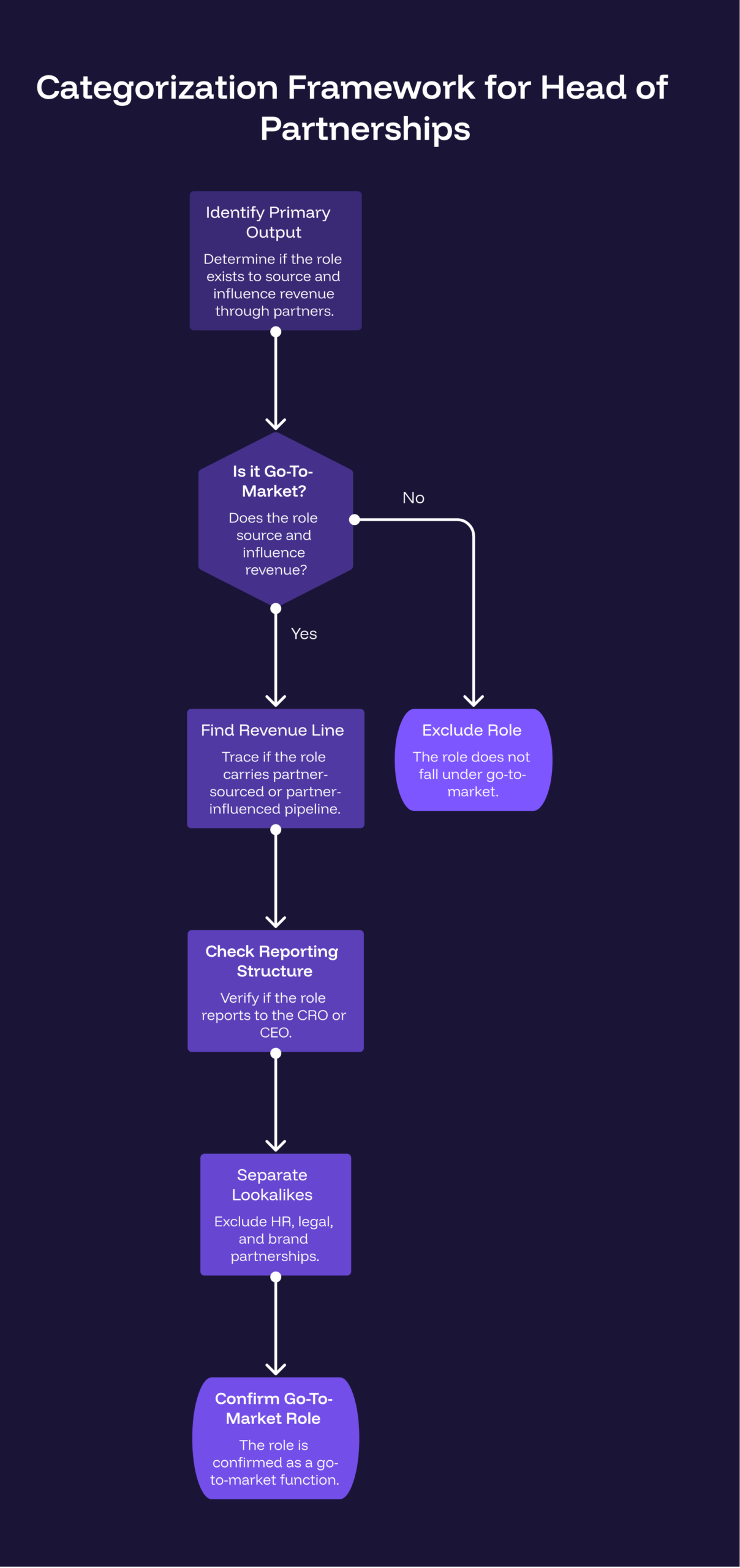
- Identify the primary output: If the role exists to source and influence revenue through partners, it is go-to-market. If it exists to sign one-off corporate deals, it is business development.
- Find the revenue line: Trace whether the role carries partner-sourced or partner-influenced pipeline. A revenue line places it in the revenue org next to sales and marketing.
- Check the reporting structure: A go-to-market role reports to the CRO or CEO, not to a people or operations leader. The reporting line confirms the category.
- Separate the lookalikes: Strip out HR “partnerships,” legal partnership agreements, and brand partnerships. Those share a word but not a function, and they belong to their own categories.
The placement is right when the role sits with the teams it must coordinate, and wrong when it is filed by the label “partnerships” instead of by the revenue it produces.
Common pitfalls in categorizing the role
- Filing by the word, not the function: “Partnerships” appears in HR, legal, and brand. Categorizing a revenue role by the shared word lands it in the wrong org with the wrong metrics.
- Hiding it under marketing as a cost center: Partner marketing is real, but a head of partnerships who owns pipeline categorized purely as marketing tends to be measured on programs run rather than revenue produced.
- Treating it as pure operations: Partner operations supports the motion; it is not the category for the leader who owns the number. Confusing the two strips the role of commercial accountability.
- No category at all: Leaving the role floating outside go-to-market means no peer group, no shared targets, and no planning seat, which is how partner revenue stays invisible.
What this looks like in practice
A company had its partnerships lead reporting into the people team because that is where the first “partnerships” hire had once lived for an employer-brand program. The new leader owned co-sell pipeline but was reviewed on partner headcount and event attendance, and the partner number never showed up in the revenue forecast. Moving the role into the revenue org changed what got measured: the same person now reported partner-sourced pipeline next to direct, joined the weekly forecast call, and got the CRM access to tag partner deals. Nothing about the work changed; the category change is what made the output countable.
Forecastable’s POV on where this role belongs
Our position is that you categorize the role by its output, not its label. A head of partnerships who sources and influences pipeline is a go-to-market leader, full stop, and belongs in the revenue org with a revenue line. The shared word “partnerships” is the single biggest reason capable leaders get filed into operations or HR and then measured on the wrong things.
The second conviction is that category is destiny for this role. Where you place it decides its peers, its metrics, and whether it sits in the room when the number gets committed. Put it in go-to-market and instrument it for partner-sourced and partner-influenced revenue, and the function defends itself. Leave it categorized as overhead and it will be the easiest line to cut the first time the budget tightens.
Forecastable is a partnerships operating platform; any third-party frameworks or structures referenced here are independent and naming them is not an endorsement of one org design over another. Categorize the role against your own revenue model.
Frequently asked questions
Is head of partnerships a sales role?
It is a go-to-market role adjacent to sales. It sources and influences revenue through partners rather than selling direct, but it belongs in the same revenue organization and is measured on pipeline contribution.
Does head of partnerships belong in marketing?
Sometimes partner marketing reports nearby, but a head of partnerships who owns pipeline is broader than marketing. The cleanest home is the revenue org, with marketing as a close collaborator.
Is partnerships part of business development?
There is overlap, but they are not identical. Business development often means one-off corporate or product deals; partnerships here means a repeatable channel and ecosystem revenue motion.
Should partnerships report to HR or operations?
No, not when the role owns revenue. HR and operations “partnerships” are different functions that happen to share the word. A revenue-owning head of partnerships reports into go-to-market.
What department is head of partnerships in?
Most commonly the revenue or go-to-market department, reporting to the CRO or CEO, sitting alongside sales and marketing.
Next step
If your partnerships leader is filed in the wrong category, the fastest fix is to give the role a revenue line and a go-to-market seat. Forecastable helps leaders define the partner number the role owns, so its category placement is obvious to the rest of the company. Start your growth journey now to put the role where its output lives. The partner program hub explains how the function coordinates across go-to-market.
Uncover Your Growth Potential
Schedule a Discovery Call