Scaling a Partner Program: What Actually Has to Change

What is scaling a partner program?
Short answer: Scaling a partner program is the work of growing partner-sourced revenue faster than the headcount and effort you add to produce it, by turning a few repeatable wins into a system that does not depend on any single person. It is an operating problem, not a recruiting problem, and that distinction decides whether growth compounds or just gets more expensive.
Most teams hear the phrase and reach for more partners. They sign logos, run more enablement sessions, and add names to a directory, then wonder why revenue stays flat while the workload climbs. More partners is an input, not the outcome.
The version that works starts from a motion that already produces revenue with a handful of partners, then removes the manual steps and personal heroics that keep it from running at ten times the volume. You scale the motion, then add partners into it.
Why scaling a partner program matters in 2026
Partner-sourced revenue is now a number leadership plans around, and a program that cannot grow it predictably gets treated as a marketing expense rather than a revenue function. In 2026, the gap between programs that compound and programs that plateau comes down to whether the motion was built to scale before the volume arrived.
The second reason is cost discipline. A program that grows revenue only by growing the partnerships team in lockstep has not scaled anything, it has just bought more output at the same unit cost. Real scale shows up when each new partner takes less of your team’s time to make productive than the last one did.
The third reason is durability. A program that runs on one talented partner manager’s relationships collapses the moment that person leaves. Scaling a partner program means encoding what that person knows into a motion, so the results survive turnover and the program keeps producing through the inevitable changes in staff.
How scaling a partner program actually works
Scaling a partner program works when you systematize a proven motion first, then pour volume and partners into a machine that does not need a hero to run.
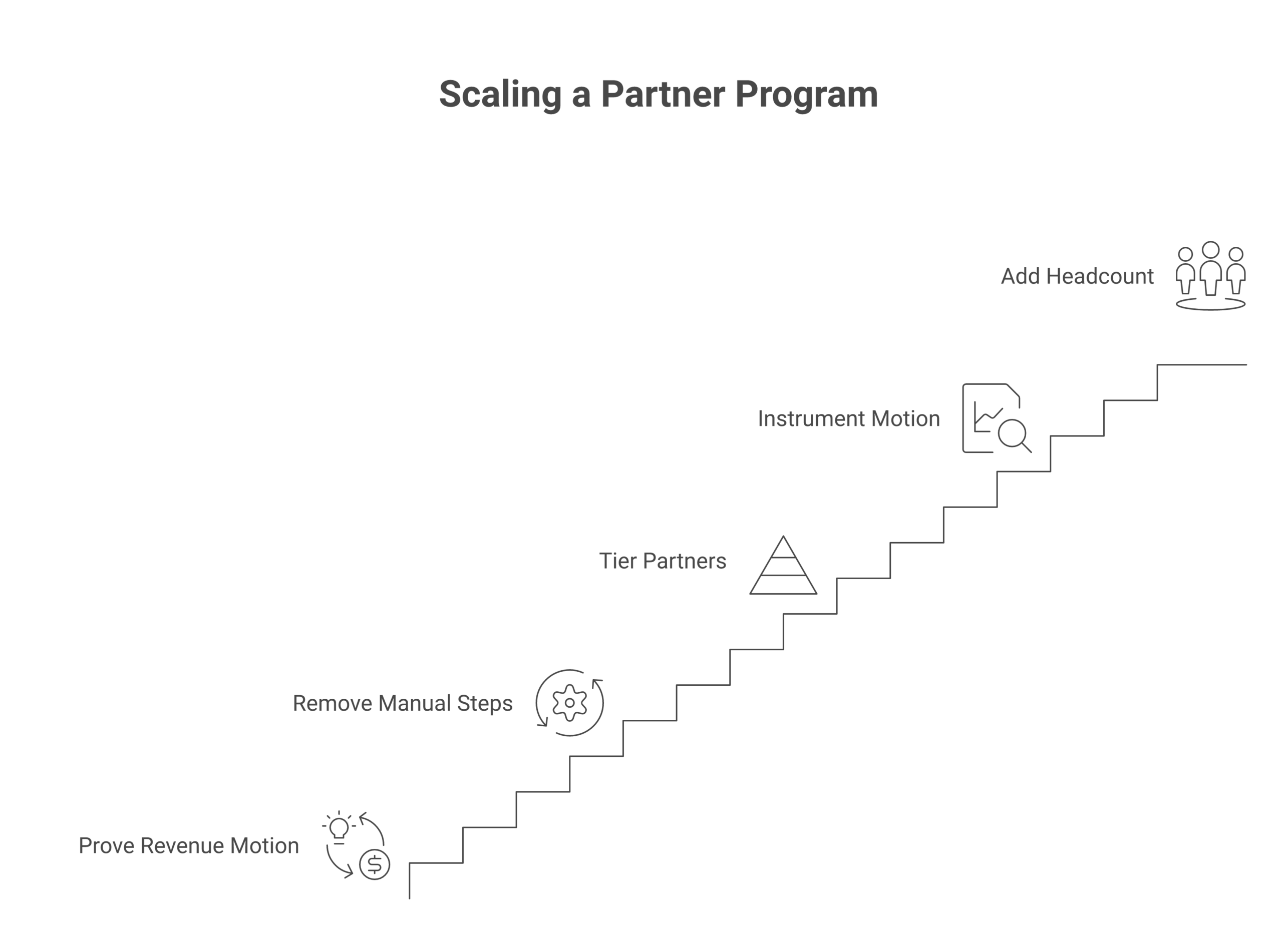
- Prove one repeatable revenue motion before you add volume: Find the specific partner play that already closes business, the integration that drives deals or the referral pattern that converts, and document exactly how it works. Adding partners to a motion you have not proven just multiplies a thing that does not work.
- Remove the manual steps that cap throughput: List every place a human has to intervene for a partner deal to move, deal registration, lead routing, co-sell handoffs, and replace the ones that do not need judgment with a defined process or tooling. Each manual bottleneck is a ceiling on how many partners one person can support.
- Tier partners by economic potential, not by logo: Sort partners into a small set of tiers based on the revenue they can realistically produce, and match your time and investment to the tier. Treating every partner equally guarantees you overspend on the many who will never produce and underspend on the few who will.
- Instrument the motion so growth is measurable: Track partner-sourced and partner-influenced revenue, time-to-first-deal, and the cost to activate each partner, so you can see whether you are scaling or just spending. A motion you cannot measure cannot be improved on purpose.
- Add headcount against the motion, not against the chaos: Hire when a defined role in a working system is the bottleneck, not to firefight a mess. The right next hire fills a known gap in a motion that already works, so they ramp into structure instead of inheriting confusion.
The program is scaling when partner-sourced revenue grows faster than the team and the cost to activate each new partner trends down, and it is not scaling when revenue only rises in step with the hours your team pours in.
Common pitfalls with scaling a partner program
- Confusing more partners with more revenue: Signing partners feels like progress and shows up in a dashboard, but a directory full of inactive logos produces nothing. The metric that matters is producing partners, not signed ones, and scaling the count without scaling activation just inflates a vanity number.
- Scaling a motion you never proved: Pouring volume into a play that has not actually closed business multiplies the failure instead of the success. Prove the motion with a few partners first, then scale what works, because volume amplifies whatever is already true.
- Letting the program run on one person’s relationships: When growth depends on a single partner manager’s personal rapport, the program is fragile and cannot scale past that person’s calendar. Encode the relationship work into a motion so it survives both volume and turnover.
- Treating every partner the same: Spreading time evenly across all partners means the few who could produce real revenue get the same attention as the many who never will. Tier by economic potential and concentrate effort where it returns.
- Hiring to escape chaos instead of to fill a defined gap: Adding people to a disorganized program imports the disorganization into more headcount. Fix the motion first, then hire into a role the working system actually needs.
What this looks like in practice
A company had thirty signed partners and one partner manager drowning in them. Revenue from partners was real but unpredictable, and every deal seemed to need the manager personally for the handoff to work. Instead of hiring three more managers to spread the load, the partnerships leader did something slower and smarter. They found the one motion that consistently closed, a co-sell play with their top integration partner, and wrote down exactly how it ran, where leads came from, who fronted the customer, how the deal got registered. They automated the deal registration and lead routing that the manager had been doing by hand, then sorted the thirty partners into three tiers and pulled their best time toward the eight partners with real revenue potential. Only then did they hire, and the new partner manager stepped into a defined motion with eight accounts rather than inheriting a pile of thirty. Within two quarters partner-sourced revenue grew while the activation cost per partner fell, because the program was finally scaling the motion instead of scaling the effort.
Forecastable’s POV on scaling a partner program
The mistake we see most often is that teams try to scale recruiting when the thing that needs to scale is the motion. Signing partners is the easy part, and it is the part that produces the least. A program with five productive partners and a repeatable play is in a far better position to scale than a program with fifty signed partners and no motion, because the first one has something worth multiplying.
The second conviction is that scale is a function of removed friction, not added effort. Every manual step in a partner deal is a tax on growth, and the programs that compound are the ones that ruthlessly take human intervention out of the places that do not need judgment. That frees your best people to do the work that genuinely requires them, which is winning deals and deepening the partners who produce.
The candid limit is that not every program is ready to scale, and forcing it early wastes money. If you have not yet proven a motion that closes business, the right move is not to scale, it is to find that motion with a few partners first. Scaling a partner program before you have something repeatable to scale just makes a small problem into an expensive one.
Forecastable is a partnerships operating platform; any third-party tools or platforms referenced here are independent third-party products, and naming them is not an endorsement of one deployment over another. Evaluate each against your own motion.
Frequently asked questions
Does scaling a partner program mean signing more partners?
No. It means growing partner-sourced revenue faster than the effort required to produce it, usually by systematizing a proven motion. Adding partners is one input, but a program with more partners and no repeatable play has added cost, not scale.
How do I know my program is ready to scale?
You are ready when at least one partner motion reliably closes business and you can describe exactly how it works. If you cannot name the repeatable play that produces revenue, you are not ready to scale yet, you are still in the find-the-motion stage.
What should I automate first when scaling a partner program?
Start with the high-volume manual steps that do not require judgment, typically deal registration, lead routing, and co-sell handoffs. These are the bottlenecks that cap how many partners one person can support, and removing them frees your team for the work that needs a human.
How do I decide where to invest as the program grows?
Tier partners by the revenue they can realistically produce and match investment to tier. Concentrate your best time on the small set of partners with genuine economic potential rather than spreading effort evenly across every signed logo.
When should I add headcount to a scaling partner program?
Hire when a defined role in a working motion is the bottleneck, not to firefight disorganization. A new hire who steps into a proven system ramps quickly; one who inherits chaos just spreads it across more people.
What metric tells me a partner program is actually scaling?
The cost to activate each new partner should trend down while partner-sourced revenue trends up. If revenue only grows in step with the hours your team adds, you are buying output at flat unit cost rather than scaling.
Next step
If your partner program is growing in workload faster than in revenue, the move this quarter is to stop signing and start systematizing, prove the one motion that closes, remove the manual steps that cap it, and tier your partners before you add another logo or another hire.
Start your growth journey now to build a partner motion that scales without scaling your headcount, or see the orientation on the partner program for how scale fits the broader operating model.
Uncover Your Growth Potential
Schedule a Discovery Call