Sales Rep Partner Adoption: How to Drive It

What is sales rep partner adoption?
Short answer: Sales rep partner adoption is the degree to which your direct sellers actually use partners in their deals, registering them, co-selling, and following partner leads, rather than ignoring the program. It is where most partner strategies quietly die, because a program can sign great partners and build perfect plays and still produce nothing if the reps who control the deals never pick them up.
Adoption is a behavior problem, not a content problem. Reps know the partner program exists; they choose not to use it, and that choice, repeated across a sales floor, is what determines whether the program produces revenue.
The distinction that matters is between a program reps comply with and one they actually adopt. Compliance is registering a deal because a manager asked; adoption is reaching for a partner because it makes the deal easier to win. Only the second produces durable partner revenue.
Why sales rep partner adoption matters in 2026
The partner program does not control the deals, the reps do, and in 2026 every elegant partner motion still depends on a direct seller choosing to use it. A program can invest heavily in partners and plays and see no return because the last mile, the rep deciding to bring a partner into the deal, was never won. Adoption is the bottleneck that limits the entire function.
The second reason is that reps are rational and busy. A seller under quota pressure does what they believe wins fastest, and if working a partner feels like added friction with uncertain payoff, they skip it. Adoption is won by making the partner the easier path to a win, not by mandating it.
The third reason is that low adoption hides as a partner problem. Leaders see flat partner revenue and conclude the partners are weak, when the real issue is that strong partners are sitting unused because reps never engage them. Diagnosing adoption correctly is what points the fix at the right place.
How sales rep partner adoption actually works
Adoption works when partners make the rep’s deal easier, the incentive favors using them, and managers reinforce the behavior on the deals reps actually care about.
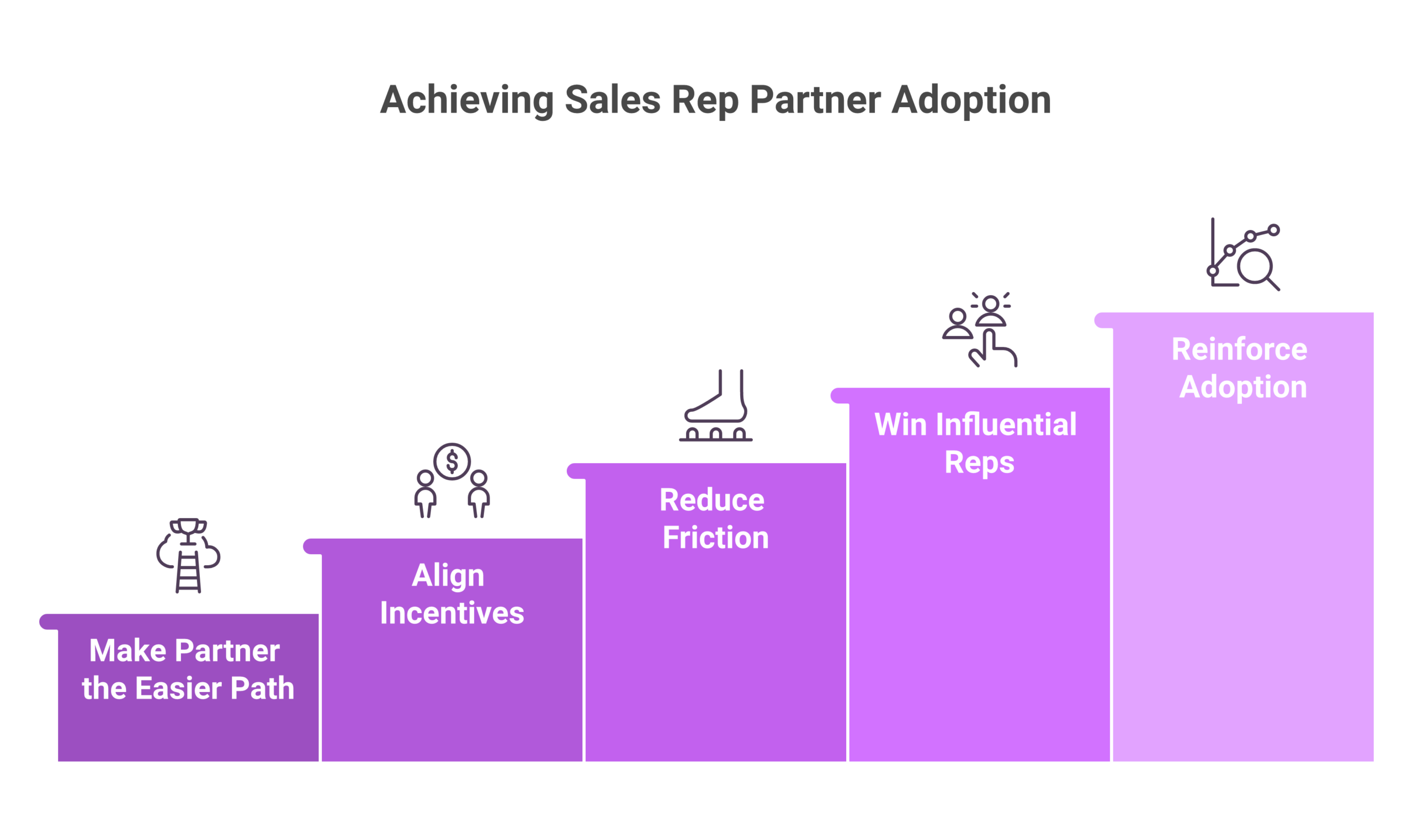
- Make the partner the easier path to a win: Ensure that bringing a partner into a deal genuinely helps the rep close faster or bigger, because a rep adopts what wins and ignores what adds friction. If the partner does not make the deal easier, no mandate will produce real adoption.
- Align the rep’s incentive with using partners: Make sure comp and credit reward, or at least do not penalize, working a partner deal, since a rep who loses credit or splits commission unfavorably for involving a partner will rationally avoid it. The incentive has to match the behavior you want.
- Reduce the friction of engaging a partner: Make registering a deal and pulling in a partner fast and obvious, because every extra step is a reason a busy rep skips the program. Friction is the silent killer of adoption.
- Win the influential reps first: Get your strongest, most respected sellers to adopt and win with partners, so the behavior spreads by example rather than by decree, since reps copy reps who win more than they follow mandates.
- Reinforce adoption in the pipeline review: Have managers ask about partner engagement on real deals in the normal review cadence, so adoption is a managed behavior, not a one-time training, and reps know it is watched where it matters.
Adoption is read against whether reps reach for partners on deals where it would help, unprompted, which is the only sign the behavior has actually taken hold rather than being temporarily complied with.
Common pitfalls with sales rep partner adoption
- Mandating adoption instead of earning it: Forcing reps to register partners produces compliance, not adoption, hollow registrations that meet the rule and change nothing. Reps adopt what helps them win, and a mandate without a real benefit just teaches them to game the requirement.
- Misaligned incentives: When working a partner costs the rep credit or splits commission unfavorably, rational reps avoid it no matter how good the program is. Adoption fails on the comp plan more often than on the plays.
- Too much friction to engage: A clunky registration process or an unclear way to pull in a partner gives a busy rep an easy reason to skip the program. Every extra step lowers adoption, and reps optimize for speed under quota pressure.
- Diagnosing low adoption as a partner problem: Reading flat partner revenue as weak partners, when the real issue is strong partners sitting unused, points the fix in the wrong direction. Low adoption masquerades as a partner-quality problem and gets misdiagnosed constantly.
- Training once and expecting behavior change: A single enablement session does not change rep behavior; adoption is reinforced in the ongoing pipeline review or it fades. Treating adoption as a one-time rollout rather than a managed behavior guarantees it decays.
What this looks like in practice
A company had invested heavily in its partner program, strong partners, polished plays, a clear motion, and watched partner-sourced revenue stay flat. The partnerships leader assumed the partners were underperforming until a closer look showed the partners were barely being used: reps ignored partner leads and rarely registered deals. The real problem was adoption. Working a partner cost reps a commission split and several clunky steps, so under quota pressure they skipped it. The team fixed the incentive so involving a partner no longer penalized the rep, streamlined registration to a couple of clicks, and recruited the floor’s top two sellers to win visible deals with partners. Managers started asking about partner engagement in normal pipeline reviews. Adoption climbed as reps saw their respected peers winning with partners and felt no penalty for joining in, and the partner revenue that had looked like a partner problem turned out to be an adoption problem all along.
Forecastable’s POV on sales rep partner adoption
Adoption is where most partner strategies actually die, and almost no one names it as the failure point. Leaders pour investment into partners and plays, see flat revenue, and conclude the partners are weak, when the truth is the reps never used them. The program does not control the deals; the reps do, and until a direct seller chooses to bring a partner into a deal, every upstream investment produces nothing. The last mile is the whole game, and it is consistently the least-managed part of the program.
The second conviction is that you earn adoption, you do not mandate it. Reps are rational and busy, and they adopt what helps them win and ignore what adds friction. A mandate produces hollow compliance, registrations that satisfy the rule and change no behavior, while real adoption comes from making the partner the genuinely easier path to a win and aligning the incentive so using a partner never costs the rep. If working a partner does not help the rep, no policy will fix it.
The candid limit is that adoption cannot rescue partners who do not actually help reps win. If bringing a partner in does not make deals close faster or bigger, reps are right to skip them, and the fix is not more adoption pressure but better partners or a better motion. High adoption of partners that genuinely help reps is the goal; pushing adoption of partners that do not just trains reps to resist the program.
Forecastable is a partnerships operating platform; any third-party tools or platforms referenced here are independent third-party products, and naming them is not an endorsement of one deployment over another. Evaluate each against your own motion.
Frequently asked questions
What is sales rep partner adoption?
It is the degree to which your direct sellers actually use partners in their deals, registering them, co-selling, following partner leads, rather than ignoring the program. It is the behavioral last mile that determines whether a partner program produces revenue.
Why do sales reps resist using partners?
Usually because working a partner adds friction or costs them credit under quota pressure, so the rational choice is to skip it. Reps adopt what helps them win fastest; if the partner motion is not that, they avoid it regardless of how good the program is.
How do you increase partner adoption among reps?
Make the partner the easier path to a win, align the incentive so using a partner is not penalized, reduce the friction of engaging one, win your influential reps first, and reinforce the behavior in pipeline reviews. Earn it through benefit, do not mandate it.
Does mandating partner registration work?
It produces compliance, not adoption, hollow registrations that meet the rule without changing behavior. Real adoption comes from reps choosing to use partners because it helps them win, which a mandate without a genuine benefit cannot create.
How do you tell an adoption problem from a partner problem?
Look at whether strong partners are actually being used. Flat partner revenue with capable partners sitting idle is an adoption problem; flat revenue with engaged partners who do not help close is a partner or motion problem. They call for opposite fixes.
How is partner adoption sustained over time?
Through ongoing reinforcement in the normal pipeline review, not a one-time training. Adoption is a managed behavior; without managers asking about partner engagement on real deals, it fades back to the path of least resistance.
Next step
If your partner revenue is flat and you have been blaming the partners, the move this quarter is to check whether reps are actually using them, then fix the incentive and the friction that keep your sellers from reaching for partners on deals where they would help.
Start your growth journey now to drive real partner adoption on the sales floor instead of hollow compliance, or read the orientation on the partner program for how adoption fits the broader operating model.
Uncover Your Growth Potential
Schedule a Discovery Call