Perpetual Mindshare Partnerships: How to Earn It

What are perpetual mindshare partnerships?
Short answer: Perpetual mindshare partnerships are the ones where a partner reaches for your product by default, recommending it without being prompted because you stay continuously present and useful to their sellers. It is earned through a steady rhythm of value rather than a launch event, which is why most programs never reach it and the few that do compound quietly.
Mindshare is not loyalty in the abstract. It is the practical reality that when a partner’s rep faces a customer need your product fits, your name is the one that surfaces first, ahead of the alternatives competing for the same recommendation.
The word that matters is perpetual. A burst of attention at signing or at a launch fades fast, and the partner drifts back to whatever is most familiar. Perpetual mindshare is the result of being reliably present long after the novelty wears off.
Why perpetual mindshare partnerships matter in 2026
A partner’s reps can only hold so many products in mind, and in 2026 the competition for that limited attention is fiercer than ever as more vendors chase the same channels. The vendor who stays top of mind wins the recommendation, and the one who launched loudly and went quiet loses it, regardless of who has the better product.
The second reason is that mindshare compounds. Each deal a partner sources through you makes the next recommendation more natural, and a partner who has won with you reaches for you faster next time. Lose presence and that compounding reverses, the partner forgets the wins and defaults elsewhere.
The third reason is economics. Mindshare is the cheapest pipeline a partner program can produce, a recommendation costs nothing per deal once the relationship is warm, while re-earning attention after it lapses is expensive and slow. Perpetual mindshare is leverage that pays continuously once established.
How perpetual mindshare partnerships actually work
Mindshare works when you trade a launch mentality for a rhythm, make the partner’s reps successful repeatedly, and stay present in the moments they actually sell.
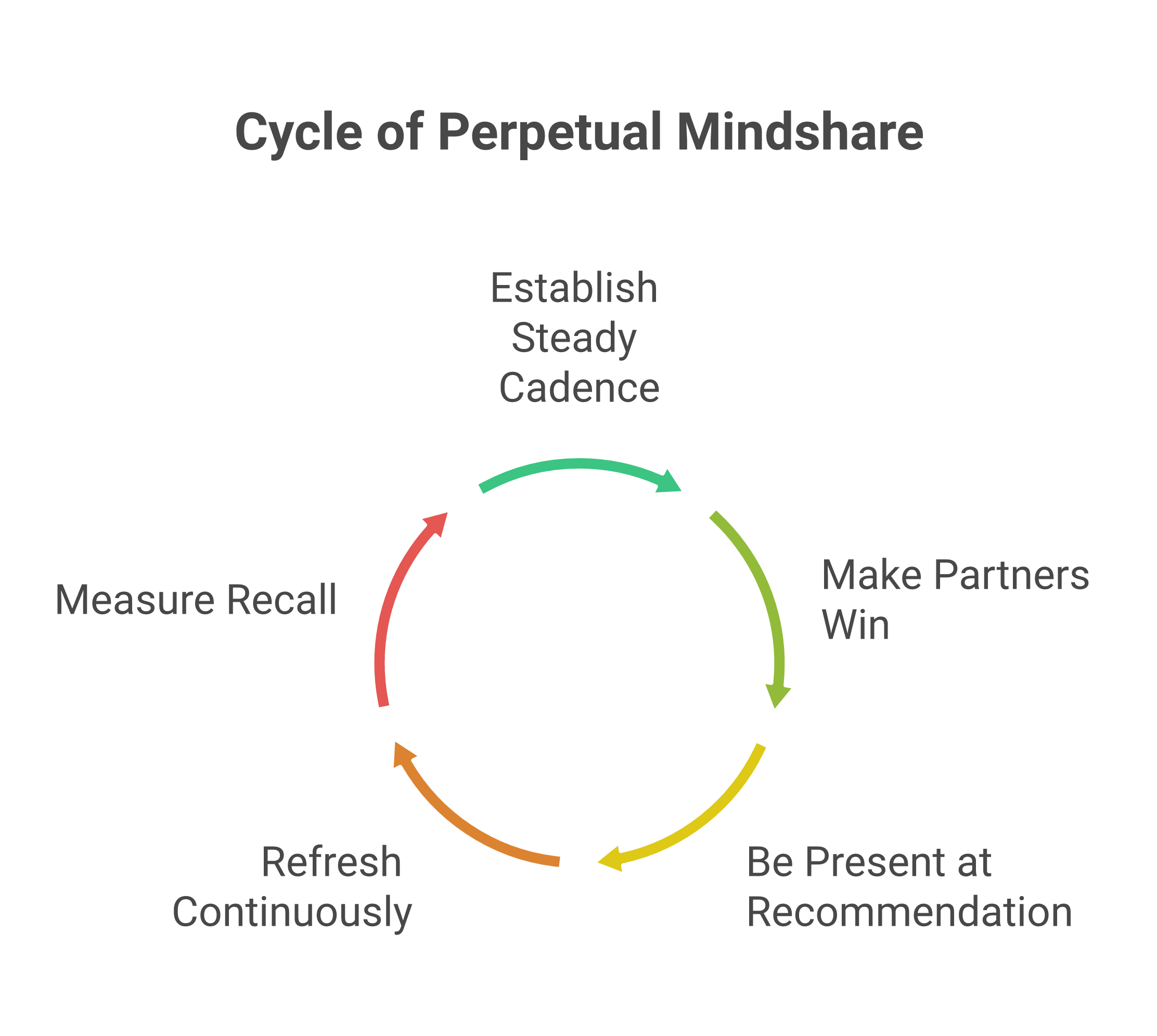
- Establish a steady cadence, not a campaign: Show up on a reliable rhythm with enablement, deal support, and updates, because mindshare is built by consistency over time, not by a single loud moment. A campaign spikes attention and then it fades.
- Make the partner’s reps win, repeatedly: Help individual sellers close deals with your product, since a rep who has personally won with you remembers you, and the memory of a win is what surfaces your name next time. Wins, not webinars, build durable recall.
- Be present at the moment of recommendation: Put easy, current materials and fast support where the rep reaches when a customer need arises, so you are the path of least resistance at the exact moment the recommendation is made. Mindshare is decided in that instant.
- Refresh continuously so you never go stale: Keep the relationship current with new plays, updated positioning, and fresh proof, because a partner’s memory of you decays and a steady refresh is what keeps it from drifting to a more recent voice.
- Measure recall, not just activity: Track whether partners are recommending you unprompted, through sourced deals and direct signals, rather than counting enablement sessions, so you know whether the rhythm is actually producing mindshare or just motion.
Mindshare is read against whether partners bring you deals without being asked, which is the only real evidence that you have become their default rather than just another vendor they were trained on once.
Common pitfalls in perpetual mindshare partnerships
- Treating mindshare as a launch, not a rhythm: A loud kickoff followed by silence produces a spike of attention that fades within weeks. Mindshare is built by showing up consistently long after the launch, and programs that confuse the event for the work never reach it.
- Enabling the partner org but not the reps: Training a partner’s enablement team or running a webinar feels productive but rarely reaches the individual sellers who make recommendations. Mindshare lives in the rep who won a deal, not in a completed training module.
- Going stale and getting forgotten: A partner’s recall of you decays, and a vendor who stops refreshing the relationship drifts out of mind as a more present competitor moves in. Continuous refresh is not optional, it is the maintenance mindshare requires.
- Measuring activity instead of recall: Counting enablement sessions and QBRs says nothing about whether partners actually reach for you. The real metric is unprompted recommendation, and a program that measures effort instead of recall flies blind.
- Buying attention with incentives alone: Spiffs and contests can rent short-term attention but do not build durable preference; when the incentive ends, so does the attention. Mindshare comes from repeated wins and reliable presence, not from a temporary payout.
What this looks like in practice
A vendor signed a major partner with a splashy kickoff, trained the partner’s enablement team, ran a launch webinar, and then moved on to the next signing. Six months later the partner was barely sourcing deals, the launch energy had evaporated, and the partner’s reps had defaulted back to a competitor they saw more often. The partnerships team rebuilt the relationship around rhythm instead of events: a reliable monthly cadence of deal support, fresh plays the reps could actually use, and a deliberate focus on helping individual sellers close, not just on training the org. They tracked unprompted sourced deals as the real signal. Within two quarters the partner was reaching for them by default, because the reps had won with them repeatedly and the vendor was simply present when a customer need arose. The change was not a bigger launch, it was never stopping.
Forecastable’s POV on perpetual mindshare partnerships
The core error programs make is treating mindshare as something you win once. They launch a partnership loudly, declare it active, and move on, and then they are surprised when the partner forgets them within a quarter. Mindshare is not a state you reach and hold, it is a rhythm you sustain, and the moment you stop showing up the partner’s attention drifts to whoever is more present. The word perpetual is the whole point, and most programs treat it as optional.
The second conviction is that mindshare lives in the rep, not the org. Companies enable a partner’s enablement team, run a webinar, check the box, and never reach the individual seller who actually makes the recommendation. The seller who personally won a deal with you is the one who reaches for you next time, so the work is making individual reps successful, repeatedly, not delivering training to a department.
The candid limit is that mindshare cannot rescue a product the partner’s customers do not want. Presence and rhythm earn you the recommendation when your product fits, but no amount of staying top of mind will make a partner recommend something that does not solve their customer’s problem. Perpetual mindshare amplifies a real fit; it does not manufacture one.
Forecastable is a partnerships operating platform; any third-party tools or platforms referenced here are independent third-party products, and naming them is not an endorsement of one deployment over another. Evaluate each against your own motion.
Frequently asked questions
What does perpetual mindshare mean in partnerships?
It is the state where a partner recommends your product by default, unprompted, because you stay continuously present and useful to their sellers. The emphasis on perpetual distinguishes it from the temporary attention a launch or campaign produces.
How do you build mindshare with a partner?
Through a steady rhythm rather than a one-time event: consistent enablement, fast deal support, fresh plays, and a focus on helping individual reps win repeatedly. Mindshare is the product of reliable presence over time, not a single loud moment.
Why does mindshare fade?
A partner’s recall decays, and reps default to whichever vendor they see most. A program that launches loudly and goes quiet drifts out of mind as a more present competitor moves in. Without continuous refresh, attention lapses.
How do you measure mindshare?
Track unprompted recommendations, primarily through partner-sourced deals and direct signals that partners are reaching for you without being asked. Counting enablement sessions or QBRs measures activity, not recall.
Do incentives build mindshare?
Incentives can rent short-term attention but do not create durable preference; when the spiff ends, the attention does too. Lasting mindshare comes from repeated wins and reliable presence, with incentives at most a supporting role.
Is mindshare worth the ongoing effort?
Yes, because it is the cheapest pipeline a program can produce once established, and it compounds, each win makes the next recommendation more natural. The effort is continuous, but the leverage pays continuously as long as you sustain it.
Next step
If a partner you launched loudly has gone quiet, the move this month is to replace the launch mentality with a reliable cadence aimed at helping individual reps win, and start tracking unprompted sourced deals as your real measure of mindshare.
Start your growth journey now to build a partner motion that earns perpetual mindshare instead of a fading launch, or read the orientation on the partner program for the broader operating model.
Uncover Your Growth Potential
Schedule a Discovery Call