Partner Sales Operations: The Engine of Co-Sell

What is partner sales operations?
Short answer: Partner sales operations is the systems, data, and process layer that makes a partner program actually run, deal registration, attribution, pipeline reporting, and the workflows that connect partners to the company’s sales process. It is the operational engine beneath co-sell, turning partnership strategy into a machine that records, routes, and measures partner deals reliably.
Most programs have a partnerships leader and partner managers but no operations function, so the leader spends half their time wrangling spreadsheets and chasing attribution instead of running the program. Partner sales operations is the discipline that takes that load off the relationship people and systematizes it.
The useful frame is that operations is the plumbing. Strategy decides where to win and partner managers build the relationships, but neither works at scale without the systems that register deals, assign credit, and report pipeline. Operations is the unglamorous layer that determines whether everything above it can scale.
Why partner sales operations matters in 2026
Programs are scaling past the point where a spreadsheet and goodwill hold them together. When partner deal volume was low, the partnerships leader could track everything by hand; at scale that breaks, and the program needs real systems and a person who owns them. Operations is what lets a program grow without collapsing under its own data.
The second force is the demand for trustworthy numbers. Leadership wants partner pipeline forecast and attributed with the same rigor as direct, and that rigor is an operations capability, not a relationship one. A program with strong partner managers but no operations cannot produce the clean data the budget conversation now requires.
The third force is the friction at the seams between systems. Partner deals have to move between the partner, the company’s CRM, and the program’s tracking, and every ungoverned seam is where data is lost and credit disputed. As the partner tech and CRM landscape grows more complex, the operations function that governs those seams becomes the difference between a program that scales and one that drowns in reconciliation.
How partner sales operations actually works
Building an operations function runs in a logical order, because reporting depends on clean data and clean data depends on governed process.
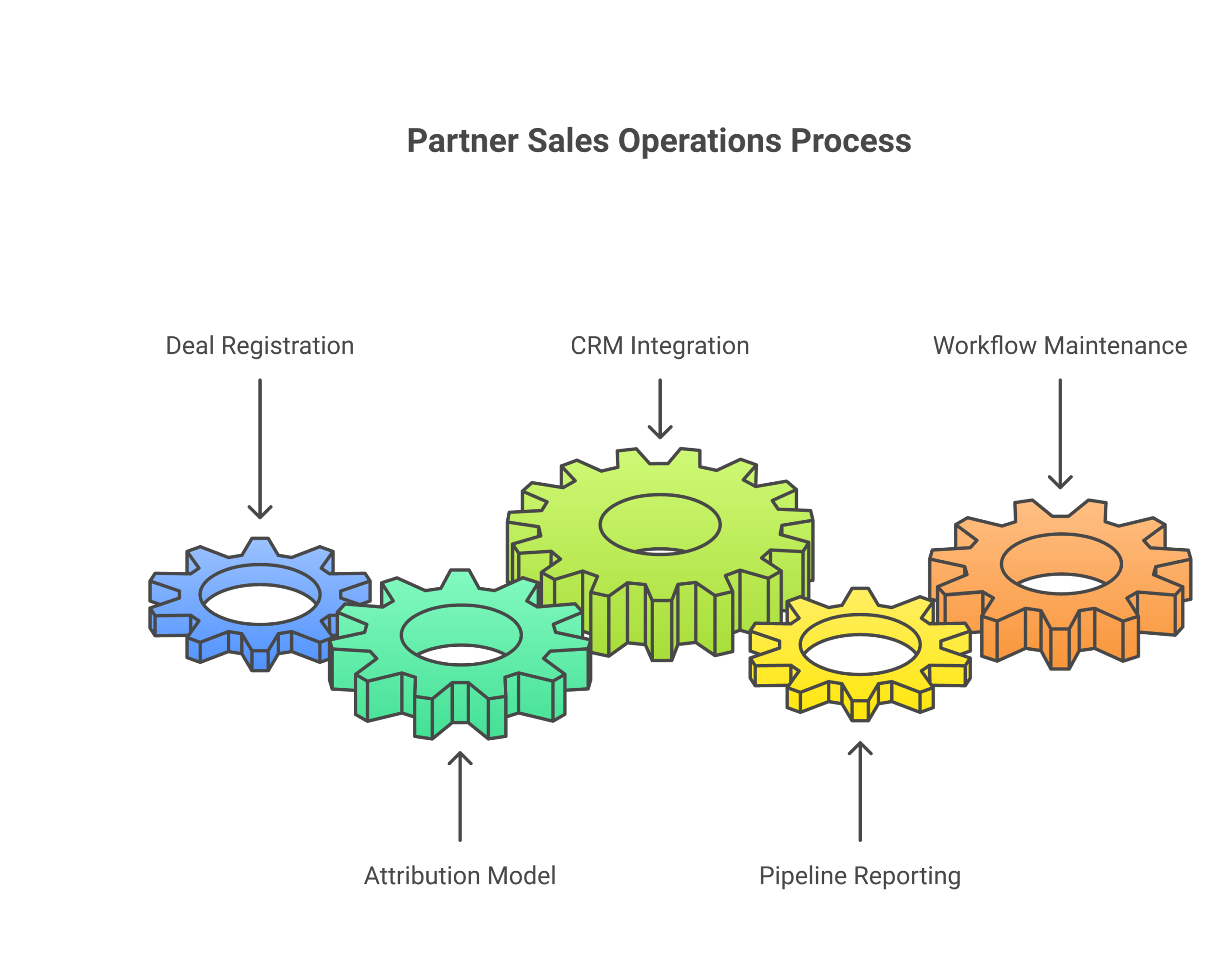
- Own deal registration and the rules around it: Establish how partners register deals, what information is required, and how conflicts are resolved, so every partner deal enters the system the same way. Registration is the front door of the data, and an ungoverned front door produces unusable reporting downstream.
- Define and enforce the attribution model: Set the rules for what counts as partner-sourced and partner-influenced, and apply them in the systems consistently. Attribution decided ad hoc per deal produces numbers no one trusts, so operations owns the rule and enforces it mechanically rather than leaving it to judgment.
- Integrate partner data with the company’s CRM: Connect partner deal data to the system the direct team already uses, so partner pipeline lives alongside direct pipeline instead of in a silo. A partner program whose data never reaches the CRM cannot be managed by the same leaders who manage the rest of revenue.
- Produce the partner pipeline reporting: Build the regular reporting that shows partner pipeline, velocity, and where deals stall, so the program can be managed on evidence. Reporting is the output the whole operations function exists to make possible, and it has to be reliable enough to forecast on.
- Maintain the workflows and clean the data: Run the ongoing hygiene, deduplication, stale-deal cleanup, and process maintenance, that keeps the system trustworthy over time. Operations is not a one-time build; the data degrades without continuous maintenance, and degraded data quietly erodes every decision above it.
The function matures as the program grows, with manual processes that worked early replaced by governed systems as volume rises.
Common pitfalls in partner sales operations
- No owner for the function: When operations is everyone’s job, it is no one’s, and the partnerships leader ends up doing it badly between relationship work. A program at any scale needs a named owner for the systems and data, or the operational load silently degrades everything else.
- Ungoverned deal registration: Letting partners register deals however they like, with optional fields and no conflict rules, produces data too messy to report on. The registration process is where data quality is won or lost, so it has to be governed at the front door.
- Attribution decided per deal: Resolving sourced-versus-influenced case by case produces numbers that shift with whoever is arguing, and finance stops trusting them. The attribution model has to be a defined rule enforced in the system, not a recurring negotiation.
- Partner data in a silo: Keeping partner pipeline in a separate spreadsheet that never reaches the CRM hides it from the leaders who manage revenue. Integrated data is what lets partner pipeline be forecast and managed alongside direct, and a silo guarantees the program is run on guesswork.
- Treating operations as a one-time build: Standing up the systems once and assuming they stay clean ignores that partner data degrades constantly. Without ongoing hygiene, the reporting quietly becomes wrong, and decisions made on it become wrong with it.
What this looks like in practice
A program had grown to a few hundred partner deals a year, and the partnerships leader was spending most of her week reconciling spreadsheets and refereeing attribution arguments instead of running the program. The company stood up a partner sales operations function with a dedicated owner. The first move was governing deal registration: a required form with mandatory fields and a conflict rule, so every deal entered cleanly. Next was a written attribution model, sourced versus influenced defined once and enforced in the system rather than argued per deal. The owner integrated partner deal data into the company’s CRM so partner pipeline sat next to direct, and built a weekly partner pipeline report leadership could forecast on. Ongoing hygiene kept it clean. Within two quarters, attribution disputes nearly vanished, the partnerships leader got her week back for relationships and strategy, and leadership could finally view partner pipeline with the same confidence as direct. The relationships had not changed; the operations underneath them finally had.
Forecastable’s POV on partner sales operations
Partner sales operations is the most underbuilt function in partnerships, and the cost shows up as the leader doing operations work badly. Programs hire relationship people and strategists and assume the data takes care of itself, so the partnerships leader spends half their capacity wrangling spreadsheets that a dedicated operations owner would handle better in a fraction of the time. The highest-leverage hire many programs are missing is not another partner manager; it is the person who makes the existing partner managers’ deals legible.
The second conviction is that attribution has to be a system rule, not a judgment call. The single biggest source of distrust in partner numbers is attribution decided deal by deal, because a rule that shifts with the argument produces numbers finance learns to discount. Operations earns the program its credibility by defining the attribution model once and enforcing it mechanically, even when a generous exception would flatter this quarter.
The candid limit is that operations cannot rescue a program with no strategy or no real partners. Clean data and governed process make a good program scalable; they do not make a bad program good. A program that operationalizes a partner motion that should not exist just produces precise reporting on a failure, so operations is the multiplier on a sound strategy, not a substitute for one.
Forecastable is a partnerships operating platform; any third-party tools or platforms referenced here are independent third-party products, and naming them is not an endorsement of one deployment over another. Evaluate each against your own motion.
Frequently asked questions
What does partner sales operations own?
The systems and process layer of the program: deal registration, the attribution model, integration of partner data with the CRM, partner pipeline reporting, and ongoing data hygiene. It is the operational engine that makes co-sell run reliably at scale.
How is partner sales operations different from a partner manager?
A partner manager owns relationships and drives deals with specific partners; partner sales operations owns the systems and data that make all partner deals trackable and reportable. One is relationship work, the other is operational infrastructure, and a scaling program needs both.
When does a program need a dedicated operations function?
When partner deal volume outgrows what the leader can track by hand, usually as the program scales past a small number of active partners. The signal is the partnerships leader spending more time reconciling data than building relationships.
What is the most important thing partner sales operations gets right?
Governed deal registration and a fixed attribution model. Clean data at the front door and a consistent attribution rule are what make every downstream report trustworthy, and they are where most programs’ data quality is won or lost.
Can partner sales operations be handled inside revenue operations?
Sometimes, and many companies start there. The key is that someone explicitly owns the partner-specific systems and data, whether inside RevOps or as a standalone function, rather than leaving it as an unowned task the partnerships leader absorbs.
Does partner sales operations require dedicated software?
It benefits from it as volume grows, but the function is fundamentally about governed process and clean data, which can start in the existing CRM with disciplined workflows. The systems make operations easier; the discipline is what makes it work.
Next step
If your partnerships leader is spending more time on spreadsheets than relationships, the move this week is to name an owner for partner sales operations, govern your deal registration with required fields, and write down a single attribution rule to enforce in the system.
Start your growth journey now to build the operations engine your program needs to scale, or read the orientation on the partner program for the broader operating model.
Uncover Your Growth Potential
Schedule a Discovery Call