Partner Sales Motion: How Deals Get Done

What is a partner sales motion?
Short answer: A partner sales motion is the repeatable, defined way a company works and closes deals that involve a partner, from the first joint signal through to the close and the credit. It specifies who does what at each stage, so partner deals run on a known process instead of being improvised every time a partner brings an opportunity.
Most companies have a direct sales motion mapped in detail and a partner motion that exists only in people’s heads. A partner deal shows up, someone figures out the handoff on the fly, and the process is reinvented for the next one. A motion is the decision to define it once.
The clearest frame is that a sales motion is the choreography of a deal. Direct sales has its choreography written down; partner sales usually does not, which is why partner deals stall at exactly the moments, the handoff, the registration, the joint pitch, that nobody owns. The motion assigns those moments.
Why a partner sales motion matters in 2026
Partner-involved deals are becoming a larger share of pipeline, and the larger that share grows, the more expensive an undefined motion becomes. A company can afford to improvise five partner deals a year; it cannot afford to improvise five hundred, and the volume in 2026 is pushing past the point where ad hoc works.
The second force is the friction between direct and partner selling. AEs default to the direct motion they know, partners default to bringing leads and waiting, and without a defined partner motion the two collide, deals get double-covered or dropped, and partners lose trust. A clear motion is what lets direct and partner selling coexist instead of competing.
The third force is measurement. A defined motion has stages, and stages can be tracked, which is what lets a program forecast partner pipeline and find where deals stall. A program with no motion cannot say where its partner deals die, so it cannot fix the leak, and in 2026 that visibility is what separates a managed channel from a hopeful one.
How a partner sales motion actually works
A working motion runs as a defined sequence of stages with owners, and the value is in naming who acts at each handoff rather than leaving it to chance.
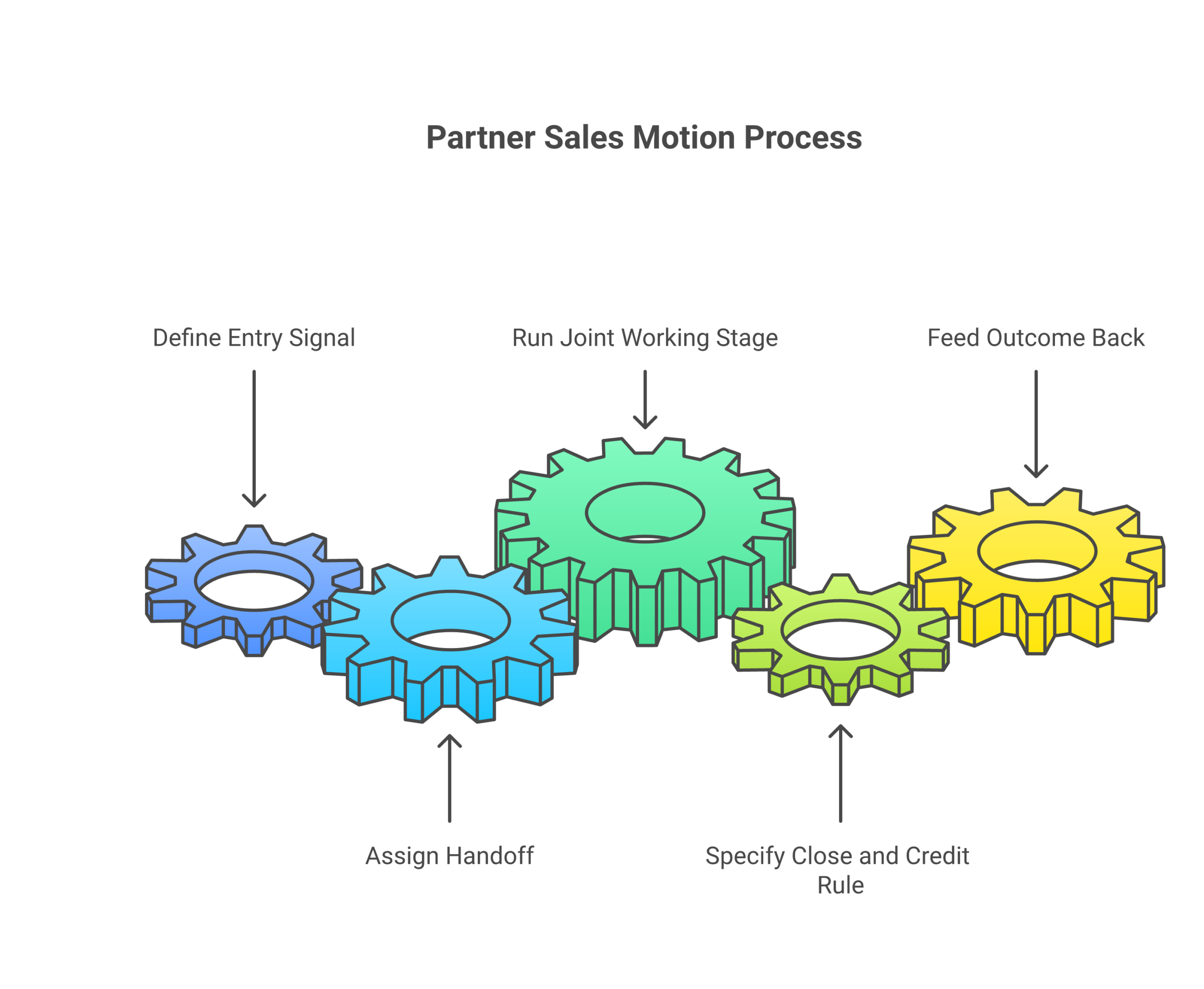
- Define the entry signal and how a deal qualifies in: Specify what counts as a partner deal entering the motion, a registered opportunity, a joint account identified, a partner-sourced lead, so deals start the process the same way. An undefined entry point means partner deals appear randomly and get worked inconsistently.
- Assign the handoff between partner and seller: Name exactly who owns the deal at the moment it moves from the partner to the company’s AE, and what gets transferred, context, contacts, next step. The handoff is where most partner deals leak, so it has to have a named owner and a defined trigger.
- Run the joint working stage with clear roles: Define what the partner and the AE each do while the deal is active, who leads the customer conversation, who handles the technical fit, who drives the close. Two sellers with unclear roles either duplicate effort or assume the other has it covered.
- Specify the close and the credit rule: Lay out who closes, how the deal is recorded, and how partner credit is assigned, before the deal closes, not after. Ambiguity about credit poisons partner trust faster than almost anything else, so the rule has to be set upfront.
- Feed the outcome back to the partner and the data: Close the loop by updating the partner on the result and recording the deal so the motion can be measured and improved. A motion that does not capture outcomes cannot be forecast or refined, and the partner who is left in the dark stops bringing deals.
The motion is reviewed against where deals actually stall, so the stages and handoffs tighten as the program learns its own leak points.
Common pitfalls in a partner sales motion
- An undefined handoff: The moment a deal passes from partner to AE is where most partner deals die, because nobody owns it and the context evaporates. A handoff with no named owner and no defined trigger turns a live opportunity into a dropped one.
- AEs defaulting to the direct motion: When a partner deal arrives, AEs trained on direct selling often work it as if the partner were not there, sidelining the partner and breaking trust. The motion has to make the partner’s role explicit enough that the AE cannot route around it.
- Unclear roles in the joint stage: Two sellers on one deal with undefined roles either duplicate the customer’s experience or each assume the other is driving. The working stage has to assign who leads what, or the deal gets worse coverage than a solo seller would give it.
- Deciding credit after the close: Leaving partner credit ambiguous until the deal closes invites disputes that poison the relationship. The credit rule has to be set when the deal enters the motion, because partners remember how they were treated on the last deal when deciding whether to bring the next.
- No feedback loop: A motion that closes deals but never reports back to the partner or records the outcome cannot be measured and quietly trains partners to stop engaging. The loop back is what keeps the motion improvable and the partner involved.
What this looks like in practice
A company with a growing roster kept losing partner deals at the same spot, and the pattern was always the handoff. A partner would surface an opportunity, email an AE, and then nothing, because no AE owned partner intake and the deal fell between the direct pipeline and the partner’s inbox. The partnerships team defined a motion. Partner deals now entered through a registered opportunity with a required context field. Intake routed to a named partner-deal owner who made the handoff to the AE within a set window, transferring the context and the partner’s role. The joint stage assigned the AE the customer relationship and the partner the technical and reference role. Credit was recorded at registration, not at close. And every closed deal triggered an update back to the partner. Within a quarter, the leak at the handoff closed, partner deal velocity improved, and partners started bringing more opportunities because they could see what happened to the last one. The deals were not new; the motion just stopped losing them.
Forecastable’s POV on a partner sales motion
The handoff is the whole game, and almost no program treats it that way. Teams invest in recruiting partners and enabling them, then lose the resulting deals at the single unowned moment where the opportunity passes from partner to seller. If a program fixed nothing else about its partner motion but assigned a named owner and a hard trigger to that handoff, it would recover more pipeline than most enablement programs produce.
The second conviction is that the partner motion has to be defended against the direct motion, not just defined alongside it. AEs will default to the selling they know, so a partner motion that merely exists on paper gets routed around the instant a deal feels easier to work directly. The motion has to be built into the deal’s required steps, the registration, the intake owner, the recorded role, so the partner cannot be quietly cut out.
The candid limit is that a defined motion adds process, and process has a cost. A heavyweight partner motion can slow deals and frustrate AEs if it is over-engineered, so the goal is the lightest motion that closes the leaks, not the most elaborate one. The art is defining the handoffs and credit rules that actually fail while resisting the urge to choreograph every step a good seller would handle on instinct.
Forecastable is a partnerships operating platform; any third-party tools or platforms referenced here are independent third-party products, and naming them is not an endorsement of one deployment over another. Evaluate each against your own motion.
Frequently asked questions
What is the difference between a partner sales motion and a partner sales process?
They are closely related and often used interchangeably; motion tends to emphasize the choreography of who acts when across partner and seller, while process can refer to the broader set of steps and approvals. Both describe the repeatable way partner deals get worked.
Where do partner deals most often stall?
At the handoff between the partner and the company’s seller. It is the moment most likely to have no named owner, so the deal falls between the partner’s inbox and the direct pipeline. Assigning that handoff is the highest-leverage fix in most motions.
How is a partner sales motion different from a direct sales motion?
A direct motion choreographs one seller and the customer; a partner motion adds a second party, the partner, and the handoffs, role splits, and credit rules between them. The added complexity is exactly why partner deals need their own defined motion rather than being forced through the direct one.
Who owns the partner sales motion?
Partnerships defines it, but it has to be owned jointly with sales, because the motion governs how AEs work partner deals. A motion partnerships writes without sales buy-in gets ignored the moment an AE finds it easier to sell directly.
When should partner credit be decided?
At the point the deal enters the motion, not at close. Deciding credit after a deal closes invites disputes that damage partner trust, and partners weigh how they were treated on the last deal when deciding whether to bring the next.
How do you know a partner sales motion is working?
Fewer deals stall at the handoff, partner deal velocity improves, and partners bring more opportunities because they can see outcomes. Because a defined motion has trackable stages, you can also see exactly where deals leak and whether a fix moved the number.
Next step
If your partner deals keep stalling at the handoff, the move this week is to name a single owner for partner-deal intake, define the trigger that moves a deal from partner to AE, and set the credit rule at registration rather than at close.
Start your growth journey now to define a partner sales motion that stops losing deals, or read the orientation on the partner program for the broader operating model.
Uncover Your Growth Potential
Schedule a Discovery Call