Skip to content
Logo โ€” Itโ€™s All AboutThe Team
  • Home
  • Who We Serve
    • By Category
      • SaaS
      • Professional Services
      • Platforms (Large Ecosystems)
      • Private Equity
    • By Role
      • Chief Revenue Officers (CRO)
      • Chief Financial Officers (CFO)
      • Chief Marketing Officers (CMO)
      • Chief Executive Officers (CEO)
      • Sales Leaders
      • Partnership Professionals
  • Solutions
    • By Partner Program Maturity
      • Partnerships Foundation
      • Partnerships Acceleration
      • Ecosystem-Wide Orchestration
    • Specialized Solutions
      • Net-New Named Account Development
      • Large Ecosystems
      • M&A: Post-Acquisition Internal Cross-Selling
  • Pricing
  • Education
  • Company
    • Our History
    • Security
  • Login
Logo โ€” Itโ€™s All AboutThe Team
  • Home
  • Who We Serve
    • By Category
      • SaaS
      • Professional Services
      • Platforms (Large Ecosystems)
      • Private Equity
    • By Role
      • Chief Revenue Officers (CRO)
      • Chief Financial Officers (CFO)
      • Chief Marketing Officers (CMO)
      • Chief Executive Officers (CEO)
      • Sales Leaders
      • Partnership Professionals
  • Solutions
    • By Partner Program Maturity
      • Partnerships Foundation
      • Partnerships Acceleration
      • Ecosystem-Wide Orchestration
    • Specialized Solutions
      • Net-New Named Account Development
      • Large Ecosystems
      • M&A: Post-Acquisition Internal Cross-Selling
  • Pricing
  • Education
  • Company
    • Our History
    • Security
  • Login
  • Home
  • Who We Serve
    • By Category
      • SaaS
      • Professional Services
      • Platforms (Large Ecosystems)
      • Private Equity
    • By Role
      • Chief Revenue Officers (CRO)
      • Chief Financial Officers (CFO)
      • Chief Marketing Officers (CMO)
      • Chief Executive Officers (CEO)
      • Sales Leaders
      • Partnership Professionals
  • Solutions
    • By Partner Program Maturity
      • Partnerships Foundation
      • Partnerships Acceleration
      • Ecosystem-Wide Orchestration
    • Specialized Solutions
      • Net-New Named Account Development
      • Large Ecosystems
      • M&A: Post-Acquisition Internal Cross-Selling
  • Pricing
  • Education
  • Company
    • Our History
    • Security
  • Login
Back to all blogs
  • Partnerships Roles & Hiring
Alex Buckles

Partner Qualification: Vetting Who to Sign

A partner manager and a sales leader running partner qualification on a wall monitor showing a scorecard with fit criteria and a go/no-go decision, a printed partner application on the table between them, deep navy and warm amber palette

What is partner qualification?

Short answer: Partner qualification is the structured process of deciding which prospective partners are worth signing before they enter the program. It applies consistent criteria to every candidate, fit, intent, and capacity, so the roster fills with partners likely to produce rather than with whoever was willing to sign a logo agreement.

Most programs qualify partners the way they qualify nothing: a friendly call, a handshake, and a signature. Qualification replaces that with the same discipline a sales team applies to a deal, asking whether this partner is actually a fit before investing in them.

The right frame is that signing a partner is a cost, not a win. Every partner you sign consumes onboarding time, enablement attention, and program capacity, so qualification is the gate that protects those finite resources from being spent on partners who will never sell.

Why partner qualification matters in 2026

Programs are drowning in inactive partners. The typical roster is full of signed logos that never produced a deal, and each one absorbed onboarding effort and now clutters the data. Qualification is the discipline that prevents the next two hundred dead partners from being signed, which matters as teams realize the cost of the first two hundred.

The second force is the shift to quality metrics. Leadership has stopped being impressed by partner count and started asking about active, producing partners, which makes the front-end filter more important than the recruiting volume. A program judged on producing partners has to qualify hard at the door.

The third force is capacity. Partnerships teams are small and partner-facing time is the binding constraint, so every unqualified partner that gets signed steals attention from one that would have produced. In 2026 the programs that scale are the ones that say no at qualification often enough to keep the team focused on partners worth the investment.

How partner qualification actually works

Qualification runs as a consistent evaluation, and the discipline is asking every candidate the same questions rather than improvising per partner.
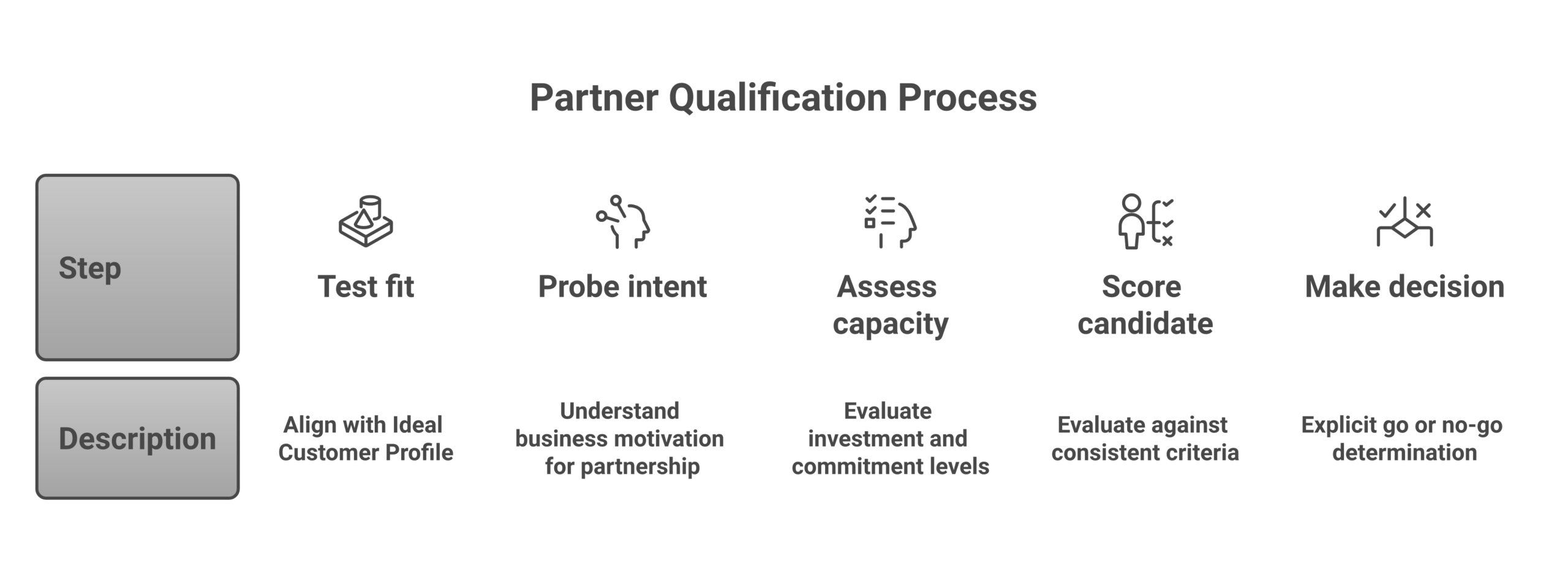
Operating model for how partner qualification actually works: Test fit against your ICP and motion, Probe intent and the business reason to partner, Assess capacity and willingness to invest, Score the candidate against consistent...

  1. Test fit against your ICP and motion: Confirm the partner actually reaches the customers you want and sells in a way that complements your motion. A partner whose customers are not your buyers, however enthusiastic, is a poor fit, and fit is the first filter because nothing downstream fixes it.
  2. Probe intent and the business reason to partner: Ask why the partner wants to work with you and what specific outcome they expect, because a partner with a concrete commercial reason behaves differently from one collecting logos. Vague intent predicts an inactive partner.
  3. Assess capacity and willingness to invest: Determine whether the partner has the people and bandwidth to actually sell, certify, and co-sell, not just sign. A willing partner with no capacity produces the same result as an unwilling one, which is nothing.
  4. Score the candidate against consistent criteria: Run every candidate through the same scorecard so the decision is comparable across partners and not driven by who was most charming on the call. A repeatable score is what makes qualification a process rather than a vibe.
  5. Make an explicit go or no-go decision: Decide, on the criteria, whether to sign, decline, or defer, and be willing to say no. A qualification process that signs everyone regardless of score is not qualification; the no is what gives the yes its meaning.

The criteria are revisited as the program learns which signals actually predicted production, so the scorecard sharpens over time.

Common pitfalls in partner qualification

  • Signing for the logo: Recruiting a recognizable partner because the name looks good ignores whether they will ever sell. A well-known partner with no fit or intent is deadweight that looks impressive in a roster screenshot and produces nothing.
  • Mistaking enthusiasm for fit: A partner who is excited on the call but whose customers are not your buyers is a poor fit no matter how warm the conversation. Enthusiasm is easy to fake and easy to feel; fit against your ICP is the harder, more predictive test.
  • No capacity check: Qualifying a partner on willingness while never asking whether they have the people to execute signs partners who mean well and do nothing. Capacity is as load-bearing as intent, and skipping it fills the roster with good intentions.
  • Inconsistent criteria: Evaluating each candidate on a different basis makes the decisions incomparable and lets charisma substitute for fit. The same scorecard applied to everyone is what keeps qualification honest.
  • Never saying no: A process that signs every candidate regardless of score is recruiting with extra steps. The willingness to decline is the entire point, because a qualification gate that never rejects anyone protects nothing.

What this looks like in practice

A partnerships team was signing every partner that expressed interest and wondering why eighty percent of the roster never transacted. They built a qualification scorecard with three sections: fit, did the partner reach the team’s ICP and sell complementarily; intent, did the partner have a concrete commercial reason and a target in mind; and capacity, did the partner have reps who could actually be certified and sell. Every new candidate ran through the same scorecard, and the team committed to declining anyone below a threshold. In the first quarter under the new gate, they signed forty percent fewer partners, and the ones they signed activated at more than double the prior rate. The partner manager who used to spend her week chasing inactive signups was now supporting partners who were actually selling. The lesson was not that fewer partners is the goal; it is that qualified partners are, and the gate is what produced them.

Forecastable’s POV on partner qualification

Signing a partner feels like a win, and that instinct is the root of most bad rosters. A signature looks like progress, so teams optimize for partner count and treat qualification as a formality, then spend the next year discovering that most of the roster is inert. The reframe that fixes this is treating every signing as a cost the partner has to justify, which makes the no at qualification feel like protection rather than a missed opportunity.

The second conviction is that fit is the filter that nothing downstream can fix. Enablement, incentives, and co-sell support can all improve a qualified partner, but none of them can turn a partner whose customers are not your buyers into a producer. Because fit cannot be remediated, it has to be tested first and weighted heaviest, and a partner who fails it should be declined regardless of how good the rest of the conversation felt.

The candid limit is that qualification will occasionally reject a partner who would have produced, and that is an acceptable cost. A scorecard is a bet on signals, and signals are imperfect, so the gate will sometimes be wrong on a single partner. The alternative, signing everyone to avoid ever missing one, guarantees a roster of deadweight, and a program is far better served by a disciplined filter that is occasionally wrong than by no filter at all.

Forecastable is a partnerships operating platform; any third-party tools or platforms referenced here are independent third-party products, and naming them is not an endorsement of one deployment over another. Evaluate each against your own motion.

Frequently asked questions

What is the most important partner qualification criterion?
Fit against your ICP and motion. A partner whose customers are not your buyers cannot be fixed by enablement or incentives, so fit is tested first and weighted heaviest, and a failure there should end the evaluation regardless of intent or enthusiasm.

How is partner qualification different from partner vetting?
The terms overlap, but qualification usually refers to the full fit-intent-capacity evaluation that decides whether to sign, while vetting often refers more narrowly to checking a partner’s legitimacy and references. Qualification is the broader go or no-go process.

How many partners should fail qualification?
Enough that the gate is real. There is no fixed rate, but a process that never declines anyone is not qualifying, and most programs that introduce a genuine scorecard find they sign meaningfully fewer partners and activate a much higher share of them.

Can you qualify partners you have already signed?
Yes, and many programs run a retroactive qualification to clean up a bloated roster. Scoring existing partners on the same criteria surfaces which signed logos are worth continued investment and which should be moved to a low-touch tier.

What should a partner qualification scorecard include?
At minimum, fit, does the partner reach your buyers and sell complementarily; intent, do they have a concrete commercial reason to partner; and capacity, do they have the people to execute. Each section should use criteria a reviewer can score consistently across candidates.

Who should run partner qualification?
The partner manager or recruiter who owns the relationship, ideally with a sales perspective on fit. The key is that the same scorecard is applied by whoever evaluates, so decisions stay comparable rather than depending on who took the call.

Next step

If you sign most partners who express interest, the move this week is to build a three-part scorecard, fit, intent, and capacity, run your next several candidates through it, and commit to declining anyone below the threshold.

Start your growth journey now to build a qualification gate that keeps your roster productive, or read the orientation on the partner program for the broader operating model.

Uncover Your Growth Potential

Whether starting with a single sales team or a single partner, any co-sell motion can be live within 30 days.

Schedule a Discovery Call
Latest Insights
A customer success manager and a partner success counterpart reviewing an account health and expansion plan on a laptop, a printed renewal-and-partner-touch timeline on the desk between them, deep navy and warm amber palette
  • Partnerships Roles & Hiring
Alex Buckles

CSM Partner Enablement: Turning Success Into Pipeline

What is CSM partner enablement? Short answer: CSM partner enablement is the practice of equipping customer success managers to bring partners into the post-sale motion, retention, adoption, and expansion. It makes the CSM a channel for partner value rather than a function that operates as if partners did not exist, which is how most success […]

Read Article
A revenue leader and a head of partnerships at a wall monitor mapping an ecosystem GTM, direct, partner-sourced, and partner-influenced motions shown as overlapping lanes against a target account list printed on the table, deep navy and warm amber palette
  • Partnerships Roles & Hiring
Alex Buckles

Ecosystem GTM: Building a Go-To-Market on Partners

What is ecosystem GTM? Short answer: Ecosystem GTM is a go-to-market model that treats the partner ecosystem as a core route to revenue alongside direct sales, not as a side channel. It organizes the company’s selling around where partners already have trust and presence, so deals come through the ecosystem by design rather than as […]

Read Article
A founder and a fractional channel chief reviewing a partner program build plan at a desk, a printed first-90-days roadmap and a partner target list between them, a laptop showing a pipeline target, deep navy and warm amber palette
  • Partnerships Roles & Hiring
Alex Buckles

Fractional Channel Chief: When It Works and When Not

What is a fractional channel chief? Short answer: A fractional channel chief is a senior partnerships leader who builds and runs a company’s partner program part-time, on a fraction of a full executive’s hours and cost. It gives a company channel leadership at a stage when the partner motion needs direction but cannot yet justify […]

Read Article
A product marketing lead and a partner manager planning a go-to-market with partners on a whiteboard listing segments, partner roles, and a joint launch motion, a printed target account list on the table, deep navy and warm amber palette
  • Partnerships Roles & Hiring
Alex Buckles

Go to Market With Partners: A Practical Playbook

What does it mean to go to market with partners? Short answer: To go to market with partners means building your route to customers around partners who already have the trust, reach, or capability you lack, rather than reaching every buyer directly. It decides where partners carry the selling motion and where your own team […]

Read Article
Logo โ€” Itโ€™s All AboutThe Team

Quick Links

  • Who We Serve
  • Solutions
  • Resources
  • Pricing
  • Our History

Social Media

  • Linkedin

Legal

  • Privacy Policy
  • Terms of Service
Quick Links
  • Who We Serve
  • Solutions
  • Resources
  • Pricing
  • Our History
Social Media
  • Linkedin
Legal
  • Privacy Policy
  • Terms of Service

Stay ahead on ecosystem-led growth

Logo โ€” Itโ€™s All AboutThe Team
ยฉ 2025 Forecastable. All rights reserved.
Book Your Strategy Call
Request Enrollment Details

[contact-form-7 id=”dfbeed3″ title=”Request Enrollment Details”]

Mollie Bodensteiner

Revops Advisory
  Mollie Bodensteiner is an experienced operations professional with a demonstrated track record of utilizing technology to support operational processes that drive performance and innovation. She currently is the Vice President of Operations at Sound and owns go-to-market agency, MB Solutions. Mollie has previously held operations leadership roles at Deel, Syncari, Corteva and Marketo. She has over 14 years of experience in both B2C and B2B operations and technology. When she is not working, Mollie enjoys spending time with her husband, three small children, and two large dogs. Childhood Career/Dream: Growing up in the age of Disney and Nick@Nite I always wanted to be a child actor (good thing that never was actually pursued ๐Ÿ™‚ Favorite Win: I am not sure I have a specific โ€œwinโ€ but I think I get the most joy and excitement from coaching others and watching them hit major milestones in their career. The first time you get to promote someone on your team or watch them lead a major project – are always career highlights! Personal Fun Facts: Favorite Song: If itโ€™s love, Train Favorite Movie: Good Will Hunting Favorite Meme: Disaster Girl
Forecastable resources: Co-Sell Orchestration Platform · All Use Cases · Live in 30 Days · Co-Sell Playbook

Kelsey Buckles

Director of Operations


My journey from Education to Operations has equipped me with a unique perspective and skill set that perfectly aligns with Forecastable’s mission to help businesses improve sales collaboration through partner co-selling strategies.

At Forecastable, I am passionate about empowering teams and organizations to unlock the full potential of strategic partnerships. By leveraging my expertise in communication, leadership, and operational efficiency, I contribute to creating seamless co-selling processes that align with business goals and deliver exceptional results.

The intersection of my educational foundation and operational experience fuels my dedication to fostering alignment, building trust, and enhancing collaboration between partners. I am driven by the opportunity to contribute to a platform that not only optimizes sales strategies but also strengthens relationships that lead to long-term growth.

Paul Jonhson

Chief Technology Officer (Co-founder)


Paul Johnson has 20+ years of software development and consulting experience for a variety of organizations, ranging from startups to large-enterprise organization with highly-complex needs.

Mr. Johnson has a long track record of successful technology deployments.
This, combined with his deep passion for machine learning and exceptional user experience design, allows him to lead our technical direction from the front with confidence.

Alex Buckles

Product, Partnerships, and Value Engineering (Co-founder)


After serving in The United States Marine Corps, Alex Buckles spent the next two decades as a student of revenue production and an advocate for innovation.

Along the way, he has helped numerous companies achieve double and triple-digit growth by crafting and executing high-performing go-to-market strategies, with co-selling at the center of each.

As a once-advanced technical marketer, an expert sales & partner professional, and a strong customer success advocate, Mr. Buckles understands the impact of these functions aligning not only on revenue production, but on the day-to-day execution of the go-to-market strategy. This concept of revenue-team alignment is what quickly became the foundation of Forecastable back in January of 2018.

In his free time, youโ€™ll find him spending quality time with his children, one of whom is on the autism spectrum. 1 in 36 children in the U.S. are on the spectrum and boys are four times more likely to be diagnosed than girls.

With that in mind, Mr. Buckles plans on dedicating the rest of his life serving those living with autism, through his organization Pathways for Autism. From his perspective, there must be a scalable and financially self-sustaining infrastructure established to put as many individuals with autism as possible on a path towards complete independence as adults.