Partner Program Template: What to Include

What is a partner program template?
Short answer: A partner program template is a reusable structure that lays out the core components of a partner program, the tiers, the benefits, the requirements, and the rules, so you can design a program without starting from a blank page. It captures the decisions every program has to make and gives you a consistent frame to fill in for your own business.
A template is a starting structure, not a finished program. Its value is making sure you address every component deliberately rather than discovering a gap months later when a partner asks a question the program never answered.
Why a partner program template matters in 2026
A partner program template matters because the most common way programs fail is by being built piecemeal, one decision at a time, until the pieces no longer fit together. A team sets tiers without defining what earns them, promises benefits without requirements, or writes rules that contradict the incentives. A template forces the components into view at once, so the program is coherent rather than a pile of well-meaning but disconnected decisions.
In 2026 it matters more because partners compare programs. A partner rep deciding where to invest attention reads your tiers, benefits, and requirements against every other vendor’s, and an incoherent or vague program signals that working with you will be confusing. A clear, well-structured program is itself a recruiting advantage, and a template is how you get to that clarity without reinventing the structure each time.
There is also a speed argument. Designing a program from scratch is slow and prone to omissions; adapting a proven structure is fast and complete. For a team standing up a new program, or formalizing one that grew informally, a template turns months of debate into a structured set of decisions you can work through and pressure-test. It is the difference between a program you designed and a program that just accumulated.
How a partner program template actually works
A partner program template is organized around the decisions every program must make. The components below are the sections a usable template has to contain, each one a choice you fill in for your own business.
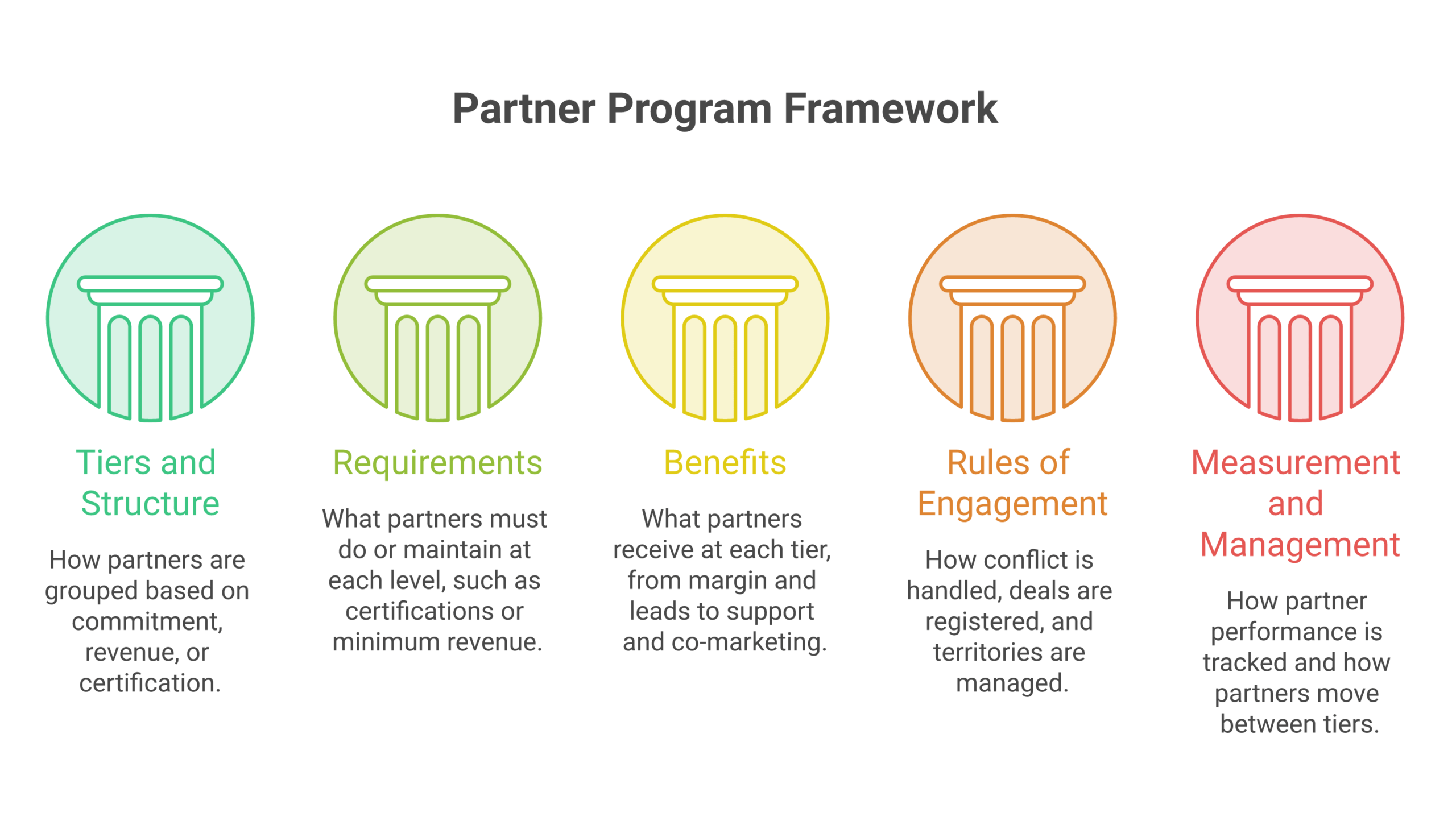
- Tiers and structure: How partners are grouped, whether by commitment, revenue, certification, or partner type. The template should make you define what each tier means and, crucially, what a partner has to do to reach it.
- Requirements: What a partner must do or maintain at each level, such as certifications, minimum revenue, or joint planning. Benefits without requirements produce a program partners take from and never invest in, so every benefit should have a matching expectation.
- Benefits: What partners receive at each tier, from margin and leads to support, co-marketing, and access. The template forces you to tie benefits to tiers so the program rewards the behavior you actually want.
- Rules of engagement: How conflict is handled, how deals are registered, how territories and accounts work, and how direct and partner motions coexist. This is the section programs most often leave vague and most often regret leaving vague.
- Measurement and management: How partner performance is tracked, how partners move between tiers, and how the program proves its contribution. A template without a measurement section produces a program nobody can manage or defend.
Common pitfalls in using a partner program template
- Treating the template as the program: A filled-in template is a design, not a working program. Teams that mistake the document for the work skip the harder job of operating, enabling, and measuring what they designed.
- Benefits without requirements: The most common imbalance. A program that gives generous benefits with little expected in return attracts partners who take and do not invest, and the template exists partly to make you pair every benefit with a requirement.
- Tiers nobody can reach or escape: Tiers set without clear earning criteria become either meaningless labels or permanent ceilings. The template should force explicit movement rules so partners understand how to climb.
- Skipping rules of engagement: Leaving conflict, registration, and territory rules vague feels easier at design time and causes the most damage later, when a partner and a direct rep collide. Fill this section in fully even though it is the hardest.
- Copying another company’s program wholesale: A template is a structure to adapt, not a program to clone. Lifting another company’s tiers and benefits without fitting them to your economics and partner types produces a program that suits neither.
What this looks like in practice
A company grew a partner program informally over a couple of years, adding partners and promising benefits deal by deal, until no one could say clearly what the program actually was. Different partners had different terms, tiers existed in name but not in criteria, and when a new partner asked how to reach the top level, no one had an answer. The program had accumulated rather than being designed, and the incoherence was starting to cost deals.
The team used a partner program template to rebuild it deliberately. They worked through each section, defining tiers with explicit earning criteria, pairing every benefit with a requirement, and finally writing down the rules of engagement they had been improvising. The hardest section was conflict and registration, exactly the one they had avoided, and getting it on paper resolved months of recurring friction. The output was not just a cleaner document but a program partners could understand and climb, and recruiting got easier because the offer was finally legible. The template did not design the program for them; it made sure they designed all of it.
Forecastable’s POV on a partner program template
Our position is that a template’s real value is forcing completeness, not saving time. The danger in program design is not slowness, it is omission, the component you never decided that surfaces as a problem later. A good template puts every decision in front of you at once, which is why it produces coherent programs and ad hoc design produces brittle ones. Use it to make sure you addressed everything, not just to move faster.
We also think the section teams most want to skip, rules of engagement, is the one that matters most. Tiers and benefits are pleasant to design because they are about giving things to partners. Conflict, registration, and territory rules are uncomfortable because they are about constraints and disputes, so teams leave them vague. That vagueness is exactly what produces the worst partner conflicts, and a template earns its keep by making you fill that section in even when you would rather not.
Finally, remember that a filled-in template is the start of the work, not the end. The design has to be operated, partners enabled, performance measured, and the program proven against revenue. A beautiful program document that no one runs or measures is worth nothing. Treat the template as the frame for a living program connected to real partner activity and pipeline, not as a deliverable to file away once it is complete.
Forecastable is a partnerships operating platform. Any third-party tools or methods named here are independent third-party products, and naming them is not an endorsement. Decide how a partner program template should fit your own economics, partner types, and goals.
Frequently asked questions
What is a partner program template?
It is a reusable structure that lays out the core components of a partner program, the tiers, requirements, benefits, rules of engagement, and measurement, so you can design a program against a complete frame rather than from a blank page.
What should a partner program template include?
At minimum, tiers and how they are earned, the requirements at each level, the benefits tied to each tier, the rules of engagement covering conflict and registration, and a measurement section for tracking performance and tier movement.
Why pair every benefit with a requirement?
Because benefits without requirements attract partners who take and never invest. Tying each benefit to an expectation keeps the program rewarding the behavior you actually want rather than subsidizing inactive partners.
Can you copy another company’s partner program?
You can use it as a reference structure, but cloning another company’s tiers and benefits wholesale rarely fits your economics or partner types. A template is meant to be adapted to your business, not lifted intact.
What is the hardest part of a partner program template to complete?
The rules of engagement, covering conflict, deal registration, and territories. Teams avoid it because it deals with constraints and disputes, but leaving it vague causes the worst partner conflicts later.
Is a partner program template the same as a partner program?
No. The template is the structure; the program is the operated, enabled, and measured reality. A completed template is a design, and the real work begins once you start running and proving it.
Next step
If your partner program grew informally and no longer hangs together, a template is how you rebuild it deliberately and find the gaps before partners do. Forecastable helps partnerships teams turn a program design into an operated, measured reality, connecting tiers, requirements, and partner activity to pipeline and revenue. Start your growth journey now to build a program partners can understand and climb. The partner program hub frames the wider program, and the co-sell hub covers running joint deals once the structure is in place.
Uncover Your Growth Potential
Schedule a Discovery Call