Partner Program Structure: Tiers, Roles, Rules

What is partner program structure?
Short answer: Partner program structure is the framework of tiers, entry criteria, benefits, and rules that governs how partners engage with a company. It defines what a partner has to do to reach each level and what they receive there, so engagement runs on published rules instead of one-off negotiations with every partner.
Structure is what turns a collection of partner relationships into a program. Without it, every partner is a custom arrangement, and the team spends its time negotiating terms instead of running a system. The structure is the system.
The useful frame is that structure is the rulebook. It tells a partner exactly how the game works, what level they are at, how to climb, and what each level earns, so they can self-direct toward the behavior you want. A clear rulebook scales; a pile of side deals does not.
Why partner program structure matters in 2026
Programs are scaling to partner counts that make custom arrangements impossible. When a program had ten partners, the team could negotiate each one; at two hundred, that approach collapses, and only a published structure keeps the program coherent. Structure is what lets a program grow without the team’s workload growing in lockstep.
The second force is partner expectation. Partners now work with many vendors and compare programs, and a structure with clear tiers, criteria, and benefits reads as a serious program while a set of ad hoc deals reads as a side project. The structure signals that the company has invested in partnerships as a real channel.
The third force is fairness and defensibility. When benefits are governed by published rules, the team can explain why one partner is Gold and another is Silver without it becoming personal, and partners can see the path to climbing. A structure removes the friction of every benefit being a negotiation, which matters more as the roster and the stakes grow.
How partner program structure actually works
Building a structure runs in a clear order, because the benefits depend on the tiers and the tiers depend on what behavior you are trying to drive.
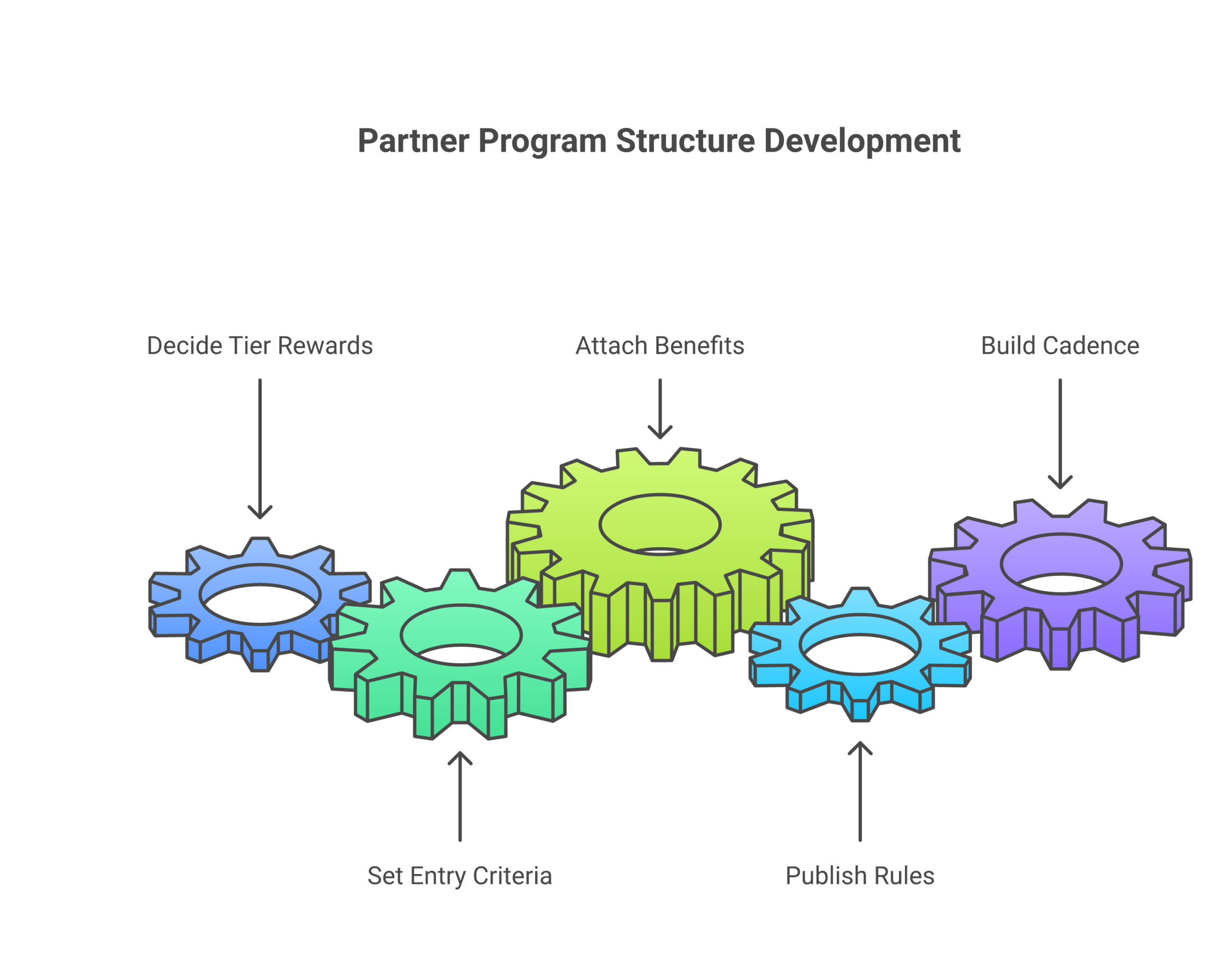
- Decide the behavior each tier should reward: Before drawing tiers, name the partner behavior the structure exists to encourage, certification, sourced deals, joint marketing, and design the levels to reward it. A structure built without a target behavior produces tiers that sort partners but change nothing.
- Set clear, measurable entry criteria per tier: Define exactly what a partner must do to reach each level, a revenue threshold, a number of certified reps, a count of sourced deals, in terms a partner can measure themselves against. Vague criteria turn every tier placement into an argument.
- Attach genuinely different benefits to each tier: Give each level benefits that meaningfully exceed the one below, better margins, more co-marketing funds, priority support, dedicated coverage, so climbing is worth the effort. A higher tier with the same benefits as the lower one gives partners no reason to advance.
- Publish the rules and apply them consistently: Make the structure visible to partners and apply it the same way to everyone, because the value of rules is that they are predictable. A structure that exists on paper but bends for every loud partner is not a structure.
- Build a review and movement cadence: Set how often partners are evaluated for tier movement, up and down, so the structure stays current and partners who slip do not keep top-tier benefits. A structure with no demotion path inflates over time until the top tier means nothing.
The structure is reviewed periodically as the program matures, because criteria that fit a young program often need to tighten as the roster grows.
Common pitfalls in partner program structure
- Tiers that sort but do not reward: Levels that change a partner’s label without changing what they receive give partners no reason to climb. Every tier has to carry benefits meaningfully better than the one below, or the structure is cosmetic.
- Vague entry criteria: When the requirements to reach a tier are fuzzy, every placement becomes a negotiation and the structure loses its authority. Criteria have to be measurable enough that a partner can tell where they stand without asking.
- No demotion path: A structure that promotes partners but never demotes them inflates over time, and the top tier fills with partners who earned it once and coasted. A movement cadence in both directions keeps the tiers meaningful.
- Bending the rules for loud partners: The value of a published structure is predictability, and every exception made for a partner who pushes hard erodes it. A structure applied inconsistently teaches partners to negotiate rather than perform.
- Structure with no target behavior: Tiers built to sort partners by size, rather than to reward the behavior the program wants, organize the roster without changing anyone’s actions. The structure has to be designed backward from the behavior it should produce.
What this looks like in practice
A company had a three-tier program on paper, but the tiers were assigned by gut and carried nearly identical benefits, so no partner cared which level they were at. The partnerships team rebuilt the structure around behavior. They decided the program needed certified reps and sourced deals, so they made those the entry criteria: the top tier required a set number of certified reps and a sourced-pipeline threshold, the middle tier a lighter version, and the entry tier just an active agreement. Then they put real benefits behind the levels, a margin step-up, co-marketing funds, and named partner-manager coverage that only the top tier received. They published the rulebook and committed to a semiannual review with demotion for partners who slipped. Within two quarters, certification rates climbed because partners now had a concrete reason to certify, and the top tier became something partners worked toward rather than a label they ignored. The structure finally did what a structure is for: it changed behavior.
Forecastable’s POV on partner program structure
The most common structural failure is tiers that sort without rewarding. Programs love building Gold, Silver, and Bronze because it feels organized, but if the three levels carry the same benefits, the structure is a coat of paint. A tier only matters if reaching it changes what the partner gets, so the benefits, not the labels, are where the design effort belongs.
The second conviction is that structure has to be designed backward from behavior. The question is not “how should we sort our partners” but “what do we want partners to do, and how do the tiers reward it.” A structure that organizes the roster without driving certification, sourcing, or whatever the program actually needs is administration, not strategy.
The candid limit is that a structure is only as good as the consistency with which it is applied. The instant the team bends the criteria for a partner who pushes hard, every other partner learns that performance is optional and negotiation is the real path. Holding the rules takes discipline, and a structure the team will not enforce is worse than no structure, because it trains partners to game it.
Forecastable is a partnerships operating platform; any third-party tools or platforms referenced here are independent third-party products, and naming them is not an endorsement of one deployment over another. Evaluate each against your own motion.
Frequently asked questions
How many tiers should a partner program structure have?
Usually two or three. Fewer gives partners little to climb toward, and more than three dilutes the meaning of each level and complicates the benefits. The count matters less than making sure each tier carries genuinely different benefits.
What should determine which tier a partner is in?
Measurable behavior tied to what the program needs, such as certified reps, sourced pipeline, or joint marketing activity, not company size or gut feel. Criteria a partner can measure themselves against remove the negotiation from tier placement.
How is program structure different from program design?
Design is the full architecture, including partner types, incentives, and enablement; structure is specifically the tiers, criteria, and benefits within it. Structure is one component of design, the part partners interact with most directly.
Should partners be able to move down a tier?
Yes. A structure that only promotes inflates over time until the top tier is meaningless. A periodic review with demotion for partners who slip below the criteria keeps the tiers honest and the benefits earned.
How often should the structure be reviewed?
The criteria should be reviewed as the program matures, often annually, and partner placements reviewed more frequently, often semiannually. Young-program criteria usually need to tighten as the roster grows and the bar rises.
What is the most common structural mistake?
Tiers that change a partner’s label but not their benefits. Without a real difference between levels, partners have no reason to climb, and the structure organizes the roster without changing any behavior.
Next step
If your tiers carry the same benefits or get assigned by gut, the move this week is to name the partner behavior your program needs most, set measurable criteria that reward it, and put genuinely different benefits behind each level before your next partner review.
Start your growth journey now to build a structure that actually changes partner behavior, or read the orientation on the partner program for the broader operating model.
Uncover Your Growth Potential
Schedule a Discovery Call