Partner Program Strategy: Choosing Where to Win

What is a partner program strategy?
Short answer: A partner program strategy is the set of choices about where partnerships will compete, which partners, which segments, which outcomes, and why those bets will produce return. It is the program’s theory of the case, and it exists to focus a finite team on the few moves most likely to work rather than chasing every available partnership.
A strategy is not a goal. “Grow partner-sourced revenue” is a goal; the strategy is the specific path you have chosen to get there and the alternatives you have ruled out. The ruling out is what makes it a strategy at all.
The clearest frame is that strategy is a set of deliberate trade-offs. You are choosing to win in one segment by declining to chase another, to invest in one partner type at the expense of a second. A program with no strategy is a program that has made no choices, which is why it ends up busy and unfocused.
Why a partner program strategy matters in 2026
Partnerships teams have more possible moves than ever, more partner types, more co-sell motions, more ecosystem plays, and a team that tries all of them does none of them well. Strategy is the discipline that turns an overwhelming option set into a focused plan, which matters more as the option set grows.
The second force is internal alignment. As partnerships becomes a tracked channel, sales, marketing, and product all have a stake in it, and without a stated strategy each function pulls the program in a different direction. A written strategy is what gives the cross-functional partners a single thing to align to.
The third force is the scrutiny on return. Leadership funds strategies it can understand and judge, and a program that cannot say where it is choosing to win cannot defend its investment or explain a miss. In 2026 the programs that hold their budget are the ones whose strategy makes their bets, and their results, legible.
How a partner program strategy actually works
Setting a strategy runs in a deliberate order, because each choice narrows the next. Skipping straight to tactics without the upstream choices is how programs end up busy with no direction.
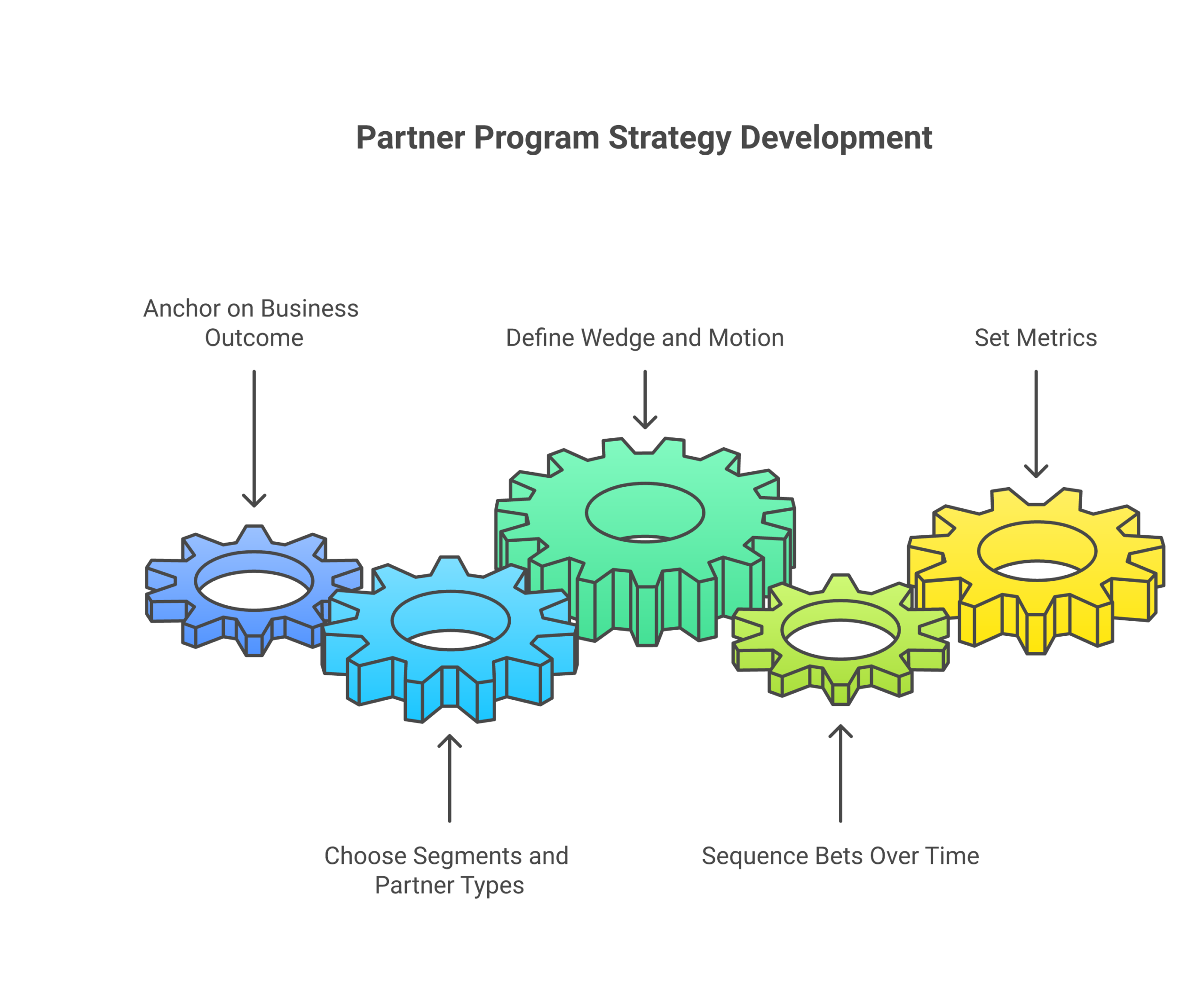
- Anchor on the business outcome partnerships will move: Start from the company goal the program exists to serve, new pipeline in a segment, faster enterprise cycles, expansion into a market, and make that the strategy’s north star. A program whose strategy is not tied to a company outcome optimizes for partnership activity instead of business results.
- Choose the segments and partner types to win in: Decide where you will compete, which markets, which customer segments, and which partner types are the route in. The choice is as much about what you decline as what you pursue, because a strategy that targets everything targets nothing.
- Define the wedge and the motion: Name the specific reason a partner in your chosen segment will work with you and the repeatable motion that produces deals. The wedge is what makes the strategy concrete enough to act on rather than a statement of intent.
- Sequence the bets over time: Lay out which moves come first and which wait, because a small team cannot run every play at once. Sequencing turns a strategy into a roadmap and prevents the program from spreading thin across simultaneous initiatives.
- Set the metrics that prove the strategy is working: Choose the leading and lagging indicators that show the bets are paying off, so the strategy can be judged and adjusted. A strategy with no success metric cannot be distinguished from drift.
The strategy is revisited each planning cycle, with bets that are working scaled and bets that are not retired rather than carried out of inertia.
Common pitfalls in a partner program strategy
- Confusing a goal with a strategy: “Increase partner revenue” is a target, not a plan, and a program that states the goal without the path has no strategy at all. The strategy is the specific route and the trade-offs, not the destination.
- Refusing to choose: A strategy that tries to win in every segment with every partner type is a list of wishes. The discipline of strategy is declining options, and a program that will not say no spreads a small team across too many bets.
- No tie to a business outcome: A strategy anchored on partnership activity, more partners, more co-sell, rather than a company result optimizes for motion. The north star has to be a business outcome leadership cares about, or the strategy drifts from what funds it.
- All bets at once: Running every initiative simultaneously because they all seem good overloads the team and produces shallow execution everywhere. Sequencing the bets is what lets a small team go deep enough on each to learn whether it works.
- No way to judge it: A strategy with no success metric cannot be told apart from inertia, so it gets carried year over year regardless of results. Defining what proof looks like is what makes a strategy adjustable instead of permanent.
What this looks like in practice
A partnerships leader at a growth-stage company inherited a program running six initiatives at once, channel resale, technology integrations, agency referrals, a marketplace listing, an events push, and a community play, all underfunded. Instead of asking for more budget, they wrote a strategy. The company’s actual goal was faster enterprise pipeline, so the strategy anchored there and chose one route: technology partners whose customers were the enterprise accounts the company wanted. The wedge was integration-led co-sell, the motion was joint account mapping into named targets, and the other five initiatives were paused, not killed, but parked. The team went deep on the one bet for two quarters. Enterprise partner-sourced pipeline grew enough that leadership funded a second bet from a position of evidence rather than hope. The program did less and produced more, because for the first time it had chosen.
Forecastable’s POV on a partner program strategy
The defining act of strategy is saying no, and it is the part programs avoid. Every available partnership looks like upside, so teams say yes to all of them and call the resulting pile a strategy. A real strategy is mostly a list of the attractive things you have chosen not to do so the team can go deep on the few that matter.
The second conviction is that the strategy has to be anchored on a business outcome, not a partnership metric. A program that sets out to “build a great ecosystem” optimizes for partner count and activity, which leadership does not fund. A program that sets out to “accelerate enterprise pipeline through integration partners” optimizes for something the company actually wants, and that anchoring is what keeps the strategy aligned with the budget that pays for it.
The candid limit is that a strategy is a bet, and some bets lose. Choosing where to win means you can be wrong about where, and a good strategy builds in the metrics to find out early and the willingness to retire a bet that is not paying off. The alternative, refusing to choose so you are never wrong, guarantees a busy program that wins nowhere in particular.
Forecastable is a partnerships operating platform; any third-party tools or platforms referenced here are independent third-party products, and naming them is not an endorsement of one deployment over another. Evaluate each against your own motion.
Frequently asked questions
What is the difference between a partner program strategy and a goal?
A goal is the outcome you want, such as more partner-sourced revenue; the strategy is the specific path you have chosen to get there and the options you have ruled out. A program with a goal but no strategy has named a destination with no route.
How is partner program strategy different from program design?
Strategy decides where the program will compete and why; design decides how it will operate to execute that. Strategy is the bet, design is the structure, and you usually set the strategy first so the design has something to serve.
How many bets should a partner program strategy make?
Few enough that a small team can go deep on each, often one or two to start. Running every attractive initiative at once produces shallow execution everywhere, so sequencing the bets matters more than pursuing all of them.
Who should own the partner program strategy?
The partnerships leader, set in alignment with the CRO or executive sponsor. Because the strategy makes cross-functional trade-offs and ties to a company outcome, it needs sign-off from whoever owns that outcome, not just the partnerships team.
How often should the strategy be revisited?
Each planning cycle, typically quarterly or by half. Bets that are working get scaled and bets that are not get retired, so the strategy stays current rather than being carried forward out of inertia.
What makes a partner program strategy fail?
Refusing to choose. A strategy that tries to win everywhere spreads the team too thin to learn whether any single bet works, and a strategy untied to a business outcome optimizes for activity that leadership will not fund.
Next step
If your program is running too many initiatives to do any of them well, the move this week is to name the one business outcome partnerships should move, choose the single bet most likely to move it, and park the rest until that bet shows evidence.
Start your growth journey now to set a focused strategy for your program, or read the orientation on the partner program for the broader operating model.
Uncover Your Growth Potential
Schedule a Discovery Call