Partner Manager Day-to-Day: The Real Job

What does a partner manager do day-to-day?
Short answer: A partner manager’s day is built around advancing partner-sourced and partner-influenced deals, running a touch cadence across a tiered book of partners, and unblocking the co-sell motions already in flight. It is a sales-adjacent operating job, not a relationship-management job, and the calendar of a good partner manager looks far more like a seller’s than a community manager’s.
The mistake most programs make is to hire and measure partner managers as relationship people, then wonder why the pipeline does not move. A partner manager who spends the week on check-in calls and goodwill produces goodwill; one who spends it on deal reviews, introductions, and co-sell unblocks produces pipeline. The day-to-day is where that difference is decided.
The real job is to make partners sell, and that work has a weekly shape.
Why the partner manager day-to-day matters in 2026
The partner manager role has been redefined from relationship steward to revenue operator, and the programs that have not updated the day-to-day are falling behind. As partner-sourced and partner-influenced revenue have become board-level numbers, the partner manager’s week has to be organized around producing those numbers, not around keeping partners happy. The job description changed; many calendars did not.
The second force is leverage. A partner manager carries a book of thirty to fifty partners, far more relationships than a seller carries accounts, which means the day-to-day cannot be spent equally across all of them. The work has to be tiered, with the bulk of the week going to the few partners running live co-sell motions and a light cadence covering the rest. A partner manager who treats all partners equally spreads thin and produces little.
The third force is that the day-to-day is now observable. Activity capture, overlap data, and PRM reporting make it possible to see how a partner manager actually spends the week and what it produces, which means coaching can be specific. In 2026 a partner manager’s week is a managed, measurable operating rhythm, and the leaders who define that rhythm get production the leaders who leave it to instinct do not.
How the partner manager day-to-day actually works
A productive partner manager week runs on a four-part operating rhythm. Each part has a named focus and a named artifact, and each part is what gets crowded out when the week fills with reactive check-ins.
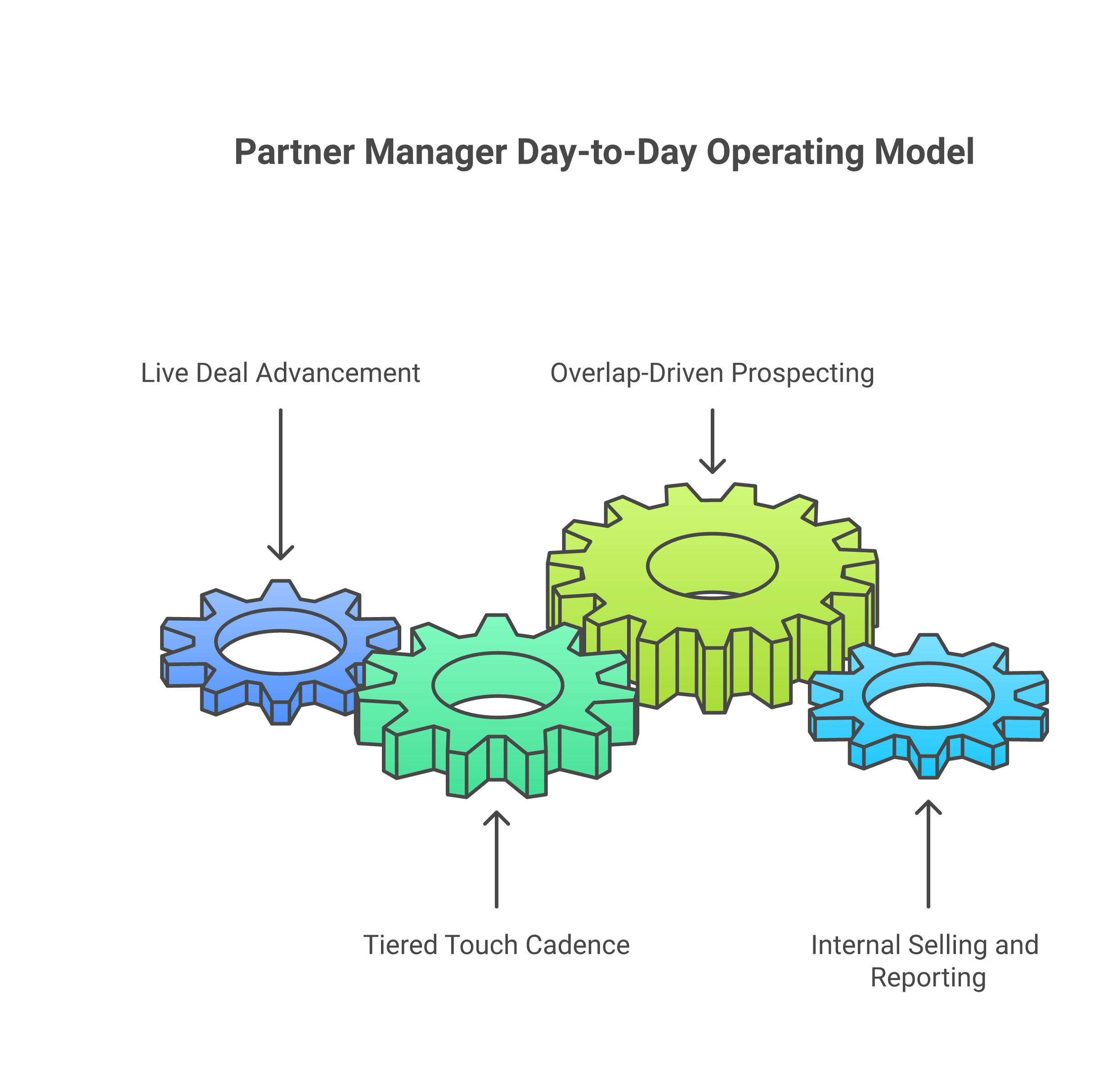
- Live deal advancement (the largest block): The biggest share of the week goes to the co-sell deals already in flight: deal reviews with partner sellers, introductions into active opportunities, references, and unblocking stalls. This is the work that moves pipeline, so it gets the calendar first.
- Tiered touch cadence: A logged touch on Tier 1 partners weekly, Tier 2 every two weeks, Tier 3 monthly, so no producing partner goes quiet. The cadence runs against a target, captured in the PRM (Introw, Euler, Impartner, PartnerStack, or Channelscaler), not from memory.
- Overlap-driven prospecting: A standing block to find the next co-sell, using Crossbeam, Pocus, or Common Room to surface fresh account overlap between partners and open pipeline, then setting the introductions that start new motions.
- Internal selling and reporting: Time spent inside your own company, briefing AEs on partner-sourced opportunities, aligning with sales leadership, and producing the sourced and influenced report. The partner manager sells internally as much as externally.
The rhythm reruns every week, weighted toward live deals, and the leader reviews how the time mapped to production at a weekly one-on-one.
Common pitfalls in the partner manager day-to-day
- Filling the week with relationship check-ins: A calendar of friendly catch-ups feels productive and produces goodwill, not pipeline. Anchor the week on live deal advancement and let the cadence touches stay short.
- Treating all partners equally: Spreading the week evenly across thirty partners starves the few that are actually producing. Tier the book and put the bulk of the time on the partners running live co-sell motions.
- Neglecting internal selling: A partner manager who never briefs the AEs or aligns with sales leadership finds partner-sourced deals stall at the internal handoff. Half the job is selling the partner motion inside your own company.
- Reacting instead of prospecting: A week spent only on inbound partner requests never starts new motions. Protect a standing block for overlap-driven prospecting, or the pipeline runs dry as current deals close.
- Running the cadence from memory: A partner manager who tracks touches in their head will let producing partners slip. Run the cadence against a target captured in the PRM so the gaps are visible.
What this looks like in practice
A partner manager carrying thirty-eight partners restructured the week after a quarter of flat pipeline. Monday and Tuesday went to live deal advancement: six co-sell deal reviews with partner sellers and four introductions into active opportunities. A two-hour Wednesday block ran the tiered touch cadence (eight Tier 1 weekly touches, the rest on a two-week or monthly rhythm) against targets logged in Introw. Thursday morning was overlap-driven prospecting, pulling fresh Crossbeam overlap between the top partners and open pipeline and setting three new introductions. Friday was internal: AE briefings on partner-sourced deals and the weekly sourced and influenced report. Within two quarters the partner-influenced pipeline on the book roughly doubled, not because the partner manager worked more hours, but because the hours moved from check-ins to deal advancement and prospecting.
Forecastable’s POV on the partner manager day to day
The partner manager calendar is the clearest diagnostic of whether a program will produce. Show me a week, and I can tell you the quarter: a week of check-ins predicts goodwill, a week of deal reviews and introductions predicts pipeline. The single most useful thing a partnerships leader can do is look at how the partner managers actually spend their time and move it toward live deals, because the day-to-day is upstream of every number that follows.
The deeper read is that the partner manager is a seller who sells through other sellers, and the job should be structured like a seller’s. A seller protects time for pipeline work and guards against the calendar filling with admin; a partner manager has to do the same, with the added complication that the selling happens through partners and inside their own company at once. The leaders who treat the role as relationship management get relationship outcomes; the ones who treat it as a selling role get revenue.
The candor on tiering is that it requires saying no to partners who want attention but are not producing. The hardest discipline in the day-to-day is keeping the bulk of the week on the few partners in live motion while keeping the rest on a light cadence, especially when a quiet partner asks for time. A partner manager who cannot tier their book will be pulled toward whoever is loudest, and the loud partners are rarely the producing ones.
Forecastable is a partnerships operating platform; the tools above (Introw, Euler, Impartner, PartnerStack, Channelscaler, Crossbeam, Pocus, Common Room) are independent third-party platforms, and naming them is not an endorsement of any specific deployment over another. Evaluate each against your own motion.
Frequently asked questions
What does a partner manager do all day?
Advances live co-sell deals, runs a tiered touch cadence across the partner book, prospects new motions from account overlap, and sells the partner motion internally to AEs and sales leadership. The largest block goes to live deal advancement.
Is a partner manager a sales role or a relationship role?
It is a sales-adjacent operating role. The work is making partners sell, which looks far more like a seller’s week than a community manager’s, even though relationships are part of it.
How many partners can one partner manager handle?
Typically thirty to fifty, which is why the book must be tiered. The bulk of the week goes to the few partners in live co-sell motion, with a light cadence covering the rest.
How much of the job is internal versus external?
A large share is internal: briefing AEs on partner-sourced deals, aligning with sales leadership, and reporting. A partner manager who only works externally finds deals stall at the internal handoff.
What should a partner manager track weekly?
Touch cadence coverage against tier targets, live co-sell deal progress, new introductions set from overlap, and the sourced and influenced pipeline, all captured in the PRM rather than from memory.
How do you coach a partner manager who is not producing?
Look at the week. A calendar of check-ins predicts flat pipeline; move the time toward deal reviews, introductions, and overlap-driven prospecting, and coach against the production the new rhythm yields.
Next step
If your partner managers run on relationship check-ins today, the move this week is to map a tiered weekly rhythm that puts the largest block on live deal advancement, protect a prospecting block, and review the calendar against production at the next one-on-one.
Start your growth journey now to design the partner manager operating rhythm for your specific program, or read the orientation on the partner program for the broader operating model.
Uncover Your Growth Potential
Schedule a Discovery Call