Partner-Led Sales: When Partners Drive the Deal

What is partner-led sales?
Short answer: Partner-led sales is a motion in which the partner runs the sales process and owns the customer relationship, while your own team supports from behind with product expertise, deal desk help, and resources. It inverts the usual arrangement, the partner is the seller in front of the customer and your rep is the supporting cast, which is the right structure when the partner has the trust and access that your team does not.
This is distinct from partner-sourced or partner-assisted deals, where your seller still runs the process. In partner-led sales the partner is genuinely in control of the deal, and your job is to make them effective rather than to drive the sale yourself.
The frame that matters is that partner-led sales requires your team to do less, not more, in front of the customer. The instinct of a good direct seller is to take the wheel, and in this motion that instinct kills deals, because the partner’s relationship and credibility are the asset and stepping in front of them squanders it.
Why partner-led sales matters in 2026
There are markets, segments, and accounts where a partner simply has access and trust that your direct team will never build, and partner-led sales is how you sell into them. In 2026, as buyers consolidate their trust in fewer advisors and existing vendors, letting the partner who already has the relationship lead is often the only realistic path into those accounts.
The second reason is scale and efficiency. A partner running deals end to end extends your reach without growing your headcount, and in markets where direct coverage is uneconomical, partner-led sales is what makes those segments addressable at all. It is leverage, not just reach.
The third reason is that partner-led sales is the motion your direct team is least prepared for, so it matters that programs understand it. A team trained to control deals has to learn to support them, and without that shift the company gets in its own way, undermining the partners it depends on and wondering why partner-led deals underperform.
How partner-led sales actually works
Partner-led sales works when your team is genuinely set up to support rather than steer, and the value is in the discipline of staying behind the partner while keeping the deal healthy.
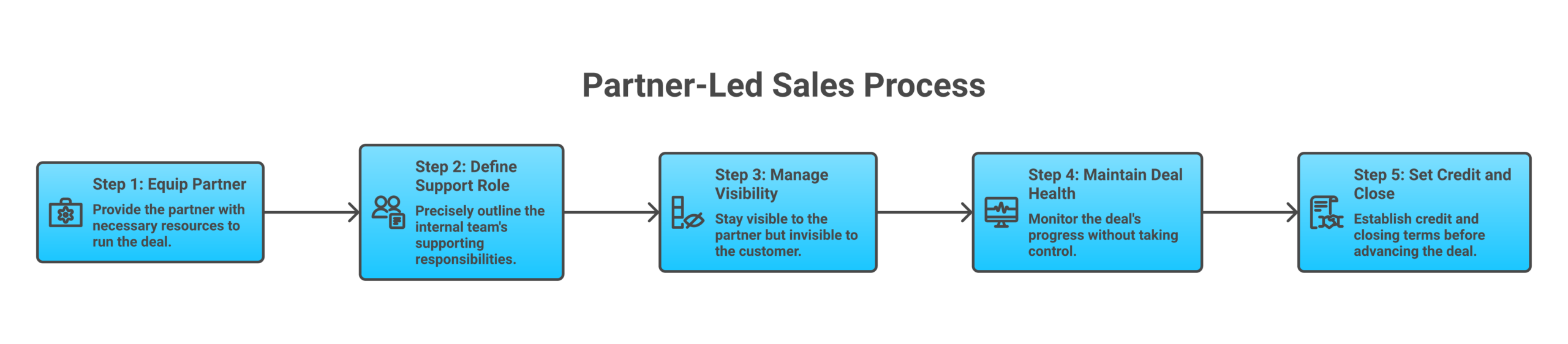
- Equip the partner to run the deal: Give the partner the product knowledge, materials, and pricing authority to actually own the sale, because a partner expected to lead without the tools to do so leads a deal into the ground. Leading requires being equipped to lead.
- Define your team’s supporting role precisely: Specify what your rep does behind the partner, technical validation, deal desk, executive air cover, and what they do not do, step in front of the customer, so the support is real help rather than quiet takeover. An undefined support role drifts into control.
- Stay visible to the partner, invisible to the customer: Be responsive and present for the partner running the deal while staying out of the customer’s view, because the partner’s relationship is the asset and your visible involvement dilutes it. Support means being available to the partner, not appearing in front of their customer.
- Keep the deal healthy without seizing it: Watch for signs a deal is stalling and help the partner address it without taking over, because the line between supporting and seizing is where the motion most often breaks. The skill is intervening in a way that strengthens the partner rather than sidelining them.
- Set the credit and the close before the deal advances: Agree how the deal closes and how credit and economics work upfront, so there is no contest at the finish that damages the relationship. A partner who runs a deal and then fights over credit will not run the next one.
The motion is read against whether partner-led deals close well and whether partners come back to run more, so the program learns whether its team is genuinely supporting or quietly undermining the partners it depends on.
Common pitfalls in partner-led sales
- Your rep taking over the deal: A direct seller’s instinct to control the sale is exactly wrong here, and stepping in front of the customer squanders the partner’s relationship, the very asset the motion depends on. The hardest discipline is doing less in front of the customer, not more.
- Under-equipping the partner: Expecting a partner to lead a deal without the product knowledge, materials, and pricing authority to do so sets them up to fail. A partner asked to lead has to be equipped to lead, or the motion is leadership in name only.
- Being unresponsive behind the scenes: A partner running a deal needs fast support, and a company slow to answer questions or unblock pricing leaves the partner exposed in front of their customer. Invisible to the customer cannot mean absent to the partner.
- Fighting over credit at the close: A partner who runs a deal and then has to contest who gets credit and economics learns the relationship is adversarial and stops bringing deals. Credit and the close have to be settled before the deal advances, not at the finish.
- Forcing partner-led where direct fits: Pushing a partner to lead a deal in a segment where your direct team has the relationship and the partner does not gets the worst of both. The motion fits where the partner has the access and trust, not everywhere a partner exists.
What this looks like in practice
A company expanding into a market segment where it had no relationships kept losing deals its direct team tried to run cold, while a partner already embedded in that segment closed similar deals easily. The partnerships team flipped the motion. In that segment, the partner ran the deals end to end, and the company’s rep moved to a support role, technical validation, fast deal desk turnaround, and executive air cover when the partner needed it, while staying out of the customer’s view entirely. The hard part was retraining the reps, whose instinct was to take over the moment a deal looked important; the team made the supporting role explicit and rewarded reps for partner-led wins rather than penalizing them for not fronting the deal. Credit and economics were settled before each deal advanced. The segment that had been closed to the direct team opened, the partner brought more deals because the experience of running one with the company’s support had been good, and the company reached a market it could not have addressed directly. The win came from the reps learning to do less in front of the customer.
Forecastable’s POV on partner-led sales
The hardest thing in partner-led sales is getting your own sellers to do less, and most programs never manage it. A good direct rep is trained to take control of a deal, and that exact instinct is poison in this motion, because the partner’s relationship is the asset and a rep who steps in front of the customer destroys it while believing they are helping. A program serious about partner-led sales has to retrain and re-incentivize its reps to support rather than steer, and the ones that skip this watch the motion fail and blame the partners.
The second conviction is that supporting invisibly is not the same as being absent, and programs confuse the two. Staying out of the customer’s view does not mean being slow to answer the partner or unwilling to unblock a price, it means being intensely available to the partner while never appearing in front of their customer. The partner leading a deal is exposed, and a company that is invisible to the customer but also unresponsive to the partner has simply abandoned them.
The candid limit is that partner-led sales only fits where the partner genuinely has access and trust your team lacks, and forcing it elsewhere is a mistake. The motion is leverage in segments and accounts you cannot reach directly, and pushing a partner to lead a deal where your own team has the relationship gets you a worse result than either party would alone. The skill is reserving partner-led sales for where it actually fits rather than applying it because partner-led numbers look good on a dashboard.
Forecastable is a partnerships operating platform; any third-party tools or platforms referenced here are independent third-party products, and naming them is not an endorsement of one deployment over another. Evaluate each against your own motion.
Frequently asked questions
How is partner-led sales different from partner-assisted selling?
In partner-assisted selling your rep runs the deal and the partner contributes at key moments; in partner-led sales the partner runs the deal and owns the customer relationship while your team supports. The difference is who is in control and in front of the customer.
When should you use partner-led sales?
When the partner has access and trust in a market, segment, or account that your direct team cannot realistically build. It is leverage into places you cannot reach directly, not a default motion to apply everywhere a partner is involved.
What is the hardest part of the motion?
Getting your own sellers to do less in front of the customer. A direct rep’s instinct to control the deal squanders the partner’s relationship, which is the whole asset. Retraining reps to support rather than steer is the central challenge.
Does supporting mean staying out of the deal?
No. It means staying out of the customer’s view while being intensely available to the partner, fast technical answers, quick deal desk turnaround, executive air cover. Invisible to the customer cannot mean absent to the partner running the deal.
How should credit work in partner-led sales?
Settled upfront, before the deal advances. A partner who runs a deal and then has to fight over credit and economics learns the relationship is adversarial and stops leading deals. Agreeing the close and the credit early protects the relationship.
What does the partner need to lead a deal?
Product knowledge, sales materials, pricing authority, and responsive support behind the scenes. A partner expected to lead without the tools and backing to do so is set up to fail, and the motion becomes leadership in name only.
Next step
If you have a market your direct team cannot crack but a partner already knows, the move this week is to let that partner lead a deal and define your rep’s role as support, then watch whether your rep can resist taking over.
Start your growth journey now to build a partner-led sales motion your team actually supports instead of undermines, or read the orientation on the partner program for the broader operating model.
Uncover Your Growth Potential
Schedule a Discovery Call