What does it take to justify partnership investment to a CFO?
Short answer: Justifying partnership investment is the budget-defense motion every head of partnerships now has to run quarterly, and the move that works is to bring a CFO a signed sourced and influenced attribution definition, a partner pipeline forecast with commit and upside ranges, a unit-economics comparison to direct sales, and a quarterly readout that the same finance partner has audited. It is not a deck about partner activity; it is a model finance can interrogate and a forecast finance can fund. The motion that fails is the brand-and-activity narrative; the motion that wins is the one finance built with you.
The shift is from defending the spend with logos and meeting counts to defending it with a CAC comparison, a payback period, and a tracked-to-source pipeline rollup. Finance does not want enthusiasm; finance wants a model.
Why justifying partnership investment matters more in 2026
Three forces have made partnership investment harder to justify in 2026 than in any prior year. The first is the maturation of partnership data tooling. Account overlap, partner-sourced and influenced attribution, and marketplace co-sell paperwork all have credible independent third-party platforms now, which means finance has tools to audit a partnership claim that did not exist two years ago. “We sourced this deal through the partner” is now a falsifiable claim.
The second force is the contraction of B2B revenue teams overall. After two budget cycles of efficiency-led planning, every line item gets defended against an opportunity cost. A dollar going to partnerships is a dollar not going to direct sales headcount, paid acquisition, or product marketing. The head of partnerships now competes against the CRO’s next AE hire, and the comparison is explicit in the finance model.
The third force is the rise of partner-sourced and influenced revenue as a board metric. The CRO defends the joint pipeline number to the board quarterly. If the head of partnerships cannot supply a defensible forecast input, the CRO defends a number they do not believe, and the partnership team loses credibility with finance and revenue leadership simultaneously.
The honest read is that most partnership investments are still defended on activity (logos signed, partners onboarded, meetings booked) when finance is asking for outcomes (sourced pipeline, influenced pipeline, conversion rates, CAC, payback). Closing that translation gap is the work.
How to justify partnership investment, step by step
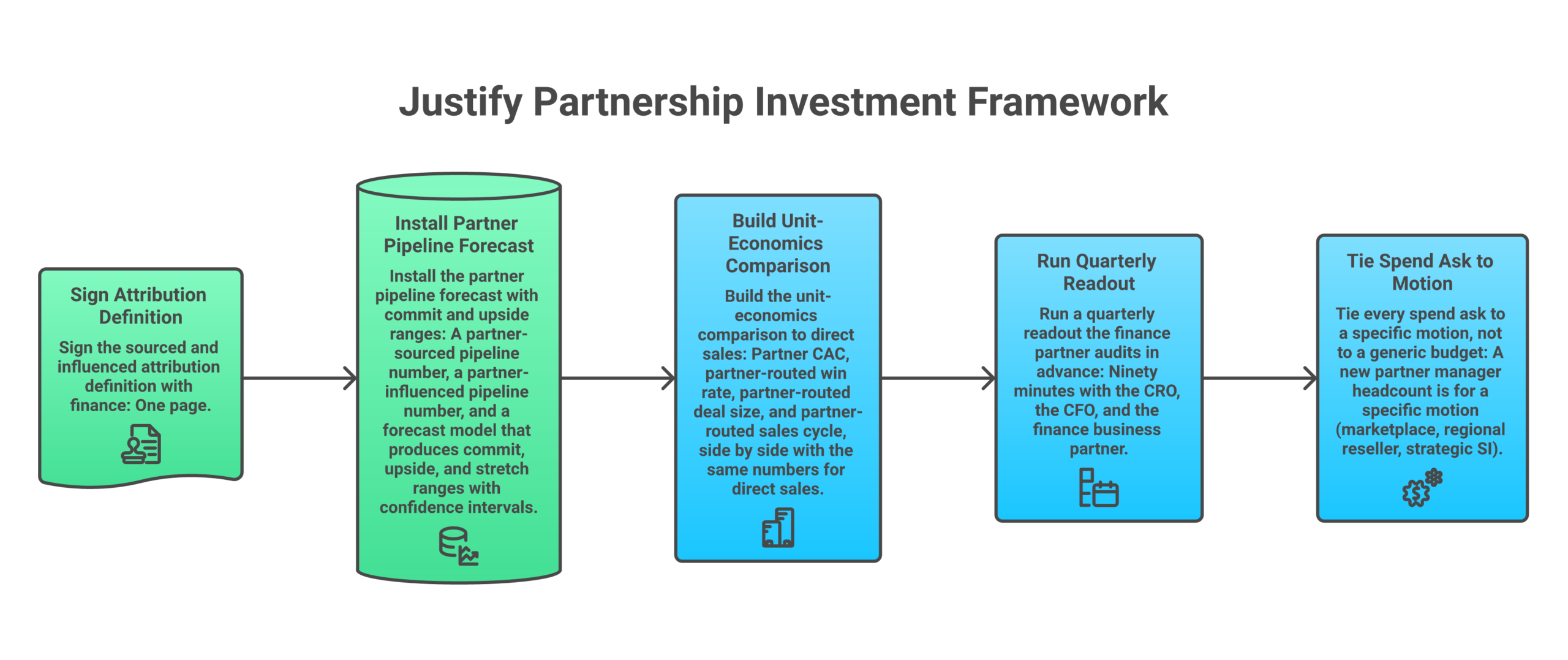
The motion that produces a fundable budget runs on five steps. Each one builds on the previous and each one produces an artifact finance can audit.
Sign the sourced and influenced attribution definition with finance: One page. Sourced means a deal where the partner-originated touch precedes the AE-originated touch. Influenced means a deal where a partner touch occurs in the buying cycle but does not precede the AE-originated touch. Both sides sign. The definition is locked for the fiscal year. Without a signed definition, every quarterly conversation re-litigates the same question.
Install the partner pipeline forecast with commit and upside ranges: A partner-sourced pipeline number, a partner-influenced pipeline number, and a forecast model that produces commit, upside, and stretch ranges with confidence intervals. The model rolls up from the same deal-level data the weekly partner deal review uses. Finance has to be able to drill from the rollup to a specific deal.
Build the unit-economics comparison to direct sales: Partner CAC, partner-routed win rate, partner-routed deal size, and partner-routed sales cycle, side by side with the same numbers for direct sales. The comparison either justifies the investment on its own or surfaces the gap that needs to close in the next quarter.
Run a quarterly readout the finance partner audits in advance: Ninety minutes with the CRO, the CFO, and the finance business partner. Pre-audited model, pre-circulated artifact, and a decision on the next quarter’s investment by the end of the meeting. A quarterly readout that surprises finance has already lost.
Tie every spend ask to a specific motion, not to a generic budget: A new partner manager headcount is for a specific motion (marketplace, regional reseller, strategic SI). A tooling spend is for a specific gap (overlap data, PRM, marketplace co-sell). Tied spend gets funded; untied spend gets discounted.
Common pitfalls that kill the justification
Defending the budget with activity instead of outcomes: “We onboarded twenty partners this quarter” is the wrong sentence to lead a CFO meeting with. The right sentence is “the partner-sourced and influenced pipeline produced 1.4 dollars per dollar invested at a 28 percent payback against a direct-sales baseline of 0.9.”
Refusing to write down the attribution definition: A floating definition that changes each quarter signals to finance that the team is hiding losses. A signed definition is a credibility instrument; refusing to sign one is the worst possible signal.
A forecast that does not roll up from deal-level data: A partner pipeline number that finance cannot trace back to a specific deal is a guess. Guesses do not get funded.
No CAC comparison to direct sales: Without the comparison, the partnership team is defending an absolute number against finance’s opportunity-cost frame. Always show the comparison.
Surprising the CFO in the quarterly meeting: Pre-audit the model with the finance business partner. The CFO meeting is a confirmation, not a discovery.
What this looks like in practice
A growth-stage B2B SaaS company had been losing the partnership budget conversation for three quarters in a row. The head of partnerships shifted the motion. The first step was a signed sourced and influenced attribution definition with finance, agreed in writing in a single ninety-minute meeting. The second step was a partner pipeline forecast that rolled up from the same Crossbeam-anchored deal data the weekly partner deal review used. The third step was a unit-economics comparison: partner-routed CAC came in at sixty-two percent of direct-sales CAC, partner-routed deal size at one hundred fifteen percent, partner-routed sales cycle at eighty-eight percent. The fourth step was a quarterly readout that the finance business partner pre-audited. The fifth step was tying the next investment ask (an additional partner manager for the marketplace motion) to a specific incremental pipeline target. The partnership budget was funded in the next cycle, including the new headcount, against a baseline of three consecutive flat-funding decisions.
A second example. A B2B SaaS partnership team with a longstanding ISV partnership had been carrying a “partner-influenced” claim of about thirty percent of revenue with no audit trail. Finance discounted the claim and treated partnerships as marketing spend. The head of partnerships ran a clean rebuild: signed the attribution definition, instrumented partner touches at deal registration via the PRM, and ran a fourth-quarter rebaseline. The audited number came in at twenty-two percent influenced and four percent sourced, lower than the prior claim but defensible. Finance moved partnerships from marketing-spend treatment to revenue-motion treatment in the next planning cycle, and the budget grew despite the lower headline number, because the model was now fundable.
Forecastable’s POV on justifying partnership investment
Justifying partnership investment is a translation problem. The partnerships team thinks in motions and relationships; finance thinks in CAC, payback, and forecastability. The teams that win at budget defense do the translation work upfront, in writing, with the finance business partner as a co-author. The teams that lose try to defend the spend in real time with marketing language.
The deeper read is that the budget-defense motion runs on the same operating model that produces partner revenue in the first place. A tiered portfolio, a standardized weekly deal review, a signed attribution definition, and a clean partner pipeline forecast are the artifacts that move the joint number and the artifacts finance trusts. The work is shared.
The candor is that most heads of partnerships spend too little time with their finance business partner. The relationship is the leverage point. A finance business partner who has co-authored the attribution definition, watched the forecast install, and audited the quarterly readout will defend the partnership budget inside finance even when the head of partnerships is not in the room. That relationship beats any deck.
The honest read is that partnership investments are usually justified after the fact rather than designed to be justifiable. A program built on activity tracking and quarterly logo counts will never be defensible to a modern CFO. A program built on signed attribution, deal-level data, weekly cadence, and unit-economics comparisons is fundable by default.
Forecastable is a partnerships operating platform; the tools named above (Crossbeam, Pocus, Common Room, Tackle, Labra, Suger, Clazar, Introw, Euler, Impartner, PartnerStack, Channelscaler) are independent third-party platforms, and naming them is not an endorsement of any specific deployment over another. Evaluate each on your own motion.
Frequently asked questions
How do we get a CFO to sign a sourced and influenced attribution definition?
Bring a one-page draft to the meeting. Walk it through. Ask what the CFO would change. Sign the revised version in the room. Most CFOs welcome the structure; the partnership team is usually the one delaying the conversation, not the CFO.
What partner-routed CAC payback should we target to justify the investment?
Partner-routed CAC at sixty to eighty percent of direct-sales CAC is a defensible range for most B2B SaaS motions. Higher than ninety percent and the investment is hard to justify; lower than fifty percent and finance will ask whether the attribution is too generous.
How often should we re-run the unit-economics comparison?
Quarterly, at the readout. Annual rebaselines are too slow; monthly comparisons introduce noise. Quarterly is the right cadence.
How do we explain partner-influenced revenue without inflating the claim?
Use the signed definition. Influenced means a partner touch in the buying cycle that did not precede the AE-originated touch. Report the number against the signed definition every quarter and resist the urge to broaden the definition mid-year.
What if finance does not trust our partner pipeline number?
That is a data problem, not a narrative problem. Instrument the partner touches at deal registration through the PRM, run a re-baseline with finance auditing, and ship the audited number. The honest first number beats the optimistic disputed number every time.
Do we need a finance business partner to run this motion?
Yes. Without a dedicated finance counterpart, the budget-defense motion is a one-shot quarterly conversation rather than a continuous co-authoring relationship. Ask for one if you do not have one.
How long does it take to install the full justification motion?
The signed attribution definition takes two to four weeks. The forecast installation takes one quarter. The unit-economics comparison takes one quarter of clean data. The quarterly readout cadence takes one cycle to stabilize. Total: roughly two quarters from a standing start to a fundable budget motion.
Next step
If the partnership budget conversation is approaching or already lost, the move this week is to schedule the ninety-minute meeting with the CFO and the finance business partner to sign the sourced and influenced attribution definition on a single page.
Start your growth journey now to walk through a working partnership-investment justification motion in your specific environment, or read the orientation on the partner program for the broader operating mod
Uncover Your Growth Potential
Whether starting with a single sales team or a single partner, any co-sell motion can be live within 30 days.
What is channel partner recruitment? Short answer: Channel partner recruitment is the process of finding, qualifying, and signing the partners who will actually sell, service, or implement your product. It is the front door of a partner program, and it decides more about the program’s results than any later stage, because you cannot enable or […]
What is a deal registration form? Short answer: A deal registration form is the structured submission a partner completes to claim an opportunity they sourced and request the vendor’s protection for it. It captures the facts the vendor needs to verify the deal, the account, contact, size, and timing, and it starts the clock on […]
What are deal registration best practices? Short answer: Deal registration best practices are the rules that make a registration program worth trusting: fast and transparent approvals, protections that are always honored, rewards for genuine early sourcing, and claims that expire when deals stall. They exist because a registration program does nothing unless partners believe the […]
What is partner enablement? Short answer: Partner enablement is the work of getting a partner ready and able to sell, service, or implement your product, so a signed partner becomes a producing one. It covers the training, tools, messaging, and support a partner needs to win deals, plus the coaching that turns that knowledge into […]
Mollie Bodensteiner is an experienced operations professional with a demonstrated track record of utilizing technology to support operational processes that drive performance and innovation.
She currently is the Vice President of Operations at Sound and owns go-to-market agency, MB Solutions. Mollie has previously held operations leadership roles at Deel, Syncari, Corteva and Marketo.
She has over 14 years of experience in both B2C and B2B operations and technology. When she is not working, Mollie enjoys spending time with her husband, three small children, and two large dogs.
Childhood Career/Dream:
Growing up in the age of Disney and Nick@Nite I always wanted to be a child actor (good thing that never was actually pursued 🙂
Favorite Win:
I am not sure I have a specific “win” but I think I get the most joy and excitement from coaching others and watching them hit major milestones in their career. The first time you get to promote someone on your team or watch them lead a major project – are always career highlights!
Personal Fun Facts:
Favorite Song: If it’s love, Train
Favorite Movie: Good Will Hunting
Favorite Meme: Disaster Girl
My journey from Education to Operations has equipped me with a unique perspective and skill set that perfectly aligns with Forecastable’s mission to help businesses improve sales collaboration through partner co-selling strategies.
At Forecastable, I am passionate about empowering teams and organizations to unlock the full potential of strategic partnerships. By leveraging my expertise in communication, leadership, and operational efficiency, I contribute to creating seamless co-selling processes that align with business goals and deliver exceptional results.
The intersection of my educational foundation and operational experience fuels my dedication to fostering alignment, building trust, and enhancing collaboration between partners. I am driven by the opportunity to contribute to a platform that not only optimizes sales strategies but also strengthens relationships that lead to long-term growth.
Paul Jonhson
Chief Technology Officer (Co-founder)
Paul Johnson has 20+ years of software development and consulting experience for a variety of organizations, ranging from startups to large-enterprise organization with highly-complex needs.
Mr. Johnson has a long track record of successful technology deployments.
This, combined with his deep passion for machine learning and exceptional user experience design, allows him to lead our technical direction from the front with confidence.
Alex Buckles
Product, Partnerships, and Value Engineering (Co-founder)
After serving in The United States Marine Corps, Alex Buckles spent the next two decades as a student of revenue production and an advocate for innovation.
Along the way, he has helped numerous companies achieve double and triple-digit growth by crafting and executing high-performing go-to-market strategies, with co-selling at the center of each.
As a once-advanced technical marketer, an expert sales & partner professional, and a strong customer success advocate, Mr. Buckles understands the impact of these functions aligning not only on revenue production, but on the day-to-day execution of the go-to-market strategy. This concept of revenue-team alignment is what quickly became the foundation of Forecastable back in January of 2018.
In his free time, you’ll find him spending quality time with his children, one of whom is on the autism spectrum. 1 in 36 children in the U.S. are on the spectrum and boys are four times more likely to be diagnosed than girls.
With that in mind, Mr. Buckles plans on dedicating the rest of his life serving those living with autism, through his organization Pathways for Autism. From his perspective, there must be a scalable and financially self-sustaining infrastructure established to put as many individuals with autism as possible on a path towards complete independence as adults.