Joint Value Prop Template: A 2026 Working Guide

What is a joint value prop template?
Short answer: Joint value prop template is the one-page format two partnering companies use to articulate the specific buyer problems their combined offering solves, the proof points behind those claims, and the discovery question an AE or partner seller would lead with to test fit. It is a working artifact for sellers in the field, not a marketing slide. The one-page constraint is doing most of the work; anything longer becomes a co-branded landing page nobody reads.
A working joint value prop has five elements: a headline that names the joint outcome in seller language, two named buyer problems the partnership solves, one verifiable proof point per problem, the joint discovery question the AE asks first, and the call-to-action. Everything else lives in an appendix the AE can ignore.
The template exists because most partner motions ship enablement materials sellers will not use. Sixty-page co-branded decks, three-page narratives, “value pillars” written in marketing language. The joint value prop template fixes that by constraining the artifact to one page in seller language, which forces both partnerships teams to decide what they actually believe is true about the combined offer.
Why a joint value prop template matters in 2026
Three pressures have made the joint value prop template the highest-leverage partner-motion artifact in 2026. The first is AE attention scarcity. Quotas are up, teams are smaller, and any asset that takes more than two minutes to read loses to the AE’s next outbound sequence. A joint value prop that does not respect the two-minute constraint will not be adopted, regardless of how well-crafted the narrative is.
The second pressure is partner-sourced and influenced pipeline becoming a board metric. The CRO defends the joint pipeline number to the board quarterly, and the number only moves when AEs are actually working partner-routed accounts. The joint value prop template is what makes the AE motion repeatable. Without it, every AE invents their own talk track and the motion does not scale beyond the first three deals.
The third pressure is the rise of buyer committee complexity. The average B2B enterprise buying committee includes seven to ten stakeholders, with a mix of business and technical buyers. A partnership selling to that committee needs a joint value prop that lands on at least two stakeholder profiles within the same conversation. Free-form storytelling does not scale across the committee; a structured template does.
The honest read is that joint value props are usually written by marketing teams optimizing for brand fit and read by sellers optimizing for the next discovery call. The template format reconciles the two by forcing the artifact into the seller’s working memory and giving marketing one tightly constrained page to land their message on.
How a joint value prop template actually works
A working joint value prop template runs on five components. Each one is constrained by length and forces a decision both partnership teams have to make jointly.
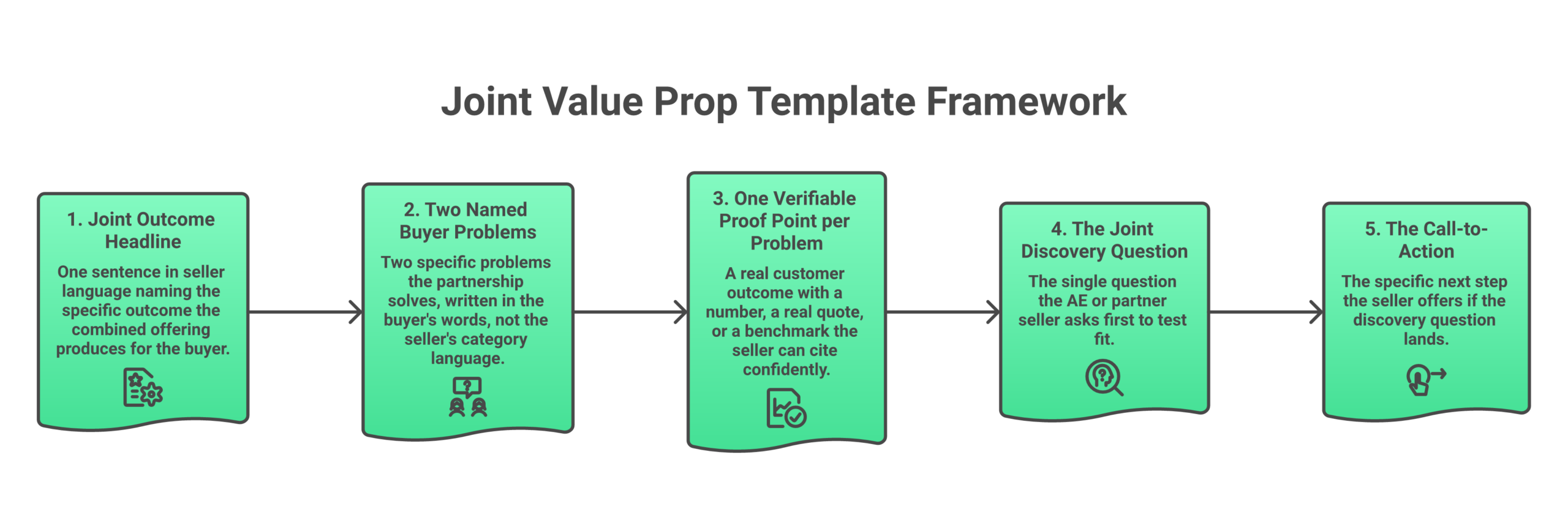
- The joint outcome headline: One sentence in seller language naming the specific outcome the combined offering produces for the buyer. Not the partnership’s brand promise; the buyer’s measurable outcome. If the headline reads like a co-branded press release, it has missed the mark.
- Two named buyer problems: Two specific problems the partnership solves, written in the buyer’s words, not the seller’s category language. Two is the working ceiling; more dilutes attention and forces the AE to memorize a list. If the partnership solves four problems, pick the two with the cleanest proof points.
- One verifiable proof point per problem: A real customer outcome with a number, a real quote, or a benchmark the seller can cite confidently. Not “many customers” or “industry-leading.” A named customer outcome, a named benchmark, or a real quote. Without verifiable proof, the discovery question does not land.
- The joint discovery question: The single question the AE or partner seller asks first to test fit. It has to surface the buyer problem within ninety seconds of conversation. A long-winded discovery script does not survive the second meeting.
- The call-to-action: The specific next step the seller offers if the discovery question lands. A working session, a proof of concept, a customer reference call. Not “let’s stay in touch” and not “let me send some material.” A specific next step with a calendar offer.
The artifact is the constraint. One page, five elements, in seller language. Both partnership teams sign off on the page together, and the page is the working asset for the weekly deal review.
Common pitfalls that kill joint value prop templates
- Writing the template in marketing language instead of seller language: A joint value prop that reads like a landing page will not be used by sellers in a discovery call. The language test is whether an AE could read the page out loud in a discovery call without sounding like an advertisement.
- Listing four to six buyer problems “for comprehensiveness”: Comprehensive lists dilute attention. Two problems with strong proof points beat six problems with weak proof points every time.
- Using vague proof points like “many customers have seen results”: A proof point without a number or a name is not a proof point. It is a hedge. The discovery question that follows a hedge does not land.
- Writing the discovery question as a multi-part sales script: A working discovery question is one sentence. Multi-part scripts do not survive a real conversation, and the AE will go back to their own talk track within two weeks.
- No call-to-action with a calendar offer: A joint value prop that ends with “learn more” produces no next meeting. The CTA has to be specific and bookable.
What this looks like in practice
A B2B SaaS company and a regional system integrator launched a co-sell motion with no joint value prop, relied on each AE to invent their own talk track, and produced two stalled deals in the first quarter. The partnership team replaced the loose approach with a one-page joint value prop template. The two named buyer problems were “joint customers cannot trace which partner sourced the deal” and “joint customers cannot forecast the partnership against finance scrutiny.” Each problem had a named customer proof point. The joint discovery question was “Who at your company defends the partnership number to your CFO today?” The CTA was a working session offer. Within four weeks of the template shipping, partner-sourced discovery meetings ran four times the prior baseline; within one quarter, the partnership closed three co-sourced deals against a starting baseline of zero.
A second example. A B2B SaaS company partnering with a hyperscaler had a six-page joint value prop deck shipped by marketing. AEs ignored it. The team rewrote the artifact to a one-page template in seller language. The two buyer problems were “the buyer’s finance team cannot quantify the joint outcome” and “the buyer’s IT team cannot get a clean trial without procurement friction.” Each had a verifiable proof point. The joint discovery question was “When did your team last try to quantify the joint outcome of this stack?” The CTA was a one-week proof-of-concept on the buyer’s data. Within six weeks, the AE adoption rate on partner-routed accounts moved from under twenty percent to over seventy percent, measured by partner-account mentions in recorded discovery calls.
Forecastable’s POV on the joint value prop template
The joint value prop template is the highest-leverage artifact in a partner motion. It is the asset that turns the partnership’s brand-level agreement into a working seller motion. The teams that win at co-sell ship the template in the first thirty days of a partnership; the teams that struggle ship a sixty-page deck six months later and wonder why nothing is moving.
The template is also the only artifact that survives a personnel change. AEs leave, partner managers move, partner CROs reorganize. The one-page joint value prop on the desk during the weekly deal review is the working memory of the partnership. Without it, every personnel change resets the motion.
The deeper read is that joint value props are usually written too early in the partnership. The right time to write the template is after the first three to five joint discovery calls, when both sides have heard the buyer’s actual language. Templates written before any joint discovery tend to be aspirational and miss the buyer’s real problems. Run discovery first, then write the template, then ship it to the field.
The candor on the constraint is that the one-page rule produces resistance from both partnership marketing teams. Both teams want to include their brand, their pillars, their proof points, and their CTAs. The constraint forces a trade-off that neither team likes individually but that both teams need collectively. Ship the page over the marketing objection.
Forecastable is a partnerships operating platform; the tools named above (Crossbeam, Pocus, Common Room, Tackle, Labra, Suger, Clazar, Introw, Euler, Impartner, PartnerStack, Channelscaler) are independent third-party platforms, and naming them is not an endorsement of any specific deployment over another. Evaluate each on your own motion.
Frequently asked questions
How long should a joint value prop be? One page. The constraint is doing most of the work. Anything longer becomes a co-branded landing page and does not survive the AE’s working memory.
When should the joint value prop be written, day one or after some discovery? After the first three to five joint discovery calls. Templates written before any joint discovery tend to be aspirational and miss the buyer’s real problems. Run discovery first, then write the template.
How many buyer problems should the joint value prop list? Two named buyer problems with strong proof points. More dilutes attention; one is too narrow to land across a buyer committee.
Who owns the joint value prop, partnerships or marketing? Both partnership teams own the artifact jointly, with input from marketing on language but final call sitting with partnerships on what ships. Marketing-owned templates tend to drift into co-branded landing-page tone.
How often should the joint value prop be refreshed? Once per quarter, replacing one element based on what the deal review surfaced. A template that has not changed in twelve months has stopped paying attention to the field.
Do we need a PRM to host the joint value prop? Not at the start. A shared doc and a recurring meeting are enough for the first quarter. Bring in a PRM (Introw, Euler, Impartner, PartnerStack, Channelscaler) when the motion is repeatable and you need a single source of truth.
What happens if the partner refuses to commit to a one-page constraint? That is the partnership’s first stress test. A partner that cannot commit to a one-page joint asset will not commit to the cadence, the joint number, or the named accounts that follow. Resolve the constraint discussion at the senior-leader level before the partnership starts running.
Next step
If a partner motion is running or about to start, the move this week is to draft the one-page joint value prop template, walk it through the first three joint discovery calls for language calibration, and ship the final page to the weekly deal review as the working agenda anchor.
Start your growth journey now to walk through a working joint value prop template in your specific environment, or read the orientation on the partner program for the broader operating mode
Uncover Your Growth Potential
Schedule a Discovery Call