How to Drive AE Adoption of Partners in 2026

What is AE adoption of partners?
Short answer: How to drive AE adoption of partners reduces to one rule: make the partner the easy path on the named accounts the AE already cares about. Every other tactic, including spiffs, mandatory deal registration, and partner training, fails unless the partner makes the AE’s existing work easier on the specific accounts the AE is already trying to close.
AEs do not adopt partners as a category. They adopt a specific partner on a specific account when the partner shortens the path to a closed deal. The partnerships team’s job is to engineer that situation often enough that the AE generalizes the behavior.
Why AE adoption matters in 2026
AE adoption matters more in 2026 because the partner-influenced number is now a board metric. The CRO has to defend the joint pipeline, the head of partnerships has to produce it, and the only people who can actually move it are the AEs who carry the bag.
The other shift is that AE attention is more scarce. Quotas are higher, deal cycles are longer, and the AE who used to attend a partner enablement session this quarter is now defending a forecast call. Adoption tactics that demand AE time without paying it back in pipeline are dead on arrival.
A successful AE adoption motion in 2026 has to land inside the AE’s existing workflow, on the AE’s existing account list, in service of the AE’s existing quota.
How driving AE adoption of partners actually works
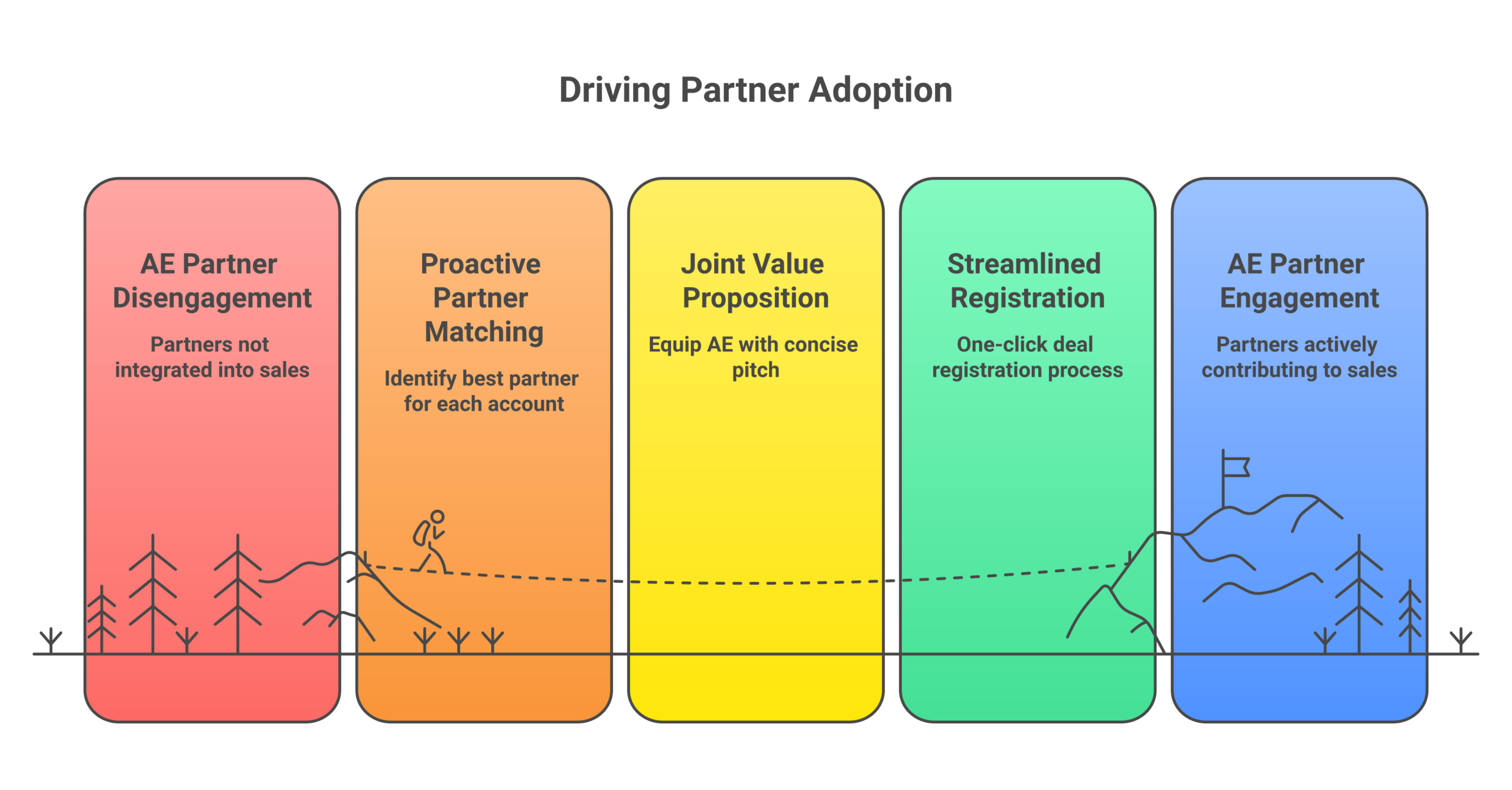
- Push the partner answer to the account, not the partner to the AE: For every named account on the AE’s list, the partnerships team should know which partner has the best fit and the most overlap. The AE should not have to discover this. The artifact is an account-by-account partner recommendation, refreshed quarterly, dropped into the AE’s account plan.
- Equip the AE with the joint pitch: A one-page joint value proposition per partner, written so the AE can use it in front of a customer without rehearsing with the partner counterpart. If the AE has to schedule a call with the partner to learn the pitch, the pitch will not get used.
- Make registration one click: Deal registration that takes the AE more than thirty seconds is registration that does not happen. The partner ops team owns making the workflow that fast inside the CRM.
- Reward visibly and quickly: Compensation, spiffs, or recognition tied to partner-sourced or influenced deals, paid out on the same cadence as direct compensation. Quarterly recognition that lags the deal close by two quarters teaches the AE not to register the next one.
Common pitfalls
- Training as the strategy: A partner enablement session with no account-specific artifact afterward teaches the AE that partners are theory, not workflow.
- Spiffs without account intelligence: A spiff on a deal the AE never finds is a budget line that produces nothing. Account intelligence has to come first; the spiff sweetens an existing motion.
- Mandatory registration without ease: Mandating registration on a workflow that takes five minutes per deal is how AEs learn to route around the partnership team entirely.
- No CRO signal: An AE adoption motion that the CRO has not personally endorsed in front of the sales floor will not survive the next forecast call.
Tools and a worked example
The data behind account-by-account partner recommendation comes from a small stack. Ecosystem tools like Crossbeam produce the overlap. Partner program operations tools like Impartner, PartnerStack, Channelscaler, Introw, and Euler hold the deal records and the partner profiles. Marketplace ops tools like Tackle, Labra, Suger, and Clazar carry the hyperscaler attribution. Forecastable produces the joint pipeline number that proves the motion is working.
A worked example. A platform vendor’s partnerships team produced a quarterly artifact for every AE: a list of the AE’s named accounts, with one recommended partner per account and a one-line pitch. Deal registration was rebuilt to a thirty-second CRM workflow, and spiffs were paid on the same monthly cadence as direct comp. Within two quarters, partner-sourced pipeline as a share of total partner pipeline rose from twenty-nine percent to fifty-two percent, and AEs began requesting the artifact in the off-quarter. The motion was no longer being pushed; it was being pulled.
Vendors named above are listed as independent third-party providers Forecastable has worked alongside. Forecastable does not endorse a single tool category leader and recommends independent third-party evaluation against your own ecosystem before any purchase.
Forecastable’s POV
The teams that struggle to drive AE adoption are usually trying to win the AE’s attention with category messaging (“partners help you sell more”). AEs do not adopt categories. They adopt the partner that closes their next deal.
The shift we recommend is to move the partnerships team’s work out of the partner-by-partner posture and into the account-by-account posture. The unit of work becomes the AE’s account list, not the partner relationship. The partner artifact becomes the per-account recommendation, not the partner profile. The cadence becomes the AE’s quarterly account planning, not the partner business review.
This reframing usually doubles partner-sourced pipeline within two quarters, because it puts the partnership team’s effort where the AE is already paying attention.
Frequently asked questions
What is the single highest-leverage tactic?
The account-by-account partner recommendation artifact, dropped into the AE’s account plan. It puts the partner inside the workflow the AE already runs.
Does compensation matter?
Yes, but second. Compensation accelerates adoption that already has account intelligence behind it. Compensation alone, without intelligence, produces noise.
How long does it take to see results?
Two quarters of the per-account artifact and the rebuilt registration workflow typically doubles partner-sourced pipeline as a share of total partner pipeline.
What role does the CRO play?
A leadership signal. The CRO has to endorse the motion in front of the sales floor at least once a quarter, or the AE inference is that the motion is optional.
Next step
If your partner-influenced pipeline is stuck, the rebuild that pays back fastest is the per-account artifact and the thirty-second registration workflow. Both are install-able in a quarter.
Start your growth journey with a working session on the artifact and the workflow. For broader context on the operating model the motion sits inside, see the Partner Program pil
Uncover Your Growth Potential
Schedule a Discovery Call