Channel Sales Management: How It Actually Works

What is channel sales management?
Short answer: Channel sales management is the discipline of producing revenue through partners with the same rigor a direct sales org applies to its own reps: selection, enablement, pipeline, and forecasting. It is the system, not the personality, that makes a channel produce. Where it is absent, partner revenue is an accident rather than a plan.
The practice sits above any single partner manager. Channel sales management is how a company decides which partners to invest in, how it enables them, and how it holds the channel accountable to a forecast.
Why channel sales management matters in 2026
Channel sales management matters because a channel without management is just a list of logos, and lists do not close deals. Partners produce when a vendor runs the motion deliberately, and they stall when the vendor treats partnerships as goodwill. The difference between the two is management.
In 2026, leadership expects partner revenue to be forecastable, not hopeful. A CRO cannot commit a number that depends on a channel nobody stages, measures, or reviews. Channel sales management is what turns partner activity into a line on the forecast that finance will accept, and its absence is why so many partner programs get cut in a downturn.
The other reason is allocation. A vendor has finite time and budget to spend on partners, and channel sales management is how that spend goes to the partners that return pipeline instead of the ones that merely look impressive. Managed well, a channel compounds; managed loosely, it consumes budget and produces slides.
How channel sales management actually works
Channel sales management works by running the partner base as a portfolio with clear stages: pick partners, enable them, co-sell, and forecast the result. The components below are the working parts of the discipline.
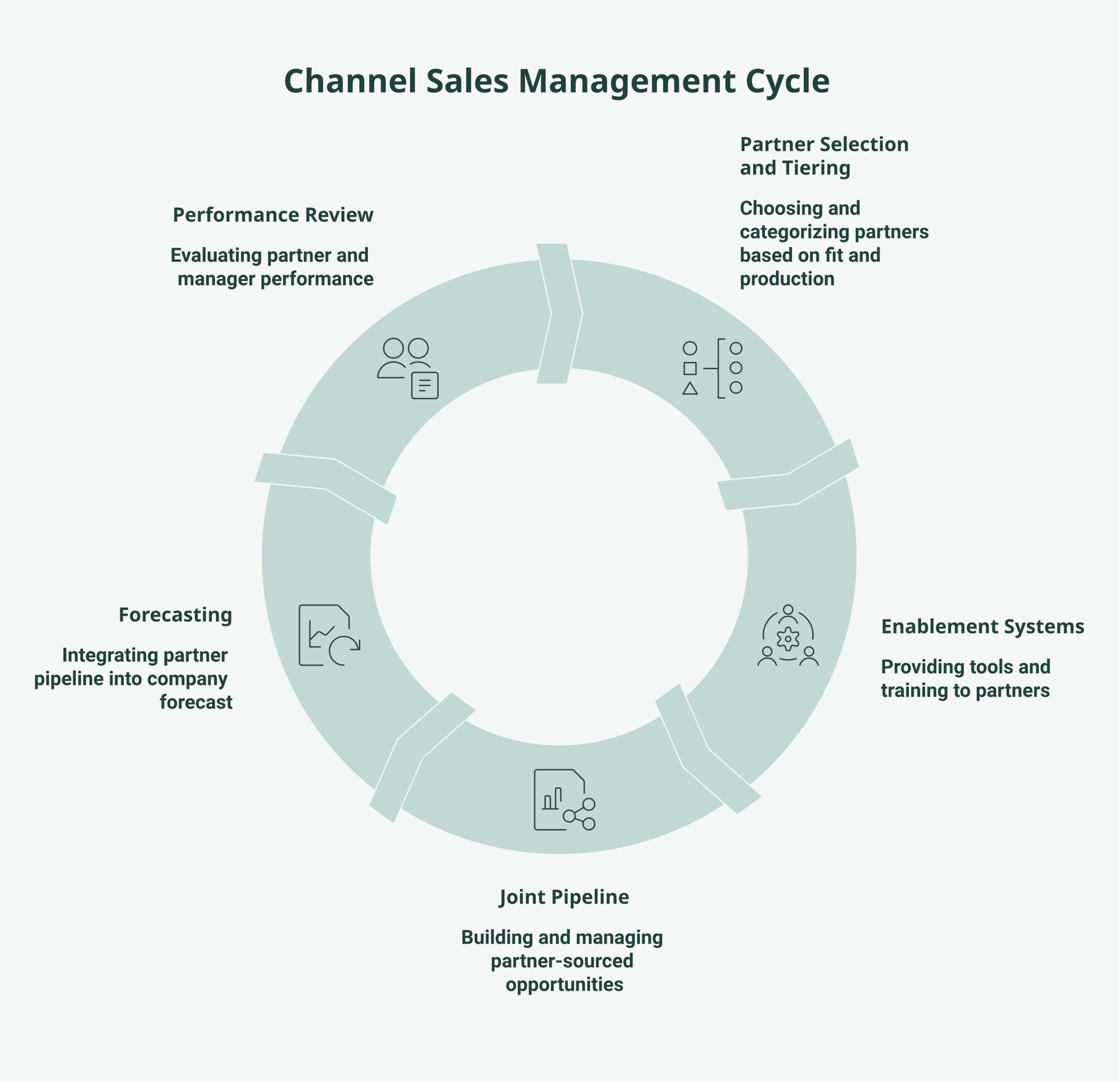
- Partner selection and tiering: Deciding which partners deserve investment based on fit and production, and tiering the rest so time flows to where it pays off.
- Enablement systems: Giving partner sellers repeatable messaging, tools, and practice so they can carry the product without a specialist in every call.
- Joint pipeline: Building and working partner-sourced and partner-influenced opportunities in CRM with real stages, owners, and dates.
- Forecasting: Rolling partner pipeline into the company forecast so leadership can commit to it, and so a miss shows up early enough to fix.
- Performance review: Running regular reviews of what each partner and each channel manager produced, and reallocating investment toward what works.
Common pitfalls in channel sales management
- No forecast for the channel: Running partner deals outside the forecast means the channel is invisible until it misses. If you cannot forecast it, you cannot manage it.
- Tiering by revenue history, not potential: Investing only in partners who already produce ignores the ones who could. Tier on fit and trajectory, not just last year.
- Enablement as a one-time event: Treating partner enablement as onboarding, with no reinforcement, lets capability decay as reps turn over and the product changes.
- Measuring activity, not production: Counting partner meetings, portal logins, and events instead of pipeline and revenue rewards motion over results. Manage to the number.
- Managing every partner the same: Applying identical cadence and investment across a wide, uneven base wastes the effort on partners who will never produce and starves the ones who could.
What this looks like in practice
A worked example: a company had a channel team, a partner portal, and a growing partner count, yet the channel never appeared in the forecast the CRO presented. Deals closed through partners, but they were logged as direct, and no one staged partner pipeline. The head of channel introduced three changes: partner-sourced opportunities got a source field and real stages in CRM, each channel manager forecast their partners monthly, and the team tiered the base so the top partners got deep support and the long tail got a lighter, self-serve motion. Within a quarter the channel had a forecast leadership could commit to, and the reviews made it obvious which partners deserved more time. The lesson was that channel sales management is mostly about making partner revenue visible and accountable, because a channel you can measure is a channel you can grow.
Forecastable’s POV on channel sales management
Our position is that channel sales management fails when it optimizes for partner count and activity instead of forecastable revenue. It is easy to grow a roster and fill a calendar with partner touches; it is hard to produce a partner forecast a CFO will accept. The programs that survive scrutiny are the ones that stage, measure, and forecast partner pipeline like the direct team does, because that is what makes the channel defensible.
We also think channel sales management should be honest about the long tail. Most partner bases are heavily uneven, with a handful of partners producing most of the pipeline. Managing all of them identically feels equitable and wastes the team’s best hours. Concentrate management depth where production is, give the tail a lighter motion, and stop pretending a dormant partner is a pipeline.
Forecastable is a partnerships operating platform focused on connecting partner conversations and actions to CRM pipeline and revenue. We do not run your channel; we make it measurable, so partner-sourced and partner-influenced deals appear in the forecast and channel managers can point their time at what produces. Channel sales management is the discipline; visibility is what lets you enforce it.
Forecastable is a partnerships operating platform and a category authority, not a PRM vendor. Any third-party tools or firms referenced in this space are independent third-party products, and mentioning them is not an endorsement. Evaluate any channel approach against your own partner mix, motion, and CRM.
Frequently asked questions
What is channel sales management?
Channel sales management is the discipline of producing revenue through partners with real rigor: selecting and tiering partners, enabling their sellers, building joint pipeline, and forecasting the result.
How is channel sales management different from direct sales management?
The mechanics are similar, but the sellers work at another company. That makes enablement, co-selling, and pipeline visibility harder, so the management discipline matters even more.
What does good channel sales management measure?
Partner-sourced and partner-influenced pipeline and revenue, partner activation, and production by tier, not partner count or activity volume.
How do you forecast channel sales?
Stage partner opportunities in CRM, have each channel manager forecast their partners on a regular cadence, and roll that into the company forecast so leadership can commit to it.
What tools support channel sales management?
CRM is the system of record for partner pipeline; partnerships operating platforms make partner activity and results visible in that pipeline. Evaluate any tool against your own motion.
Why do channel programs get cut?
Usually because the channel cannot show a forecastable contribution. A program that stages and measures partner revenue is far harder to cut than one that reports activity.
Next step
If your channel closes deals but never shows up in the forecast, the gap is management, not effort. Stage partner pipeline in CRM, tier the base, forecast it monthly, and review what each partner produced. Start your growth journey now to make channel revenue visible and forecastable. The partner program hub frames how channel sales management connects to enablement, roles, and attribution.
Uncover Your Growth Potential
Schedule a Discovery Call