Channel Partner Onboarding: How to Do It Right

What is channel partner onboarding?
Short answer: Channel partner onboarding is the structured process of taking a newly signed partner from contract to first deal, covering setup, training, enablement, and the early support that turns intent into revenue. It is the bridge between recruitment and production, and it is where most partnerships quietly die. A partner who signs but never gets onboarded well becomes a logo, not a channel.
The process is not paperwork and a portal login. It is the deliberate work of making a partner capable and motivated to sell you, fast enough that early enthusiasm does not fade into inactivity.
Why channel partner onboarding matters in 2026
Channel partner onboarding matters because the window after signing is short, and a partner who does not reach a first deal quickly usually never does. Enthusiasm at signing is real but perishable; if the first ninety days pass with no traction, the partner moves on to vendors who made selling easy. Onboarding is how a program converts that early intent before it evaporates.
In 2026, with partner teams stretched across large networks, the temptation is to automate onboarding into a self-serve portal and hope. But the partners worth having need more than a login; they need a path to a first deal and someone who helps them get there. The programs that produce are the ones that treat onboarding as a guided motion, not a document dump.
The other driver is efficiency. A well-onboarded partner produces sooner and needs less hand-holding later, while a poorly onboarded one absorbs support forever or churns. Getting onboarding right is how a small team scales a channel without drowning in remedial work.
How channel partner onboarding actually works
Channel partner onboarding works as a staged path from signature to first deal, with clear milestones and real support at each step. The components below are what a working process includes.
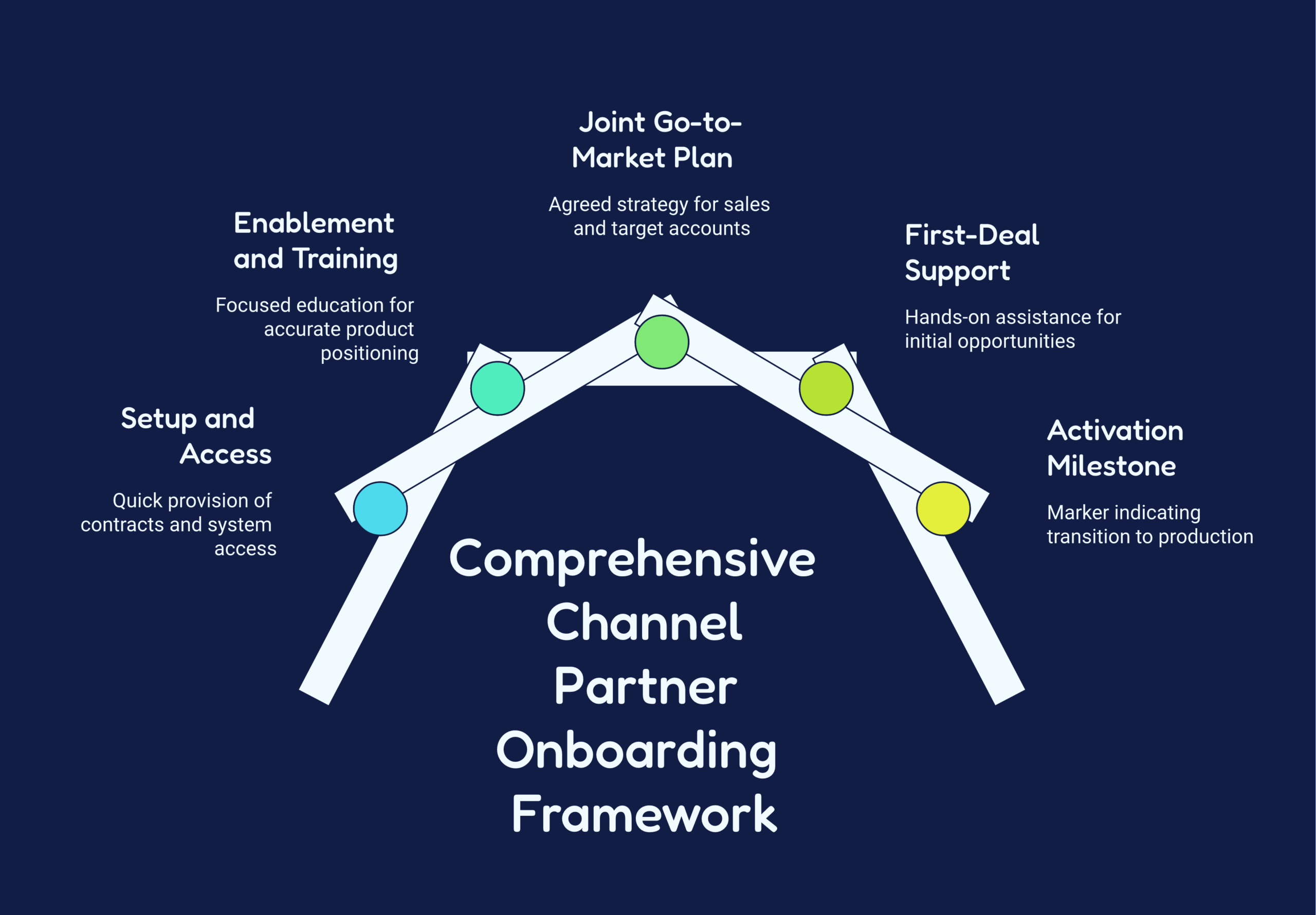
- Setup and access: Contracts, portal access, deal registration, and system provisioning handled quickly, so a partner is operational within days rather than chasing logins for weeks.
- Enablement and training: The focused education that teaches a partner to position and sell your product accurately, kept short enough that they finish it rather than a certification marathon they abandon.
- Joint go-to-market plan: An agreed plan for how and where the partner will actually sell you, including target accounts, so onboarding ends in a motion rather than a hope.
- First-deal support: Hands-on help through the partner’s first opportunity, because the first deal is where a partner learns your product wins or decides it is not worth the effort.
- Activation milestone: A defined marker, usually the first registered or closed deal, that signals the partner has crossed from onboarding into producing and support can shift accordingly.
Common pitfalls in channel partner onboarding
- Treating onboarding as paperwork: A portal login and a contract are setup, not onboarding. A partner who is provisioned but not enabled is not onboarded.
- Certification marathons: Front-loading hours of required training kills momentum. Teach enough to sell the first deal, then build depth over time.
- No first-deal support: Leaving a new partner alone for their first opportunity is where most onboarding fails. That deal decides whether they stay.
- No go-to-market plan: Onboarding that ends without an agreed motion produces a trained partner with no reason to act. The plan is what turns capability into activity.
- Same onboarding for every partner: A strategic reseller and a casual referral partner need different paths. One template applied to both fits neither.
What this looks like in practice
A worked example: a vendor signed partners steadily but saw most go quiet within a quarter. Its onboarding was a welcome email, a portal login, and a long certification course almost nobody finished. The team rebuilt it as a thirty-day guided path: setup done in the first week, a short enablement focused only on the first sales conversation, a joint plan naming target accounts, and a partner manager who joined the first opportunity. Activation, defined as a first registered deal, jumped, and the partners who reached it kept producing. The lesson was that onboarding is not about how much a partner learns; it is about how fast they reach a first deal with help.
Forecastable’s POV on channel partner onboarding
Our position is that onboarding is a first-deal problem, not a training problem. Teams over-index on certification and content because those are easy to build, and under-invest in the messy, human work of getting a partner through an actual opportunity. But the first deal is the moment a partner decides you are worth their time, and no course substitutes for support in that moment. Design onboarding backward from the first deal, not forward from the curriculum.
We also think onboarding should end at a measurable activation milestone, not a completion certificate. A partner who finished training but never registered a deal is not onboarded in any way that matters. When activation is defined as a real deal in CRM, the program can see which partners actually crossed over and which stalled, and support can go where it moves the number.
Forecastable is a partnerships operating platform focused on connecting partner conversations and actions to CRM pipeline and revenue. We do not run the training, but we make partner activity and first deals visible in the forecast, so onboarding success is measured by production rather than course completion. The process builds capability; we help you see when it turned into revenue.
Forecastable is a partnerships operating platform and a category authority, not a PRM vendor. Any third-party tools or firms referenced in this space are independent third-party products, and mentioning them is not an endorsement. Evaluate any onboarding approach against your own partner types, motion, and CRM.
Frequently asked questions
What is channel partner onboarding?
It is the structured process of moving a newly signed partner from contract to first deal, covering setup, enablement, a go-to-market plan, and first-deal support.
How long should channel partner onboarding take?
The goal is a first deal within the first ninety days, with setup done in the first week. Onboarding that drags past a quarter usually loses the partner’s early momentum.
What is the difference between onboarding and enablement?
Onboarding is the initial path from signing to first deal. Enablement is the ongoing training and support that continues after. Enablement is a component of onboarding and then a practice of its own.
What is the most common onboarding mistake?
Treating it as paperwork and certification rather than a guided path to a first deal. A partner who is provisioned and trained but never supported through an opportunity often goes quiet.
How do you measure onboarding success?
By activation, usually the first registered or closed deal in CRM, not by training completion. A finished course with no deal is not a successful onboarding.
Should every partner get the same onboarding?
No. A strategic reseller needs a deeper, guided path; a casual referral partner needs a lighter one. Match the onboarding to the partner’s potential and motion.
Next step
If your partners sign and then go quiet, the problem is almost always onboarding that ends at a login instead of a first deal. The fix is a guided path built backward from that first opportunity, with activation measured as a real deal in the forecast leadership trusts. Forecastable helps partnerships teams see partner activation and first deals in measured CRM pipeline, so onboarding is judged by production, not completion. Start your growth journey now to make partner activation visible. The partner program hub frames how channel partner onboarding connects to enablement and attribution.
Uncover Your Growth Potential
Schedule a Discovery Call