Allbound PRM: Capabilities, Fit, and Alternatives

What is Allbound PRM?
Short answer: Allbound PRM is a full-suite partner relationship management platform for standing up a partner portal, onboarding partners, sharing enablement content, and registering deals. It gives a partner team one place to administer partners at scale rather than running the program out of email and spreadsheets.
It sits in the PRM category alongside a handful of other full-suite platforms, and it is bought mostly by vendors that already have partners and need a system of record to manage them. The promise is administrative: one portal, one content library, one deal-registration workflow, and reporting on top.
Understanding that scope matters before you evaluate. Allbound PRM is infrastructure for administering a program, not a source of demand on its own, and the distinction shapes everything about how you should judge it.
Why Allbound PRM matters in 2026
More revenue moves through partners every year, and the programs that scale past a handful of partners hit a wall when they try to run everything manually. A partner portal, a content library, and a deal-registration process that lives in one system is what lets a small partner team support a large partner roster. That is the practical reason a PRM like Allbound matters.
In 2026, the pressure is on partnerships teams to show pipeline, not activity. A PRM helps you administer partners efficiently, and efficiency is worth real money when a two-person team is supporting two hundred partners. The risk is treating the tool as the strategy. A tidy portal with current content and clean deal registration is table stakes, and it is not the same thing as partner-sourced pipeline.
The market has also matured. Buyers now compare full-suite PRM platforms against each other and against lighter, newer entrants, and they ask harder questions about how the PRM connects to the CRM where revenue is actually tracked. That connection, not the portal itself, is where programs win or lose.
How Allbound PRM actually works
Allbound PRM works the way most full-suite PRM platforms do: it centralizes the administrative surface of a partner program into a portal partners log into, a set of workflows the vendor manages, and reporting that rolls up partner activity. The capability areas below are what a working PRM deployment includes, and they are worth evaluating one at a time rather than as a single “does it have a portal” checkbox.
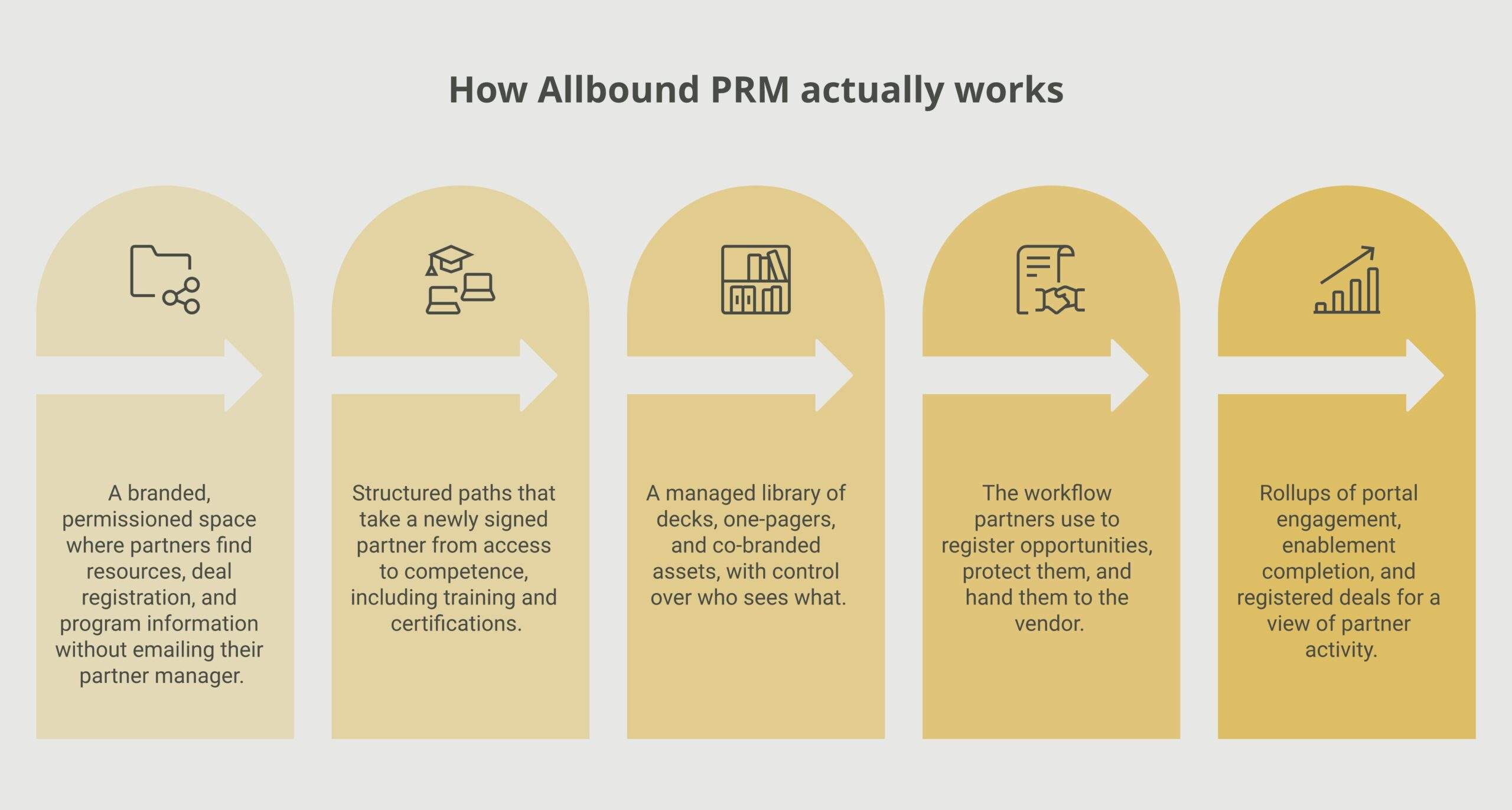
- Partner portal: A branded, permissioned space where partners find what they need, resources, deal registration, and program information, without emailing their partner manager. The portal is the front door, and its usefulness depends on whether partners actually log in and find something current when they do.
- Onboarding and enablement: Structured paths that take a newly signed partner from access to competence, including training, certifications, and the sequence a partner follows before they are ready to sell. Good onboarding shortens time to first deal; weak onboarding leaves signed partners idle.
- Content management: A managed library of decks, one-pagers, and co-branded assets, with control over who sees what. The value is in freshness and findability, a library of stale content is worse than no library because partners stop trusting it.
- Deal registration: The workflow partners use to register opportunities, protect them, and hand them to the vendor. This is the most revenue-adjacent piece of a PRM, and it is the piece that most needs to connect to CRM pipeline rather than sit in its own silo.
- Reporting and analytics: Rollups of portal engagement, enablement completion, and registered deals so the program has a view of partner activity. The honest question here is whether the reporting measures activity or measures pipeline, because those are not the same number.
Common pitfalls when evaluating Allbound PRM
- Buying a PRM to administer partners while never connecting it to CRM pipeline: The most common and most expensive mistake. A PRM administers partners; the revenue is tracked in the CRM. If deal registration and partner activity never flow into CRM pipeline, you have a tidy portal and no line of sight to what partners actually produced.
- Confusing portal engagement with production: Logins, content downloads, and certifications completed are activity metrics. They feel like progress and they correlate weakly with pipeline. Evaluate a PRM on whether it helps you see production, not just participation.
- Signing for features you will not staff: Full-suite PRM platforms do a lot. A program that cannot keep the content library current or the onboarding paths maintained will underuse most of what it paid for. Match the tool to the team you actually have.
- Skipping the integration questions: How deal registration syncs to the CRM, how attribution is handled, and how partner records reconcile with account records are the questions that determine whether the PRM earns its cost. Ask them during evaluation, not after signing.
- Treating a vendor’s category label as verified fact: Vendors describe themselves generously. Confirm capabilities and integrations against your own requirements and independent evaluation rather than the sales narrative.
Tools and examples
The table groups a representative set of platforms by their primary category so you can compare like with like. Full-suite PRM platforms cover portal, onboarding, content, and deal registration in one system; a partner-ecosystem or affiliate platform is a different category built around recruiting and paying a distributed partner or affiliate base.
| Tool | Primary category | Best for |
|---|---|---|
| Allbound | Full-suite PRM | Vendors wanting a portal, onboarding, content, and deal registration in one system |
| Impartner | Full-suite PRM | Larger programs wanting a broad, established PRM feature set |
| Introw | Full-suite PRM | Teams wanting a full-suite PRM with a modern, CRM-connected approach |
| Euler | Full-suite PRM | Teams wanting full-suite partner management with tight operational focus |
| PartnerStack | Partner-ecosystem / affiliate platform (part of AppDirect) | Programs recruiting and paying a distributed partner or affiliate base |
A worked example shows how the choice usually gets made. A mid-market software vendor was choosing between Allbound and Introw. Both are full-suite PRM platforms, so the portal, onboarding, content, and deal-registration checkboxes came out roughly even. The decision turned on one question: how cleanly registered deals and partner activity would land in their CRM, because the head of partnerships had been asked by the CRO to report partner-sourced pipeline, not portal logins. They ran both through the same test, registering a sample deal and tracing it into the CRM, and picked the platform that made that path shortest for their specific setup. The lesson was not that one PRM is better, it was that the deciding criterion was CRM connection, and that is the criterion most evaluations underweight.
Forecastable’s POV on Allbound PRM
Our position is straightforward. A PRM administers partners, and Allbound is a capable full-suite option for doing that. It gives you a portal, onboarding, content, and deal registration in one place, and for a program drowning in email and spreadsheets, that consolidation is real and worth paying for.
What a PRM does not do, on its own, is produce pipeline. A portal is a place partners can go; it is not a reason they sell. The program still has to connect partner conversations and actions to the revenue tracked in the CRM, and no PRM makes that connection automatically just because deals get registered inside it. The vendors that win with partners are the ones that measure the program by pipeline and revenue, not by portal engagement, and that measurement lives in the CRM.
Forecastable is a partnerships operating platform that connects partner conversations and actions to CRM pipeline and revenue, following the flow from conversations to actions to pipeline to revenue. We are a category authority on partner-led growth, not a PRM, and we do not compete with Allbound. A PRM administers your partners; we make it visible which partner actions actually produced pipeline, so the two are complementary. If you run a PRM well and still cannot answer what your partners produced, that gap is exactly the one we exist to close.
Vendor specifics, including capabilities, integrations, and pricing, change over time and should be verified against independent third-party evaluations and your own hands-on testing rather than any single vendor’s or commentator’s description.
Frequently asked questions
Is Allbound a full-suite PRM?
Yes. Allbound is a full-suite partner relationship management platform covering partner portal, onboarding and enablement, content management, and deal registration, with reporting on top.
What are the main Allbound alternatives?
The main full-suite PRM alternatives include Impartner, Introw, and Euler. PartnerStack is sometimes mentioned in the same breath but is a different category, a partner-ecosystem and affiliate platform that is part of AppDirect, better suited to recruiting and paying a distributed partner base than to full-suite partner administration.
How much does Allbound PRM cost?
Pricing is not published as a simple flat rate and depends on program size, partner counts, and the modules you enable, so treat any single number you see as unverified. Request a current quote scoped to your program and compare it against alternatives on the same scope rather than list price.
How is Allbound different from a CRM?
A CRM tracks accounts, opportunities, and revenue. A PRM like Allbound administers partners, the portal, onboarding, content, and deal registration. They are complementary, and the value comes from connecting the two so partner activity is visible as CRM pipeline.
Does Allbound produce partner pipeline by itself?
No. Allbound administers partners and captures registered deals. Pipeline comes from partners actually selling, and the program has to connect those partner actions to the CRM where revenue is tracked to prove what was produced.
Who is Allbound PRM best for?
Vendors that already have partners and need a system of record to administer them at scale, and that have the team to keep the portal, content, and onboarding current. It is less useful for programs that will not staff it or that have no partners to administer yet.
What should I evaluate first when comparing PRM platforms?
Start with how deal registration and partner activity flow into your CRM. The portal, content, and onboarding features tend to converge across full-suite PRM platforms; the CRM connection and the reporting that measures pipeline are where the real differences show up.
Next step
If you are evaluating Allbound PRM, run every candidate through the same test your CRO will eventually run on you: register a sample deal, trace it into the CRM, and see how quickly you can report partner-sourced pipeline rather than portal activity. Pick the platform that makes that path shortest, and staff the program to keep it running. Start your growth journey now to measure your partner program by pipeline, not logins. For the broader picture of how a PRM fits into partner-led growth, the PRM hub frames where partner administration ends and revenue measurement begins.
Uncover Your Growth Potential
Schedule a Discovery Call