Partner Marketing Agency: What They Do and When

What is a partner marketing agency?
Short answer: A partner marketing agency is an outside firm that plans and runs marketing through and with your partners, from co-branded campaigns to through-partner demand and MDF programs. It exists because most in-house partner teams have the relationships but not the marketing capacity to activate them at scale.
Think of it as marketing execution built for the partner channel rather than for your direct funnel. The work looks like normal demand generation, campaigns, content, events, and nurture, except the audience is your partners and their customers, and the goal is partner-sourced pipeline rather than direct leads.
A good agency does not replace your partner managers. It gives them a marketing engine so the partners they recruit and enable actually get campaigns run around them instead of sitting on a list.
Why a partner marketing agency matters in 2026
More revenue moves through partners every year, and marketing is usually the weakest link in the partner motion. Companies recruit partners, sign them, and enable them, then run no marketing around them, so the partnership never produces demand. A partner marketing agency exists to close that gap.
In 2026, the pressure is sharper because partner teams are lean and the channel is crowded. Your partners are being marketed to by a dozen other vendors, and the one that shows up with co-branded campaigns, ready-to-use content, and MDF gets the partner’s attention and their pipeline. Doing nothing is a choice to lose that attention.
The honest reason agencies get hired is capacity. A two-person partner team cannot build campaigns for forty partners, manage an MDF budget, produce enablement content, and still do the relationship work. An agency absorbs the execution so the internal team can stay on strategy and relationships.
How a partner marketing agency actually works
A partner marketing agency works by taking your partner roster and your goals and turning them into campaigns that run through partners, generate demand, and get measured. The good ones operate like a demand-generation team pointed at the channel, with a clear line from activity to partner-influenced pipeline. The components below are what a working engagement includes.
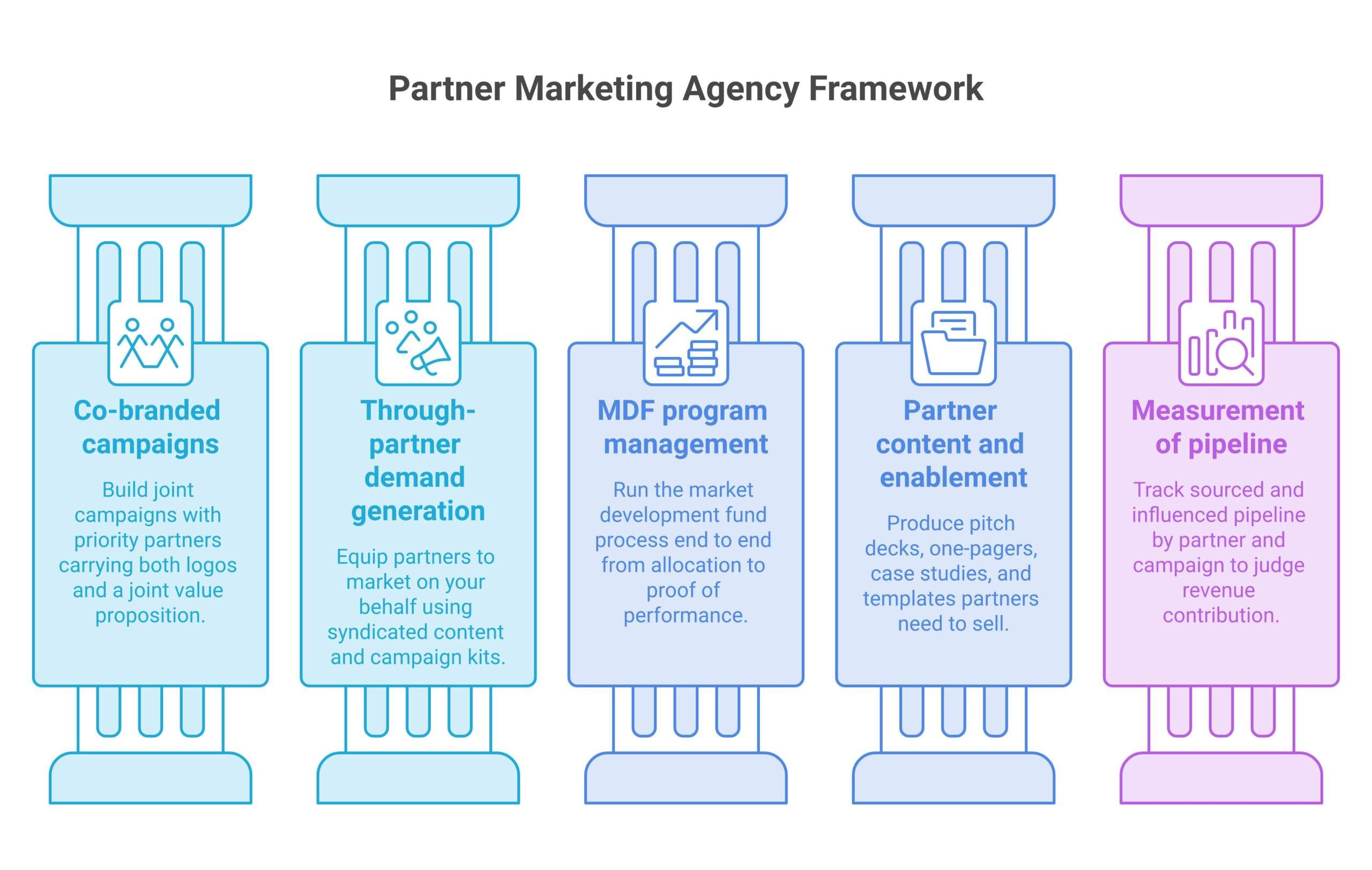
- Co-branded campaigns: Build joint campaigns with your priority partners, webinars, email, landing pages, and social, carrying both logos and a joint value proposition, so the partner has a reason to promote you to their audience.
- Through-partner demand generation: Equip partners to market on your behalf, syndicated content, co-branded assets, and campaign kits they can run to their own customer base, so demand is created through the partner rather than only alongside them.
- MDF program management: Run the market development fund process end to end, allocation, approvals, execution, and proof of performance, so the budget actually produces campaigns instead of sitting unspent or getting wasted on low-return spend.
- Partner content and enablement assets: Produce the pitch decks, one-pagers, case studies, and campaign templates partners need to sell and market you, so enablement is a real library and not a promise.
- Measurement of partner-influenced pipeline: Track what the campaigns produce, sourced and influenced pipeline by partner and by campaign, so the program is judged on revenue contribution rather than activity volume.
Common pitfalls when hiring a partner marketing agency
- Buying activity instead of pipeline: Hiring an agency to produce campaigns without agreeing on a pipeline goal gets you a lot of webinars and no way to know if any of it worked. Set the outcome first, then the activity.
- No measurement plan: If the agency cannot tie campaigns back to partner-sourced or partner-influenced pipeline in your CRM, you are buying motion you cannot evaluate. Agree on attribution before the first campaign runs.
- Treating MDF as a checkbox: An agency that just processes MDF paperwork is not managing a program. MDF should be allocated to the partners and campaigns most likely to produce, with proof of performance, not spread evenly to keep everyone happy.
- Generic co-marketing: Running the same webinar template with every partner ignores what each partner’s audience actually wants. The best co-marketing is specific to the partner’s customers, not a reused shell.
- Skipping the internal handoff: An agency that operates in a silo produces campaigns your partner managers never hear about and your sellers never follow up on. The engagement has to connect to the internal team and the CRM, or the leads leak.
What this looks like in practice
A mid-market software company had signed thirty partners and enabled them, but partner-sourced pipeline was flat because no one was running marketing around the roster. The internal partner team was two people, fully consumed by relationships and deal support, with no capacity to build campaigns. They brought in a partner marketing agency to run co-branded campaigns with the top ten partners, manage the MDF budget that had been sitting unspent, and produce a content library the whole roster could use. The agency also stood up a simple attribution model so every campaign tied back to partner-influenced pipeline in the CRM. Within two quarters, the top ten partners were each running at least one active co-branded campaign, MDF was fully allocated against campaigns with proof of performance, and partner-influenced pipeline was rising for the first time in a year. The unlock was not the campaigns themselves but the fact that someone finally had the capacity to run them and the discipline to measure them.
Forecastable’s POV on partner marketing agencies
Our position is that a partner marketing agency is worth hiring when you have partners but no marketing capacity, and a waste of money when you have neither the partners nor a way to measure what the marketing produces. The agency can create activity, co-branded campaigns, content, events, but the program still has to connect that activity to partner-sourced pipeline, or it is just spend. Buy the outcome, not the motion.
We also think the measurement problem is the one most companies get wrong. An agency will happily report on campaigns run, emails sent, and webinars held, and none of that tells you whether the channel produced revenue. The number that matters is partner-sourced and partner-influenced pipeline in your CRM, tied back to the specific campaigns and partners that generated it. If the engagement cannot produce that, you are flying blind no matter how much activity you see.
Forecastable is a partnerships operating platform focused on connecting partner conversations and actions to CRM pipeline and revenue, the flow from Conversations to Actions to Pipeline to Revenue. We do not run your co-marketing. We make it visible which partner campaigns and partners actually produce pipeline, so an agency engagement can be judged on revenue contribution rather than activity volume, and so your MDF goes to the partners the data says are producing.
Forecastable is a partnerships operating platform and a category authority, complementary to PRM administration and not a PRM vendor. Any agencies or tools referenced in this space are independent third-party providers, and mentioning them is not an endorsement. Evaluate any agency against your own partner mix, marketing capacity, and CRM attribution.
Frequently asked questions
What does a partner marketing agency do?
It plans and runs marketing through and with your partners, co-branded campaigns, through-partner demand generation, MDF program management, partner content, and measurement of partner-influenced pipeline, so your partner roster actually produces demand.
When should you hire a partner marketing agency vs build in-house?
Hire an agency when you have partners worth marketing around but not the internal capacity to run campaigns, manage MDF, and produce content. Build in-house when partner marketing is central enough to your model that you want the muscle permanently, and you have the headcount to staff it. Many companies use an agency to get the engine running, then bring it in-house once the volume justifies it.
How is partner marketing different from regular marketing?
Regular marketing targets your buyers directly. Partner marketing targets your partners and their customers, and the goal is partner-sourced pipeline rather than direct leads. The campaigns look similar, but the audience, the co-branding, the MDF mechanics, and the attribution model are all built around the channel rather than your direct funnel.
What is MDF and why does the agency manage it?
MDF, market development funds, is budget you give partners to run marketing on your behalf. An agency manages the allocation, approvals, execution, and proof of performance so the money produces campaigns and pipeline instead of sitting unspent or getting wasted.
How do you measure a partner marketing agency?
By partner-sourced and partner-influenced pipeline in your CRM, tied back to the specific campaigns and partners that produced it, not by the volume of campaigns, emails, or webinars. Agree on the attribution model before the first campaign runs.
How much does a partner marketing agency cost?
It varies widely by scope, from a retainer for a handful of co-branded campaigns to a full through-partner demand and MDF program. The more useful question is what pipeline the engagement is expected to produce, because that is what tells you whether the cost is justified.
Can a partner marketing agency replace my partner team?
No. An agency runs marketing execution, but your partner managers still own the relationships, recruitment, and deal work. The agency gives the internal team a marketing engine, it does not replace the people who manage the partners.
Next step
If you have partners but no marketing running around them, the gap is capacity, not strategy, and a partner marketing agency can close it, as long as you buy pipeline rather than activity. Agree on the pipeline goal, insist on CRM attribution before the first campaign, and point MDF at the partners the data says are producing. Start your growth journey now to measure partner marketing by pipeline, not activity. The partner program hub frames how partner marketing connects to recruitment, enablement, and co-selling.
Uncover Your Growth Potential
Schedule a Discovery Call