Partner Incentive Program: Design One That Produces

What is a partner incentive program?
Short answer: A partner incentive program is the set of rewards, tiers, and payout rules a vendor uses to pay partners for the behaviors that produce revenue. It works when it pays for the specific actions that lead to pipeline, and it fails when it pays for signings, logos, or activity that never reaches a deal. The design decides the outcome.
Most programs get this backwards. They reward the moment a partner joins or the volume a partner moves, then wonder why the incentive line item grows while partner-sourced pipeline stays flat.
An incentive program is not a loyalty perk. It is a behavior contract, and the behaviors you choose to pay for are the behaviors you will get.
Why a partner incentive program matters in 2026
A partner incentive program matters because it is the lever that moves partner behavior at scale, and in 2026 more revenue runs through partners than through any single direct motion. If the incentives point at the wrong actions, the whole roster optimizes for the wrong actions. You do not get to fix that later with enablement.
The cost of a badly designed program is not just the payout. It is the pipeline you never see because partners were paid to sign, register, or resell without ever being paid to source and progress deals. Money spent on the wrong behavior is worse than money not spent, because it teaches partners to do the wrong thing.
There is also a margin story. Every dollar of rebate, MDF, or SPIFF comes out of the deal, so an incentive program that does not tie payout to produced revenue is just erosion with a nicer name. The programs that win in 2026 are the ones that can show, in the CRM, that the incentive dollar bought pipeline.
How a partner incentive program actually works
A partner incentive program works as a chain: name the behavior you want, attach a reward to it, gate the reward behind tiers, define how and when it pays, and measure the result against the CRM. Each link has to hold or the money leaks. The components below are what a working program includes.
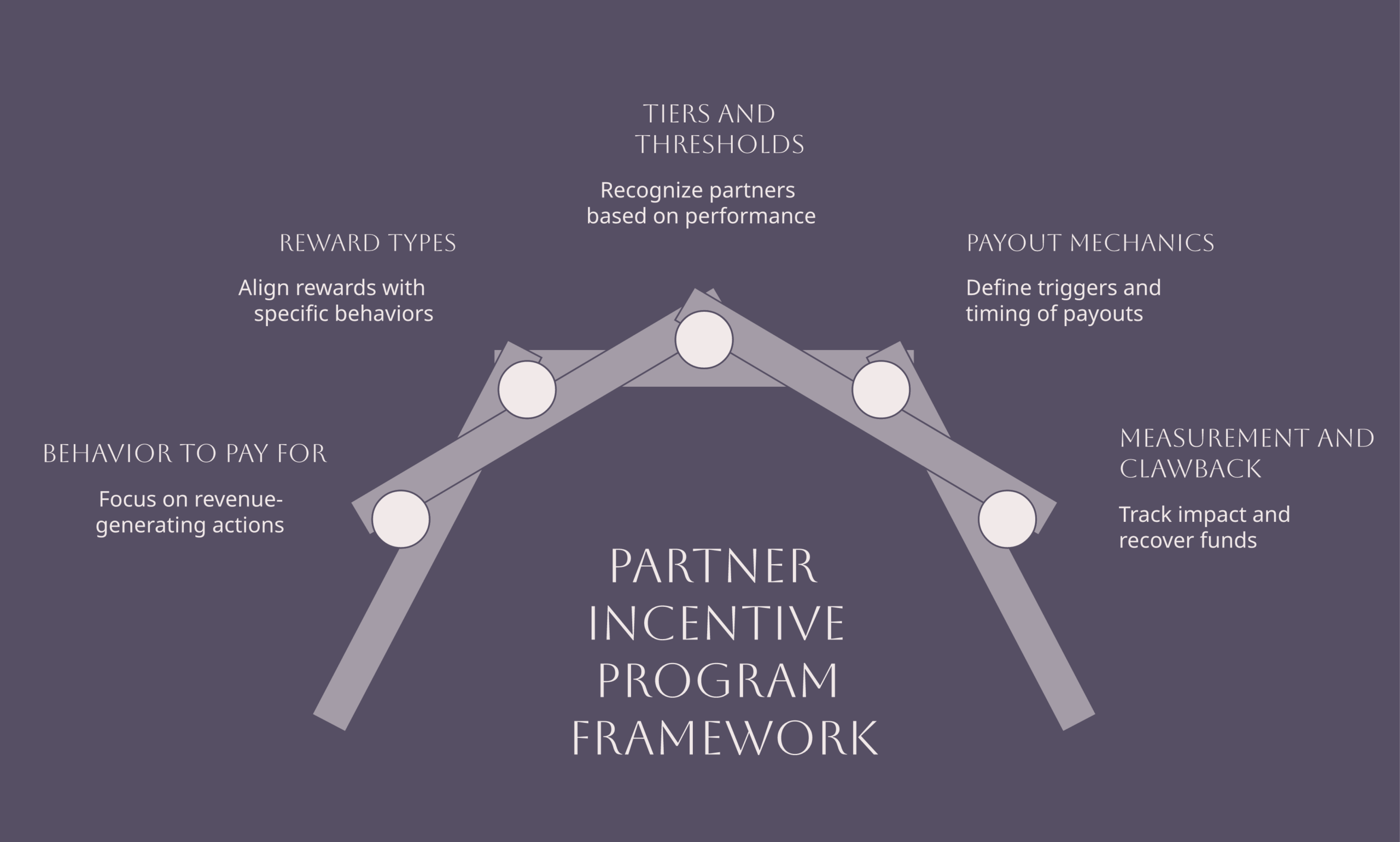
- The behavior you want to pay for: Decide the exact partner action that produces revenue, sourcing a qualified opportunity, progressing a co-sell deal, delivering an implementation that renews, then pay for that, not for signing or logo count. This is the single most important choice in the program, and most programs skip it.
- Reward types: Match the reward to the behavior. Rebates reward volume and margin against booked revenue, MDF funds demand generation, SPIFFs pay a fixed bonus for a specific short-term action, and margin or discount rewards the resale itself. Mixing these without intent is how programs pay twice for the same outcome.
- Tiers and thresholds: Set tiers that a partner reaches by producing, not by joining. A tier earned on sourced pipeline or closed revenue pulls behavior upward. A tier earned on headcount or certifications alone rewards presence, not production.
- Payout mechanics: Define what triggers a payout, when it pays, and against what record. Pay on closed and recognized revenue where you can, add clawback for deals that unwind, and make the mechanics simple enough that a partner can predict their own payout.
- Measurement and clawback: Instrument every incentive against the CRM so you can see which reward produced which pipeline, and claw back payouts on deals that fall out. A program you cannot measure is a program you cannot defend at budget time.
Common pitfalls in partner incentive programs
- Paying for signings, not sales: Rewarding the moment a partner registers or joins fills the roster with partners collecting on a signature and producing nothing. Pay for the deal, not the deal registration.
- Rewarding volume, not behavior: A rebate on raw volume pays partners for motion that may never convert, and it rewards your largest partners for what they were going to do anyway. Tie the reward to the behavior that actually moves a deal forward.
- Stacking rewards that pay twice: When a rebate, an MDF claim, and a SPIFF all fire on the same action, you pay three times for one outcome and cannot tell which reward did the work. Assign one reward per behavior and keep the map clean.
- No clawback: Paying out on bookings with no clawback means partners get paid on deals that unwind, and your incentive line drifts away from recognized revenue. Build clawback in from the start.
- Incentives measured on activity: Counting emails, portal logins, or certifications as the payout trigger produces a busy program and an empty forecast. Measure against the CRM, or you are measuring nothing that pays the bills.
What this looks like in practice
A software vendor ran a partner incentive program that paid a flat bonus on every new partner signing and a volume rebate on resale, and the incentive budget grew every quarter while partner-sourced pipeline sat flat. When they mapped payouts against the CRM, most of the money was going to partners who had signed, collected the bonus, and never sourced a deal, and the volume rebate was flowing to two large partners for business that would have closed regardless. They rebuilt the program around one behavior, a sourced and qualified opportunity that a rep could verify in the CRM, and moved the signing bonus into a tier a partner only reached after producing real pipeline. They added clawback on any deal that unwound within the quarter. Two quarters later the incentive budget was smaller, the payouts were concentrated on partners who actually sourced, and partner-sourced pipeline had roughly doubled off a program that cost less than the old one. The change was not more incentive money. It was paying for the right behavior and measuring it against the CRM.
Forecastable’s POV on partner incentive programs
Our position is that a partner incentive program should reward the specific partner behaviors that produce pipeline, measured against the CRM, not activity, signings, or logo count. Most programs pay for the wrong thing because the wrong thing is easier to count, a signature, a portal login, a certification, and the payout follows what is easy to measure rather than what produces revenue. Fix the measurement and the incentive design fixes itself.
We also think the reward has to be matched to the behavior, one reward per action, so you never pay twice for a single outcome and can always tell which incentive dollar bought which deal. A rebate, MDF, and a SPIFF do different jobs, and stacking them on the same action turns the program into erosion you cannot audit. Partner incentive programs earn their budget when every payout traces to a produced result. Research from Partnership Leaders found co-sell deals close 28% faster and run 13% larger, which is exactly the kind of produced outcome an incentive should be paying toward, not the signing that precedes it.
Forecastable is a partnerships operating platform that connects partner conversations and actions to CRM pipeline and revenue, following the flow from Conversations to Actions to Pipeline to Revenue. We do not administer your incentives or replace your PRM. We make it visible which partner behaviors and which incentives actually produce pipeline, so the program can be tuned against real outcomes instead of a hunch, and so a partner incentive program is measured by the revenue it produces rather than the payouts it processes.
Forecastable is a partnerships operating platform and a category authority, not a PRM vendor, and it is complementary to the PRM that administers your program. Any third-party tools or firms referenced in this space are independent third-party products, and mentioning them is not an endorsement. Evaluate any incentive design against your own partner mix, margins, and CRM.
Frequently asked questions
What is a partner incentive program?
The set of rewards, tiers, and payout rules a vendor uses to pay partners for the behaviors that produce revenue, designed so payouts follow sourced and closed deals rather than signings or activity.
What is the difference between a rebate and a SPIFF?
A rebate is a percentage returned against booked or recognized revenue, usually tied to volume or margin over a period. A SPIFF is a fixed, short-term bonus paid for a specific action, like sourcing a named opportunity. Rebates reward sustained production, SPIFFs push a targeted behavior now.
What behaviors should a partner incentive program reward?
The behaviors that produce revenue: sourcing a qualified opportunity, progressing a co-sell deal, and delivering implementations that renew. Reward the action that moves a deal, not the signing or the login.
How do you measure a partner incentive program?
Against the CRM. Trace every payout to the pipeline or revenue it produced, and use clawback for deals that unwind, so the incentive budget stays tied to recognized outcomes.
What is MDF in a partner incentive program?
Market development funds are money a vendor gives a partner to run demand generation, events, or campaigns. MDF funds activity that should create pipeline, so it works best when claims are tied to measurable results rather than spent as a standing entitlement.
Why do partner incentive programs leak money?
Because they pay for signings, volume, or activity that never reaches a deal, and they stack multiple rewards on one action without clawback. The money grows while pipeline stays flat.
How many tiers should a partner incentive program have?
As few as you need to pull behavior upward, with every tier earned on production, sourced pipeline or closed revenue, rather than on headcount or certifications. Fewer, production-based tiers beat many status-based ones.
Next step
If your incentive budget is growing but partner-sourced pipeline is not, the money is pointed at the wrong behaviors. Name the behavior that produces revenue, attach one reward to it, gate it behind production-based tiers, and measure every payout against the CRM. Start your growth journey now to measure your partner incentive program by the pipeline it produces, not the payouts it processes. The partner program hub frames how incentives connect to recruitment, onboarding, and co-selling.
Uncover Your Growth Potential
Schedule a Discovery Call