Skip to content
Logo — It’s All AboutThe Team
  • Home
  • Who We Serve
    • By Category
      • SaaS
      • Professional Services
      • Platforms (Large Ecosystems)
      • Private Equity
    • By Role
      • Chief Revenue Officers (CRO)
      • Chief Financial Officers (CFO)
      • Chief Marketing Officers (CMO)
      • Chief Executive Officers (CEO)
      • Sales Leaders
      • Partnership Professionals
  • Solutions
    • By Partner Program Maturity
      • Partnerships Foundation
      • Partnerships Acceleration
      • Ecosystem-Wide Orchestration
    • Specialized Solutions
      • Net-New Named Account Development
      • Large Ecosystems
      • M&A: Post-Acquisition Internal Cross-Selling
  • Education
  • Company
    • Our History
    • Security
  • Login
Logo — It’s All AboutThe Team
  • Home
  • Who We Serve
    • By Category
      • SaaS
      • Professional Services
      • Platforms (Large Ecosystems)
      • Private Equity
    • By Role
      • Chief Revenue Officers (CRO)
      • Chief Financial Officers (CFO)
      • Chief Marketing Officers (CMO)
      • Chief Executive Officers (CEO)
      • Sales Leaders
      • Partnership Professionals
  • Solutions
    • By Partner Program Maturity
      • Partnerships Foundation
      • Partnerships Acceleration
      • Ecosystem-Wide Orchestration
    • Specialized Solutions
      • Net-New Named Account Development
      • Large Ecosystems
      • M&A: Post-Acquisition Internal Cross-Selling
  • Education
  • Company
    • Our History
    • Security
  • Login
  • Home
  • Who We Serve
    • By Category
      • SaaS
      • Professional Services
      • Platforms (Large Ecosystems)
      • Private Equity
    • By Role
      • Chief Revenue Officers (CRO)
      • Chief Financial Officers (CFO)
      • Chief Marketing Officers (CMO)
      • Chief Executive Officers (CEO)
      • Sales Leaders
      • Partnership Professionals
  • Solutions
    • By Partner Program Maturity
      • Partnerships Foundation
      • Partnerships Acceleration
      • Ecosystem-Wide Orchestration
    • Specialized Solutions
      • Net-New Named Account Development
      • Large Ecosystems
      • M&A: Post-Acquisition Internal Cross-Selling
  • Education
  • Company
    • Our History
    • Security
  • Login
Back to all blogs
  • Partnerships Roles & Hiring
Alex Buckles

Deal Registration Form: What to Include (Template)

A partner account executive filling out a deal registration form on a laptop while a channel manager reviews the required fields on a printed template beside them, account name and close date visible, deep navy and warm amber palette

What is a deal registration form?

Short answer: A deal registration form is the structured submission a partner completes to claim an opportunity they sourced and request the vendor’s protection for it. It captures the facts the vendor needs to verify the deal, the account, contact, size, and timing, and it starts the clock on approval. A good form is short enough that partners actually fill it out and specific enough that the vendor can decide fairly.

The form is the first impression of your whole registration program. If it is long, confusing, or asks for things partners cannot know yet, they register less. If it is tight and clear, they register early and often.

Why the deal registration form matters in 2026

The deal registration form matters because it is the point where a partner decides whether registering is worth the effort. Every extra field, every ambiguous requirement, and every question the partner cannot answer at that stage is friction, and friction at the form is friction on your entire pipeline. The form is small, but it gates the behavior the whole program depends on.

In 2026, partners work with many vendors and have little patience for a registration process that feels like paperwork. A form that respects their time, asks only for what the vendor genuinely needs, and starts a visible clock on approval, signals a program that is run well. A bloated or unclear form signals the opposite and quietly trains partners to register only the deals they were going to lose. The form is where trust in the program is either earned or spent.

How a deal registration form actually works

A deal registration form works by collecting exactly the information the vendor needs to verify a claim and grant protection, no more, and by triggering a timed review the moment it is submitted. Each field earns its place by answering a question the vendor must answer to approve. The components below are what a well-designed form captures.
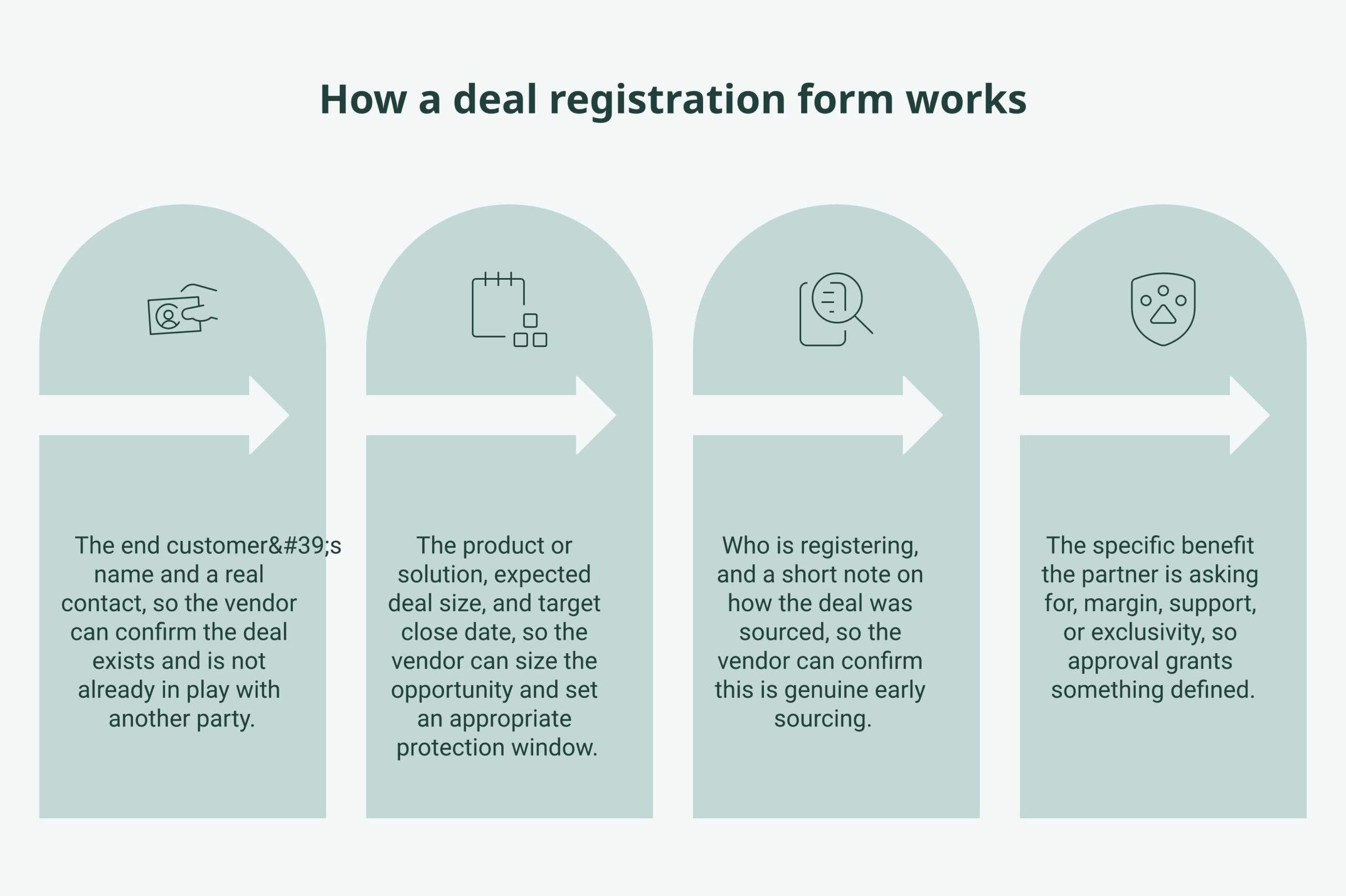
deal registration form framework diagram showing account and contact, opportunity detail, partner and sourcing, and protection request fields

  1. Account and contact: The end customer’s name and a real contact, so the vendor can confirm the deal exists and is not already in play with another party.
  2. Opportunity detail: The product or solution, expected deal size, and target close date, so the vendor can size the opportunity and set an appropriate protection window.
  3. Partner and sourcing: Who is registering, and a short note on how the deal was sourced, so the vendor can confirm this is genuine early sourcing rather than a claim on an obvious deal.
  4. Protection requested: The specific benefit the partner is asking for, margin, support, or exclusivity, so approval grants something defined rather than leaving the terms vague and disputable later.

A deal registration form template you can copy

Keep the form to these fields. Each line is a field and the question it answers for the reviewer.

  • Partner name and rep (who is claiming this deal).
  • End customer / account name (which deal, and is it already in play).
  • Primary contact at the account (is this real and specific).
  • Product or solution (what is being sold).
  • Expected deal size (how big, for sizing the protection).
  • Target close date (the timing, for setting the protection window).
  • How the deal was sourced (genuine early sourcing or an obvious deal).
  • Protection requested (margin, support, or exclusivity).
  • Date submitted (starts the approval clock).

Two rules make the template work: do not add fields the partner cannot answer at submission, and show the partner the response window and next step the moment they submit. Everything past nine or ten fields is friction you are charging against your own pipeline.

Common pitfalls in a deal registration form

  • Too many fields: A form that asks for a full forecast, a signed NDA, and a project plan at registration teaches partners not to bother. Ask only what approval genuinely requires.
  • Fields partners cannot know yet: Requiring detail that only exists later in the deal pushes registration late, which defeats the purpose of rewarding early sourcing.
  • No visible clock: A form that submits into silence gives the partner no reason to trust the process. Show the response window and next step at submission.
  • Vague protection request: If the form does not capture what protection is being requested, approval grants something undefined, and the dispute happens later when it is worst.
  • A form disconnected from the process: A form that is not tied to a timed review and a written decision is just a data-collection exercise, not a registration.

What this looks like in practice

A worked example: a vendor could not understand why partners registered so few deals until they looked at their own form. It had twenty-two fields, including a required competitive analysis and an expected services attach, things a partner rarely knows when a deal is early. Partners were skipping registration entirely and only filling out the form for deals already far along, which defeated the point. The vendor cut the form to nine fields, all answerable at the moment a partner first sees an opportunity, and added an automatic confirmation showing a two-business-day response window. Registrations rose sharply within weeks, and more importantly they arrived earlier in the deal, which is exactly the behavior the program was meant to reward. The lesson was that the form was not neutral. Its length was directly suppressing the pipeline the program depended on.

Forecastable’s POV on the deal registration form

Our position is that a deal registration form is a friction instrument, and every field is a small tax on the exact behavior you want more of. Programs tend to add fields over time because each one seems reasonable in isolation, and the cumulative weight quietly pushes registration later and rarer. The discipline is subtraction: keep only the fields approval truly needs, and treat any field a partner cannot answer early as a reason they will register late or not at all.

We also think the form should visibly start the clock, because the partner’s trust in the program forms at submission. A form that acknowledges the submission, states the response window, and names the next step converts a paperwork moment into a signal that the program is run well. That small feedback is worth more than any additional field you could add.

Forecastable is a partnerships operating platform focused on connecting partner conversations and actions to CRM pipeline and revenue. We do not host your form. We make the partner-sourced pipeline behind your registrations visible in the forecast, so the deals your form captures show up as measured revenue and you can see whether a heavier or lighter form changes how early partners register.

Forecastable is a partnerships operating platform and a category authority, not a PRM vendor. Any third-party tools or firms referenced in this space are independent third-party products, and mentioning them is not an endorsement. Evaluate any registration form against your own partner mix, motion, and CRM.

Frequently asked questions

What is a deal registration form?
The structured submission a partner completes to claim an opportunity they sourced and request the vendor’s protection, capturing the facts the vendor needs to verify and approve the deal.

What fields should a deal registration form include?
At minimum the account and contact, product, expected size, target close date, how the deal was sourced, and the protection requested, kept to roughly nine or ten fields.

How long should a deal registration form be?
Short enough that partners fill it out early, which in practice means only the fields approval genuinely requires and nothing a partner cannot know at that stage.

What happens after a partner submits the form?
The submission starts a timed review; the vendor confirms the deal, approves or declines within a stated window, and grants the defined protection on approval.

Why do partners avoid the deal registration form?
Usually because it is too long or asks for detail they do not have yet, so they register late or not at all, which suppresses exactly the pipeline the program wants.

Should the form capture the requested protection?
Yes. Capturing the specific protection requested means approval grants something defined, which prevents disputes later when the terms would otherwise be argued.

Next step

If partners register few deals or register them late, look at your form before you blame partner effort. Cut it to the fields approval truly needs, add a visible response clock, and use the template above as your baseline. Start your growth journey now to make the partner-sourced pipeline behind your registrations visible in the forecast. The partner program hub frames how the deal registration form connects to the wider registration process, co-selling, and attribution.

Uncover Your Growth Potential

Whether starting with a single sales team or a single partner, any co-sell motion can be live within 30 days.

Schedule a Discovery Call
Latest Insights
A partnerships leader interviewing a prospective channel partner across a conference table, an ideal partner profile scorecard and a shortlist of partner names visible on a printed sheet between them, deep navy and warm amber palette
  • Partnerships Roles & Hiring
Alex Buckles

Channel Partner Recruitment: A Practical Playbook

What is channel partner recruitment? Short answer: Channel partner recruitment is the process of finding, qualifying, and signing the partners who will actually sell, service, or implement your product. It is the front door of a partner program, and it decides more about the program’s results than any later stage, because you cannot enable or […]

Read Article
A channel manager and a partner reviewing deal registration best practices against an approval queue on a wall monitor, a printed program terms sheet with response times and protection rules visible on the table, deep navy and warm amber palette
  • Partnerships Roles & Hiring
Alex Buckles

Deal Registration Best Practices for 2026

What are deal registration best practices? Short answer: Deal registration best practices are the rules that make a registration program worth trusting: fast and transparent approvals, protections that are always honored, rewards for genuine early sourcing, and claims that expire when deals stall. They exist because a registration program does nothing unless partners believe the […]

Read Article
A partner enablement manager coaching two partner sellers through a live deal review at a shared screen, a partner scorecard and a first-deal checklist visible on the monitor, an open office in the background, deep navy and warm amber palette
  • Partnerships Roles & Hiring
Alex Buckles

What Is Partner Enablement? A Plain Answer

What is partner enablement? Short answer: Partner enablement is the work of getting a partner ready and able to sell, service, or implement your product, so a signed partner becomes a producing one. It covers the training, tools, messaging, and support a partner needs to win deals, plus the coaching that turns that knowledge into […]

Read Article
A partner operations lead walking a new partner through a partner onboarding process flow chart on a wall monitor, the stages and owners drawn as connected boxes, a printed onboarding checklist on the desk between them, deep navy and warm amber palette
  • Partnerships Roles & Hiring
Alex Buckles

Partner Onboarding Process Flow Chart (Template)

What is a partner onboarding process flow chart? Short answer: A partner onboarding process flow chart is a visual map of the stages, owners, and decision points that move a newly signed partner from contract to first deal. It turns onboarding from a set of scattered tasks into a sequence anyone can see, follow, and […]

Read Article
Logo — It’s All AboutThe Team

Quick Links

  • Who We Serve
  • Solutions
  • Resources
  • Pricing
  • Our History

Social Media

  • Linkedin

Legal

  • Privacy Policy
  • Terms of Service
Quick Links
  • Who We Serve
  • Solutions
  • Resources
  • Pricing
  • Our History
Social Media
  • Linkedin
Legal
  • Privacy Policy
  • Terms of Service

Stay ahead on ecosystem-led growth

Logo — It’s All AboutThe Team
© 2025 Forecastable. All rights reserved.
Book Your Strategy Call
Request Enrollment Details

[contact-form-7 id=”dfbeed3″ title=”Request Enrollment Details”]

Mollie Bodensteiner

Revops Advisory
  Mollie Bodensteiner is an experienced operations professional with a demonstrated track record of utilizing technology to support operational processes that drive performance and innovation. She currently is the Vice President of Operations at Sound and owns go-to-market agency, MB Solutions. Mollie has previously held operations leadership roles at Deel, Syncari, Corteva and Marketo. She has over 14 years of experience in both B2C and B2B operations and technology. When she is not working, Mollie enjoys spending time with her husband, three small children, and two large dogs. Childhood Career/Dream: Growing up in the age of Disney and Nick@Nite I always wanted to be a child actor (good thing that never was actually pursued 🙂 Favorite Win: I am not sure I have a specific “win” but I think I get the most joy and excitement from coaching others and watching them hit major milestones in their career. The first time you get to promote someone on your team or watch them lead a major project – are always career highlights! Personal Fun Facts: Favorite Song: If it’s love, Train Favorite Movie: Good Will Hunting Favorite Meme: Disaster Girl
Forecastable resources: Co-Sell Orchestration Platform · All Use Cases · Live in 30 Days · Co-Sell Playbook

Kelsey Buckles

Director of Operations


My journey from Education to Operations has equipped me with a unique perspective and skill set that perfectly aligns with Forecastable’s mission to help businesses improve sales collaboration through partner co-selling strategies.

At Forecastable, I am passionate about empowering teams and organizations to unlock the full potential of strategic partnerships. By leveraging my expertise in communication, leadership, and operational efficiency, I contribute to creating seamless co-selling processes that align with business goals and deliver exceptional results.

The intersection of my educational foundation and operational experience fuels my dedication to fostering alignment, building trust, and enhancing collaboration between partners. I am driven by the opportunity to contribute to a platform that not only optimizes sales strategies but also strengthens relationships that lead to long-term growth.

Paul Jonhson

Chief Technology Officer (Co-founder)


Paul Johnson has 20+ years of software development and consulting experience for a variety of organizations, ranging from startups to large-enterprise organization with highly-complex needs.

Mr. Johnson has a long track record of successful technology deployments.
This, combined with his deep passion for machine learning and exceptional user experience design, allows him to lead our technical direction from the front with confidence.

Alex Buckles

Product, Partnerships, and Value Engineering (Co-founder)


After serving in The United States Marine Corps, Alex Buckles spent the next two decades as a student of revenue production and an advocate for innovation.

Along the way, he has helped numerous companies achieve double and triple-digit growth by crafting and executing high-performing go-to-market strategies, with co-selling at the center of each.

As a once-advanced technical marketer, an expert sales & partner professional, and a strong customer success advocate, Mr. Buckles understands the impact of these functions aligning not only on revenue production, but on the day-to-day execution of the go-to-market strategy. This concept of revenue-team alignment is what quickly became the foundation of Forecastable back in January of 2018.

In his free time, you’ll find him spending quality time with his children, one of whom is on the autism spectrum. 1 in 36 children in the U.S. are on the spectrum and boys are four times more likely to be diagnosed than girls.

With that in mind, Mr. Buckles plans on dedicating the rest of his life serving those living with autism, through his organization Pathways for Autism. From his perspective, there must be a scalable and financially self-sustaining infrastructure established to put as many individuals with autism as possible on a path towards complete independence as adults.