Channel Partner Recruitment: A Practical Playbook

What is channel partner recruitment?
Short answer: Channel partner recruitment is the process of finding, qualifying, and signing the partners who will actually sell, service, or implement your product. It is the front door of a partner program, and it decides more about the program’s results than any later stage, because you cannot enable or co-sell your way out of a roster of partners who were never a fit. Recruit the wrong partners and every downstream effort compounds the mistake.
The discipline is less about volume than about selection. A program with twenty partners who produce beats one with two hundred who signed and went quiet.
Why channel partner recruitment matters in 2026
Channel partner recruitment matters because the partners you sign set the ceiling on what the program can produce. A partner with no reach into your buyers, no motivation to sell you, or no capacity to service the deal will not become productive no matter how good your enablement is. Recruitment is where you either build a producing roster or a vanity one.
In 2026, more revenue moves through partners, and the cost of a bloated, unproductive roster is higher than it used to be. Every signed partner consumes onboarding, enablement, and management attention whether they produce or not. A program that recruits carefully spends its finite attention on partners who move revenue. A program that recruits by logo count spreads that attention thin across partners who never will. The difference shows up as pipeline, and it starts at recruitment.
There is also a reputational cost to over-recruiting. Partners talk to each other, and a program known for signing anyone and supporting no one struggles to attract the partners it actually wants. Selective recruitment is part of how you earn the good partners.
How channel partner recruitment actually works
Channel partner recruitment works as a qualified pipeline, run like a sales process: define the partner you want, source candidates against that definition, qualify for fit and motivation, and make a specific case for why partnering pays. Each step filters, so the partners who reach a signature are the ones worth enabling. The components below are what a working recruitment motion includes.
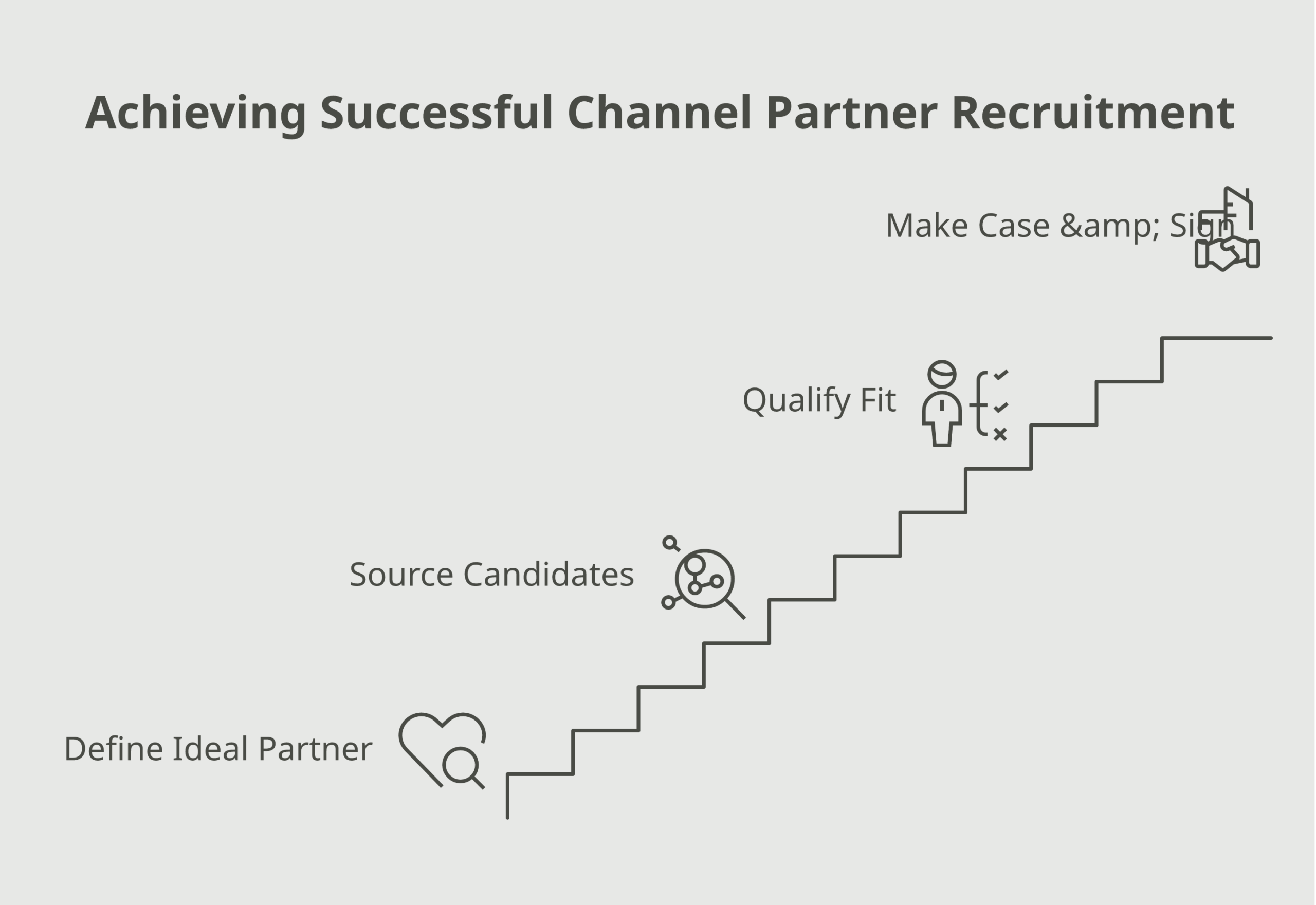
- Define the ideal partner: Write down the partner profile, reach into your buyers, complementary offering, capacity to sell or service, and a real reason to want you, so recruitment has a standard rather than a gut feel. Without this, every candidate looks plausible.
- Source against the definition: Find candidates through existing customer relationships, competitor and adjacent ecosystems, events, and referrals from current partners, aimed at the profile rather than whoever is available.
- Qualify for fit and motivation: Treat recruitment like discovery. Confirm the partner reaches your buyers, has capacity, and has a reason to sell you now, not someday. A partner who is interested but not motivated is a slow no.
- Make the case and sign: Show the specific partner why partnering pays, the economics, the support, the pipeline they can expect, and set a clear first goal so the relationship starts with a shared expectation instead of a vague hope.
Common pitfalls in channel partner recruitment
- Recruiting by logo count: Signing partners to hit a roster number fills the program with names that never produce and drains the attention that should go to real ones.
- No ideal partner definition: Without a written profile, recruitment defaults to whoever is willing, which is rarely who you want. Define first, then source.
- Skipping qualification: Treating a signature as the goal rather than fit and motivation produces a roster that looks healthy and produces nothing.
- A generic pitch: Telling every candidate the same story about your program ignores what this specific partner would gain. The case has to be theirs, not yours.
- No first goal at signing: A partnership that starts without a shared expectation drifts, and the partner quietly joins the ranks of the signed-and-silent.
What this looks like in practice
A worked example: a vendor had signed over a hundred partners in eighteen months and celebrated the roster in every board deck, yet partner-sourced pipeline was flat. When they looked closely, most of the roster had been recruited on availability, not fit, partners who were willing to sign but had no reach into the vendor’s buyers and no real reason to sell. The vendor stopped recruiting by count and wrote an ideal partner profile: reach into two specific buyer segments, a complementary services offering, and a stated motivation. They re-ran sourcing against that profile and qualified candidates like sales opportunities, confirming reach, capacity, and motivation before any signature. New signings dropped sharply in number and rose sharply in quality. Within two quarters, a much smaller set of newly recruited partners was producing more pipeline than the prior hundred combined. The lesson was that recruitment is a filter, and a program is only as good as what it lets through.
Forecastable’s POV on channel partner recruitment
Our position is that channel partner recruitment is a selection problem disguised as a growth activity, and the programs that treat it as growth, more logos, bigger roster, keep paying for that mistake at every later stage. The right instinct is closer to hiring than to marketing: define the profile, qualify hard, and be willing to say no. A smaller producing roster beats a large silent one on every measure that matters.
We also think recruitment should be judged by what the recruited partners eventually produce, not by how many signed. A recruitment motion that fills the roster but not the forecast is not working, however good the signing numbers look. That means tracking recruited partners forward into production and using what you learn to sharpen the profile, so each cohort of new partners is better selected than the last.
Forecastable is a partnerships operating platform focused on connecting partner conversations and actions to CRM pipeline and revenue. We do not source your partners. We make it visible which recruited partners actually produce pipeline, so the recruitment profile can be refined against real outcomes rather than a hunch, and so the roster is measured by production, not headcount.
Forecastable is a partnerships operating platform and a category authority, not a PRM vendor. Any third-party tools or firms referenced in this space are independent third-party products, and mentioning them is not an endorsement. Evaluate any recruitment approach against your own partner mix, motion, and CRM.
Frequently asked questions
What is channel partner recruitment?
The process of finding, qualifying, and signing the partners who will actually sell, service, or implement your product, run as a selective pipeline rather than a headcount drive.
How do you find channel partners to recruit?
Through existing customer relationships, adjacent and competitor ecosystems, events, and referrals from current partners, sourced against a written ideal partner profile.
How do you qualify a channel partner?
Confirm reach into your buyers, capacity to sell or service, and a real reason to sell you now, treating recruitment like sales discovery rather than order taking.
How many partners should you recruit?
As many as you can genuinely enable and support, which for most programs means fewer and better rather than more. A producing roster beats a large silent one.
What is an ideal partner profile?
A written definition of the partner you want, reach, complementary offering, capacity, and motivation, used as the standard for sourcing and qualifying candidates.
Why do recruited partners never sell?
Usually because they were recruited on availability rather than fit and motivation, and no amount of later enablement fixes a partner who was never a match.
Next step
If your roster is growing but your pipeline is not, the problem is upstream in recruitment, not downstream in enablement. Write an ideal partner profile, qualify like it is a sales cycle, and track recruited partners forward into production. Start your growth journey now to measure your roster by pipeline, not headcount. The partner program hub frames how channel partner recruitment connects to onboarding, enablement, and co-selling.
Uncover Your Growth Potential
Schedule a Discovery Call