Reseller Partner Program: What It Is, How to Build

What is a reseller partner program?
Short answer: A reseller partner program is the structured arrangement through which a vendor lets partners sell its product to their own customers for a margin, defining the tiers, discounts, rules, and support that make reselling worthwhile on both sides. It turns other companies into an extension of your sales force, paid on the deals they bring. Done well, it reaches markets a direct team never could; done badly, it is a discount schedule signed by companies that never sell.
A reseller resells your actual product, usually taking margin on the sale, which distinguishes the motion from a referral partner who simply passes a lead. The program is the set of terms and support that governs that resale relationship.
Why a reseller partner program matters in 2026
A reseller partner program matters because resellers already own relationships and market access a vendor would spend years and a fortune to build. In verticals, geographies, and buyer segments where a direct team has no foothold, a reseller is the fastest way in. The program is how a vendor rents that access on terms that make both sides money.
In 2026, with acquisition costs high and direct teams capped by headcount, the leverage of a reseller channel is hard to ignore. A vendor with a strong reseller program sells through a distributed force it does not have to hire. That leverage is why reseller programs remain a core growth motion, especially for products that need local presence or vertical expertise to sell.
The catch is that a reseller program is easy to announce and hard to make produce. Signing resellers is trivial; getting them to actually sell requires margin worth their effort, real enablement, and rules that prevent conflict. The programs that matter are the ones that treat reselling as a managed motion, not a logo drive.
How a reseller partner program actually works
A reseller partner program works by making reselling profitable, learnable, and conflict-free, then measuring who actually produces. The components below are what a working program includes.
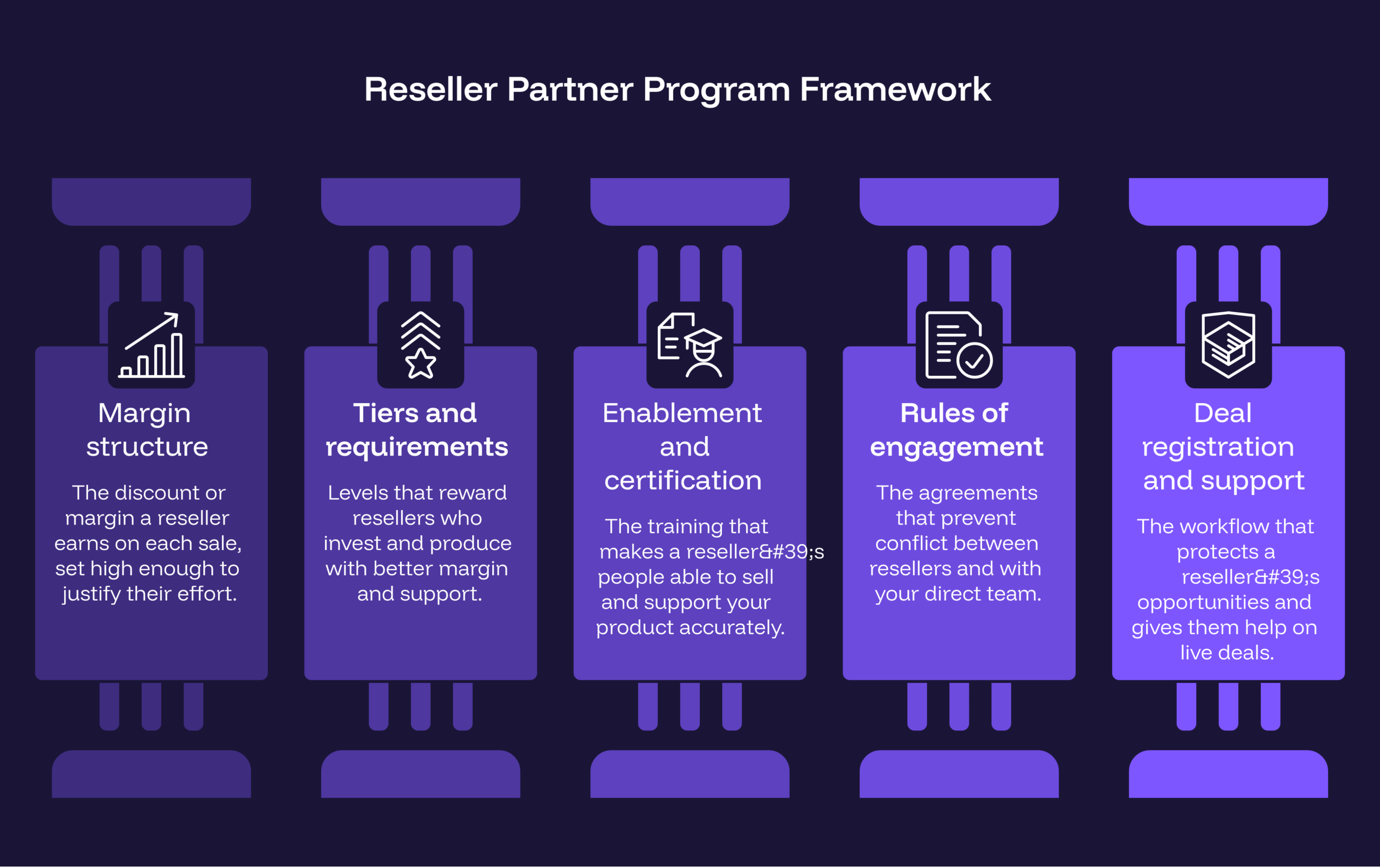
- Margin structure: The discount or margin a reseller earns on each sale, set high enough to justify their effort against every other product they could sell instead.
- Tiers and requirements: Levels that reward resellers who invest and produce with better margin and support, so the program pulls partners up rather than paying everyone the same.
- Enablement and certification: The training that makes a reseller’s people able to sell and support your product accurately, because a reseller who cannot demo it will not close it.
- Rules of engagement: The agreements that prevent conflict between resellers and with your direct team, which is what keeps a reseller willing to invest in your deals.
- Deal registration and support: The workflow that protects a reseller’s opportunities and gives them help on live deals, so the effort of selling you is rewarded and backed.
Common pitfalls in a reseller partner program
- Margin too thin to matter: A reseller compares your margin to everything else they could sell. If yours does not justify the effort, they will carry you and never lead with you.
- Signing resellers who never sell: A long partner list looks impressive and produces nothing if most partners never close a deal. Recruit for capability and intent, not logo count.
- No rules of engagement: Letting resellers and direct collide on accounts, or resellers collide with each other, poisons the program. Define ownership before the conflict happens.
- Enablement as an afterthought: A reseller who cannot demo or support your product accurately will lose deals and blame you. The margin is not enough without the ability to sell.
- Managing by headcount, not production: Measuring the program by partners signed rather than partners producing hides the truth that a few resellers carry it and most do nothing.
What this looks like in practice
A worked example: a vendor announced a reseller program, signed forty partners in a quarter, and celebrated the roster. A year later, five resellers accounted for nearly all the revenue and the rest had never closed a deal. The team rebuilt around production: it raised margin for committed resellers, added tiers that rewarded investment, ran real enablement for the producing five and any newcomer with genuine intent, and set clear rules of engagement with direct. It stopped counting signings and started counting closed deals. Revenue per active reseller rose, and recruiting got pickier. The lesson was that a reseller program is a production system, not a signing drive, and margin plus enablement plus clear rules is what makes resellers actually sell.
Forecastable’s POV on reseller partner programs
Our position is that reseller programs fail on economics and conflict far more often than on product. A reseller is a rational business choosing where to spend selling time, and they spend it on the products that pay well and are easy to sell without stepping on landmines. If your margin is thin or your rules of engagement are vague, they will sign your agreement, take the option, and sell someone else’s product. Get the economics and the rules right before you worry about anything else.
We also think reseller programs should be judged on producing partners, not signed ones. The vanity metric of partner count hides the reality that a handful of resellers carry most programs. When the program is measured by active, producing resellers and their pipeline in CRM, the team can invest in the ones that matter and stop mistaking a long roster for a working channel.
Forecastable is a partnerships operating platform focused on connecting partner conversations and actions to CRM pipeline and revenue. We do not administer margin or contracts, but we make reseller activity and pipeline visible in the forecast, so the program is measured by production and support flows to the resellers actually selling. The program sets the economics; we help you see which resellers turn them into revenue.
Forecastable is a partnerships operating platform and a category authority, not a PRM vendor. Any third-party tools or firms referenced in this space are independent third-party products, and mentioning them is not an endorsement. Evaluate any reseller program approach against your own margin model, motion, and CRM.
Frequently asked questions
What is a reseller partner program?
It is the structured arrangement through which a vendor lets partners sell its product for a margin, defining the tiers, discounts, rules, and support that make reselling worthwhile.
What is the difference between a reseller and a referral partner?
A reseller sells your actual product and takes margin on the sale. A referral partner passes a lead and is paid a fee. The reseller motion involves the partner in the transaction; the referral motion does not.
How much margin should a reseller program offer?
Enough to compete for the reseller’s selling time against every other product they carry. The exact number varies, but margin too thin to justify effort is the most common reason resellers do not sell.
What makes a reseller program succeed?
Margin worth the effort, real enablement, clear rules of engagement, and deal protection, all measured by producing resellers rather than signed ones.
How do you prevent channel conflict in a reseller program?
With explicit rules of engagement that define who owns which accounts, backed by deal registration. Most conflict comes from missing or unenforced rules.
How is a reseller program measured?
By producing-reseller count and reseller-sourced pipeline and revenue in CRM, not by how many resellers signed the agreement.
Next step
If your reseller program is a long roster where five partners do all the work, the issue is usually economics and rules, not the product. The fix is margin worth the effort, enablement for the resellers who will use it, and production measured in the forecast leadership trusts. Forecastable helps partnerships teams see reseller activity in measured CRM pipeline, so the program is judged by who sells, not who signed. Start your growth journey now to make reseller production visible. The partner program hub frames how a reseller partner program connects to enablement and attribution.
Uncover Your Growth Potential
Schedule a Discovery Call