Channel Marketing Software: What It Is, How to Pick

What is channel marketing software?
Short answer: Channel marketing software is the set of tools a vendor uses to run marketing through its partners at scale, covering co-branded campaigns, asset distribution, market development funds, and lead tracking. It lets one marketing team equip hundreds of partners to market locally without building each campaign by hand. Think of it as the marketing counterpart to a partner portal that mostly handles sales.
The category is often labeled through-channel marketing automation, or TCMA, and it overlaps with partner relationship management. Its focus is the marketing motion specifically, meaning campaigns, content, and funds rather than deal registration and pipeline.
Why channel marketing software matters in 2026
Channel marketing software matters because partners rarely have the time, skill, or budget to market a vendor’s product well, and a vendor cannot run local marketing for every partner by hand. The software closes that gap by packaging campaigns partners can launch in a few clicks. Without it, most partner marketing is a shared folder of logos that nobody uses.
In 2026, with buyers starting from trusted local sources and marketing teams stretched thin, the ability to activate partners as a marketing channel is a real growth lever. A vendor whose partners actually run campaigns reaches audiences the vendor’s own team never could. That reach is why channel marketing spend keeps holding even as other line items get trimmed.
The other driver is accountability for market development funds. When a vendor hands partners money to market, leadership wants to know what it produced. Channel marketing software is how MDF requests, spending, and resulting leads get tracked instead of disappearing into unaccountable co-op budgets.
How channel marketing software actually works
Channel marketing software works by turning a vendor’s marketing into something a partner can run without marketing skill. The components below are what a working platform provides.
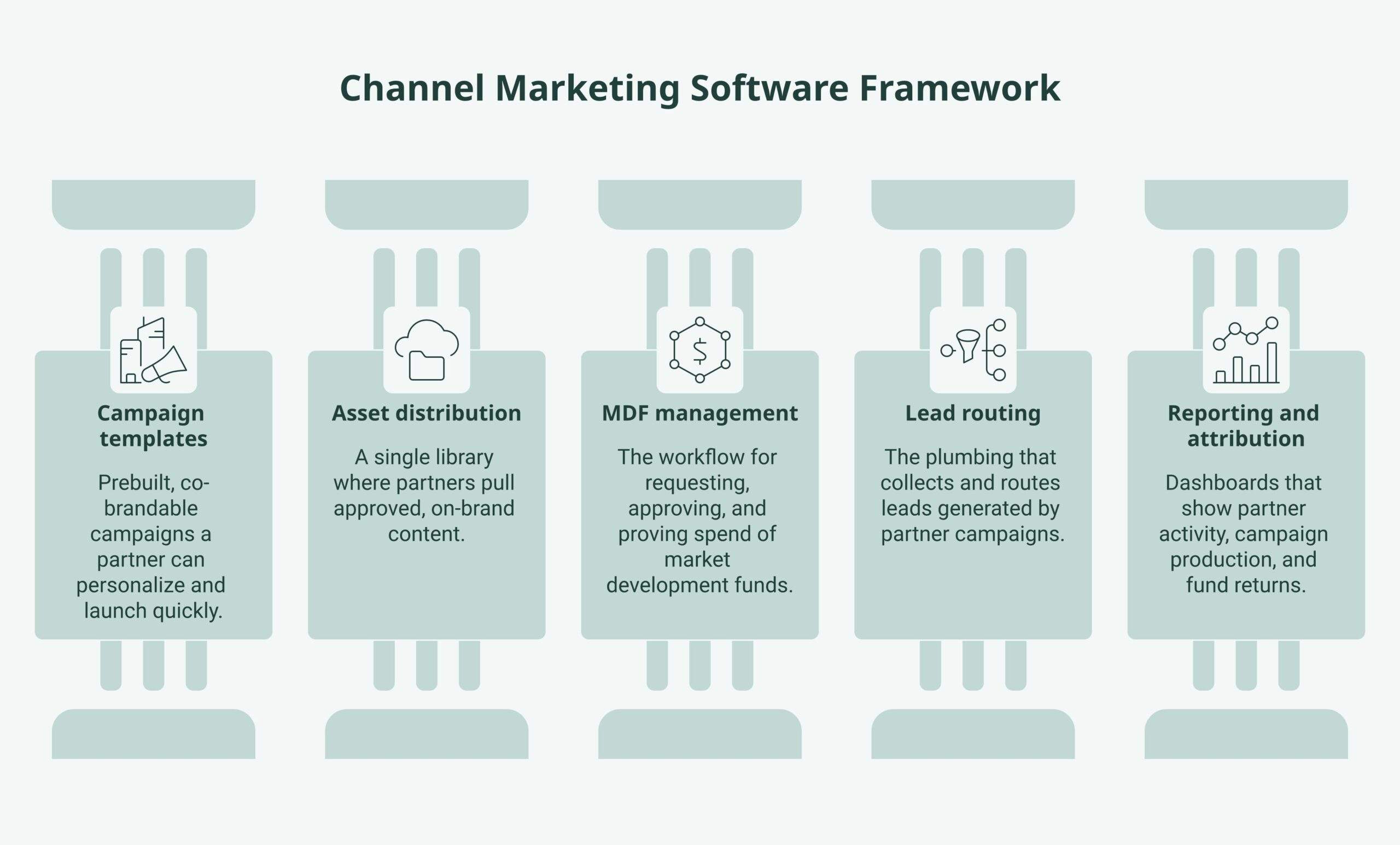
- Campaign templates: Prebuilt, co-brandable campaigns a partner can personalize and launch quickly, so partners market without building anything from scratch.
- Asset distribution: A single library where partners pull approved, on-brand content, so the vendor controls the message while partners get what they need.
- Market development funds management: The workflow for requesting, approving, and proving spend of MDF, so co-marketing money is accountable rather than a black hole.
- Lead capture and routing: The plumbing that collects leads a partner campaign generates and routes them to the right partner or the vendor, so marketing effort produces trackable pipeline.
- Reporting and attribution: Dashboards that show which partners market, which campaigns produce, and what the funds returned, so investment follows evidence.
Common pitfalls in channel marketing software
- Buying software before partners will market: If partners have no appetite or incentive to run campaigns, a platform sits empty. Demand for the tool has to exist before the license does.
- A content library nobody opens: Loading assets without co-brandable, launch-ready campaigns leaves partners staring at files they will not use. The value is in packaged campaigns, not a folder.
- MDF with no proof of performance: Handing out funds without tracking spend and results turns market development money into an entitlement. The accountability loop is the point.
- Leads that vanish: A campaign that generates interest but has no routing back to a partner or CRM wastes the effort and sours the partner on the next one.
- Confusing marketing software with sales software: Channel marketing software runs campaigns and funds; it does not manage deal registration or pipeline. Expecting one tool to do both leads to a poor fit on both sides.
Tools and examples
Channel marketing software spans a few groups, and the table below maps categories rather than ranking vendors. Fit depends on how many partners you market through, how much co-branding you need, and whether you want marketing and sales in one platform.
| Category | What it does | Example providers |
|---|---|---|
| Full-suite PRM with marketing modules | Partner marketing, enablement, deal registration, and reporting in one platform | Introw, Euler, Impartner, Allbound, ZINFI |
| Through-channel marketing automation (TCMA) | Co-branded campaigns, asset distribution, and MDF built specifically for partner marketing | Mindmatrix, Channext, and adjacent TCMA tools |
| Ecosystem and overlap data | Finds shared accounts so co-marketing targets the partners and segments most likely to convert | Crossbeam, Pocus, Common Room |
A worked example: a vendor gave partners a shared drive of logos and one-pagers and wondered why partner-driven marketing produced nothing. It moved to a platform with co-brandable campaign templates, an MDF workflow, and lead routing wired to its CRM. Instead of asking partners to build campaigns, it gave them three they could launch in a few clicks, funded the spend through tracked MDF, and routed the resulting leads back with attribution. Within two quarters a third of active partners had run at least one campaign, and the marketing team could finally say what the channel produced. The software did not create partner demand; it made the marketing partners were willing to do actually runnable and measurable.
Forecastable’s POV on channel marketing software
Our position is that channel marketing software is a distribution tool, not a demand generator. It makes a vendor’s marketing runnable by partners at scale, which is genuinely valuable, but it does not make partners want to market. A vendor that buys a TCMA platform expecting it to create partner enthusiasm will own a well-built system that partners ignore. The incentive and the relationship come first; the software amplifies them.
We also think the lead and attribution loop is the line that separates useful channel marketing software from expensive brochure-ware. Campaigns and MDF only matter if the leads they produce are tracked back to a partner and into the forecast the company runs on. Marketing spend the business cannot connect to pipeline is spend that gets cut, and channel marketing money is an easy target when nobody can prove its return.
Forecastable is a partnerships operating platform focused on connecting partner conversations and actions to CRM pipeline and revenue. We sit alongside channel marketing software rather than replacing it: the marketing platform runs campaigns and funds, and we make the partner activity and pipeline it generates visible and measured in the forecast leadership plans around. The software distributes the marketing; we make its output something you can prove.
Forecastable is a partnerships operating platform and a category authority, not a PRM vendor. Any third-party tools named here are independent third-party products, and naming them is not an endorsement of one over another. Evaluate channel marketing software against your own partner count, co-branding needs, and CRM.
Frequently asked questions
What is channel marketing software?
It is the set of tools a vendor uses to run marketing through partners at scale, covering co-branded campaigns, asset distribution, market development funds, and lead tracking.
Is channel marketing software the same as TCMA?
Largely, yes. Through-channel marketing automation is the industry term for the campaign and asset side of channel marketing software; many platforms bundle it with MDF and lead routing.
How is channel marketing software different from PRM?
PRM covers the whole partner program including sales and enablement. Channel marketing software focuses on the marketing motion of campaigns, content, and funds. Full-suite platforms such as Introw, Euler, Impartner, Allbound, and ZINFI often include both.
What should channel marketing software include at a minimum?
Co-brandable campaign templates, an asset library, MDF management, and lead capture with routing to CRM. Reporting on partner marketing activity is what makes it accountable.
Does channel marketing software generate demand on its own?
No. It makes a vendor’s marketing runnable by partners, but partners still have to want to market. The software amplifies incentive and relationship rather than replacing them.
How does MDF fit into channel marketing software?
The software runs the request, approval, spend, and proof workflow for market development funds, which turns co-marketing money into something the vendor can track and hold partners accountable for.
Next step
If your partner marketing is a shared folder of logos nobody opens, the problem is not partner laziness, it is that marketing was never made runnable or accountable. The fix is software that packages campaigns partners can launch and routes the resulting leads into the forecast leadership watches. Forecastable helps partnerships teams connect partner marketing activity to measured CRM pipeline, so the channel you fund is a channel you can prove. Start your growth journey now to make partner marketing something you can measure. The partner program hub frames how channel marketing software fits alongside enablement and attribution.
Uncover Your Growth Potential
Schedule a Discovery Call