Channel Partner Marketing: What It Is and How It Works

What is channel partner marketing?
Short answer: Channel partner marketing is the practice of generating demand through a vendor’s channel partners, meaning resellers, distributors, and solution providers, rather than only through the vendor’s direct marketing. It equips those partners to market the vendor’s product to their own customers and prospects, and it measures the pipeline that motion returns. Done well, it turns a partner roster into a distributed demand engine.
The term narrows partner marketing to the channel, meaning the partners who resell or deliver a product. It emphasizes the reseller and solution-provider relationships that carry a vendor into markets a direct team would struggle to reach alone.
Why channel partner marketing matters in 2026
Channel partner marketing matters because a vendor’s channel partners already own relationships in the accounts the vendor wants, and marketing through them is faster than earning those relationships cold. A reseller has trust with a customer base built over years. A campaign that runs through that reseller reaches those buyers with credibility a vendor’s own outreach cannot buy.
In 2026, with budgets tight and buyers skeptical of vendor marketing, that borrowed credibility is where the channel earns its keep. A direct campaign competes for attention in a crowded inbox; a campaign a trusted partner sends lands differently. Channel partner marketing is how a vendor turns its partners’ relationships into reach, and it is why the vendors who invest in it out-market rivals who rely on direct demand alone.
There is also a scale argument. A vendor’s marketing team is finite, but a network of marketing-active channel partners multiplies the number of campaigns in market. The constraint shifts from the vendor’s headcount to the partners’ willingness and ability to run, which is exactly what a channel partner marketing program is built to solve.
How channel partner marketing actually works
Channel partner marketing works through a set of moves that turn partner relationships into demand the vendor can measure. The components below are what a working program assembles.
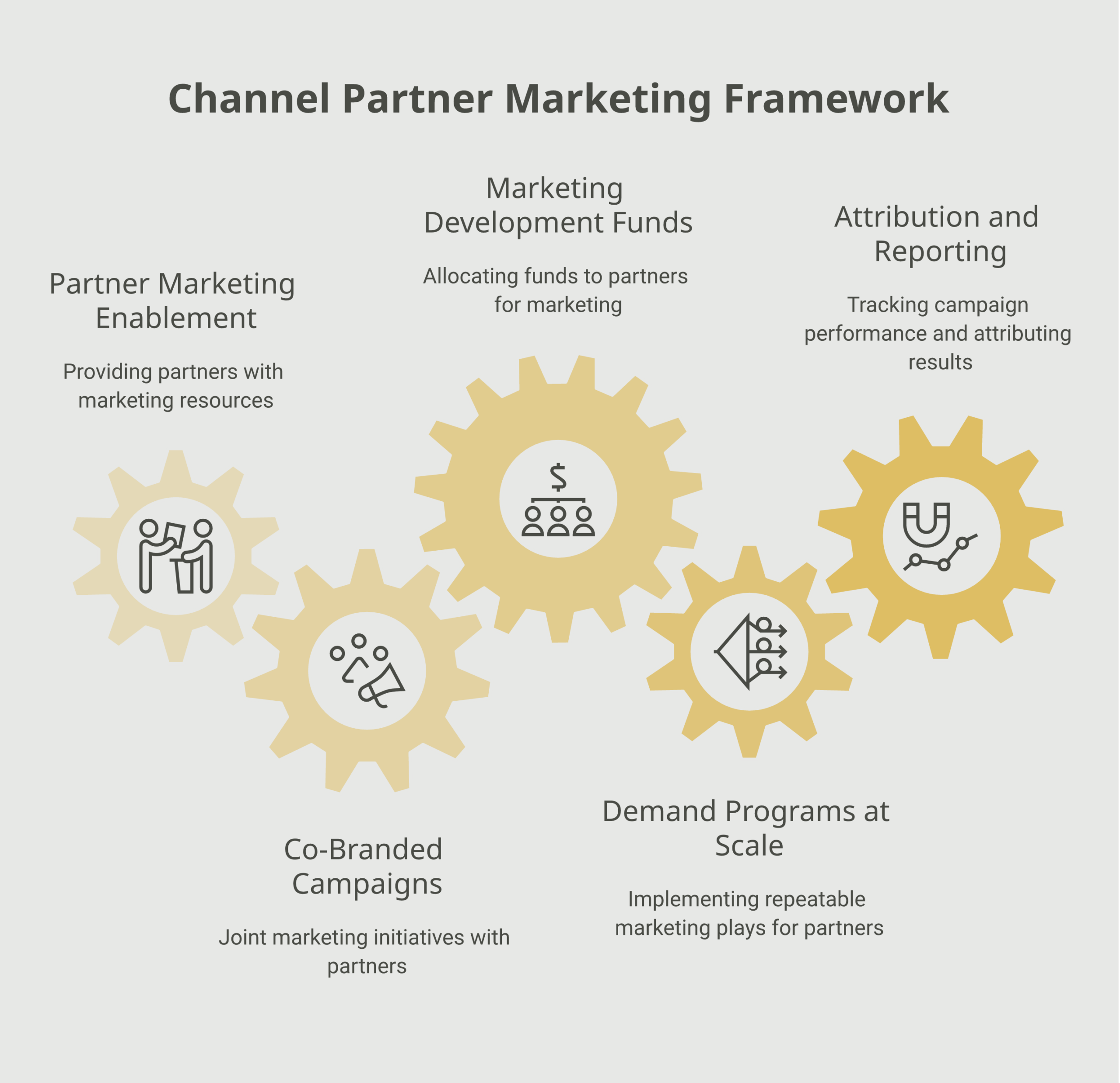
- Partner marketing enablement: The campaign kits, messaging, and templates a partner needs to market the vendor without building anything from scratch, because a partner who has to create it will not run it.
- Co-branded campaigns: Joint webinars, emails, and events that carry both brands, so the partner lends its customer relationships and the vendor lends the offer and product substance.
- Marketing development funds: Money the vendor allocates to partners to run marketing on its behalf, tied to a plan and a claimed pipeline outcome rather than handed over without accountability.
- Demand programs at scale: Repeatable plays many partners can launch at once, so the vendor activates the whole channel rather than just its top few partners.
- Attribution and reporting: The connection from a partner campaign to a specific opportunity in CRM, so the vendor funds the partners who produce and stops funding the ones who do not.
Common pitfalls in channel partner marketing
- Activating only the top partners: The two or three partners who market well get all the attention while the rest sit idle. A real program has a plan for the long tail, not just the stars.
- Funding activity instead of pipeline: Marketing development funds handed over without a claimed outcome buy webinars nobody attributes. Every dollar needs a plan and a pipeline expectation.
- Shipping assets partners never use: A portal of campaign materials nobody opens is common. Partners run what is easy to launch, so build for their workflow, not the vendor’s brand guidelines.
- No attribution to CRM: If the vendor cannot say which partner campaign influenced which deal, it cannot manage the program or defend the budget. The measurement gap is where the program loses its seat.
- One motion for every partner type: A national reseller and a boutique solution provider market differently. A single template applied to both fits neither.
What this looks like in practice
A worked example: a vendor relied on three resellers who marketed well and ignored the other twenty in its channel. It built a channel partner marketing program with ready-to-run campaign kits, market development funds tied to lead targets, and attribution wired to CRM so every partner-sourced registrant was tracked. It also segmented the motion, giving large resellers concierge support and smaller partners simple one-click plays. Within two quarters, the number of partners running any marketing tripled, and the vendor could name which partners produced pipeline. The three stars did not change; the twenty idle partners started contributing, and that is where the growth came from.
Forecastable’s POV on channel partner marketing
Our position is that channel partner marketing is won in the long tail, not the top three partners. Every program has a few partners who market well without help; the growth is in activating the many who do not, and that requires making campaigns genuinely easy to run and worth running. A program that only supports its stars is leaving most of its channel idle and calling it a strategy.
We also think attribution is the line that separates a program from a hope. The campaign kits and the funds are the visible part, but the connection from a partner’s marketing touch to a real opportunity in CRM is the only thing that proves the program works. Without it, channel partner marketing is spend a vendor cannot defend, and undefendable spend does not survive a budget cycle.
Forecastable is a partnerships operating platform focused on connecting partner conversations and actions to CRM pipeline and revenue. That lens makes channel partner marketing accountable: a vendor can see which partners’ campaigns produce pipeline, which partners are idle, and where funds are working. The program stops being a set of activities and becomes a channel leadership can plan around.
Forecastable is a partnerships operating platform. Any tools or approaches named here are independent third-party products, and naming them is not an endorsement. Design channel partner marketing around your own partner types, motion, and attribution needs.
Frequently asked questions
What is channel partner marketing?
It is the practice of generating demand through a vendor’s channel partners, such as resellers and solution providers, by equipping them to market the vendor’s product to their own customers and measuring the pipeline that results.
How is channel partner marketing different from partner marketing?
Channel partner marketing narrows the focus to reseller and solution-provider channels. Partner marketing is broader and includes technology and referral partners. Both run marketing through partners rather than around them.
What are marketing development funds?
They are money a vendor allocates to channel partners to run marketing on the vendor’s behalf, ideally tied to a plan and a claimed pipeline outcome rather than handed over without accountability.
How do you measure channel partner marketing?
By attribution: connecting a partner’s marketing touch to a specific opportunity in CRM, then tracking influenced pipeline and closed revenue by partner.
How do you get more partners to market?
By making campaigns easy to launch, segmenting support by partner type, and tying funds to outcomes. The long tail activates when running a campaign is genuinely simple and clearly worthwhile.
Who owns channel partner marketing?
Usually a channel or partner marketing function inside the vendor, working with the partner managers who own the relationships and the sales team that works the resulting pipeline.
Next step
If your channel marketing only reaches the two or three partners who already market well, most of your channel is idle reach. The fix is a program that activates the long tail and ties every campaign to pipeline. Forecastable helps partnerships teams connect partner marketing activity to opportunities in CRM, so channel partner marketing is measured by revenue, not activity. Start your growth journey now to make partner-driven demand forecastable. The partner program hub frames how channel partner marketing fits enablement and co-sell.
Uncover Your Growth Potential
Schedule a Discovery Call