Through Channel Marketing Automation: What It Is

What is through channel marketing automation?
Short answer: Through channel marketing automation is software that lets many partners run a vendor’s marketing campaigns at scale, each in their own branding and voice, from a shared system. It solves a specific problem: equipping a hundred partners to launch the same campaign without a marketer building it a hundred times. The category is often shortened to TCMA.
The phrase describes the direction of the motion. The vendor creates a campaign once, and it flows through the channel, meaning out to and through partners, who each deploy it to their own audience rather than the vendor reaching those audiences directly.
Why through channel marketing automation matters in 2026
Through channel marketing automation matters because manual partner marketing caps how many partners a team can activate, and the cap is low. A marketer can personally build a co-branded webinar for a handful of partners. Scaling that to fifty or a hundred partners by hand is impossible, so most of the ecosystem gets no campaign at all and sits idle.
In 2026, with lean marketing teams and large partner networks, that idle majority is the real cost. A vendor whose top five partners run campaigns while the other ninety-five do nothing is leaving most of its reach untapped. Through channel marketing automation is what makes the long tail operable, letting every partner launch a proven play in their own voice without a marketer in the loop for each one.
The other driver is consistency with personalization. Buyers trust a partner’s brand, not a template that obviously came from a vendor. TCMA lets a campaign carry the partner’s identity while keeping the vendor’s message intact, which is the balance that makes through-partner marketing actually convert.
How through channel marketing automation actually works
Through channel marketing automation works by turning a vendor’s campaign into something partners can deploy themselves. The components below are what a working platform provides.
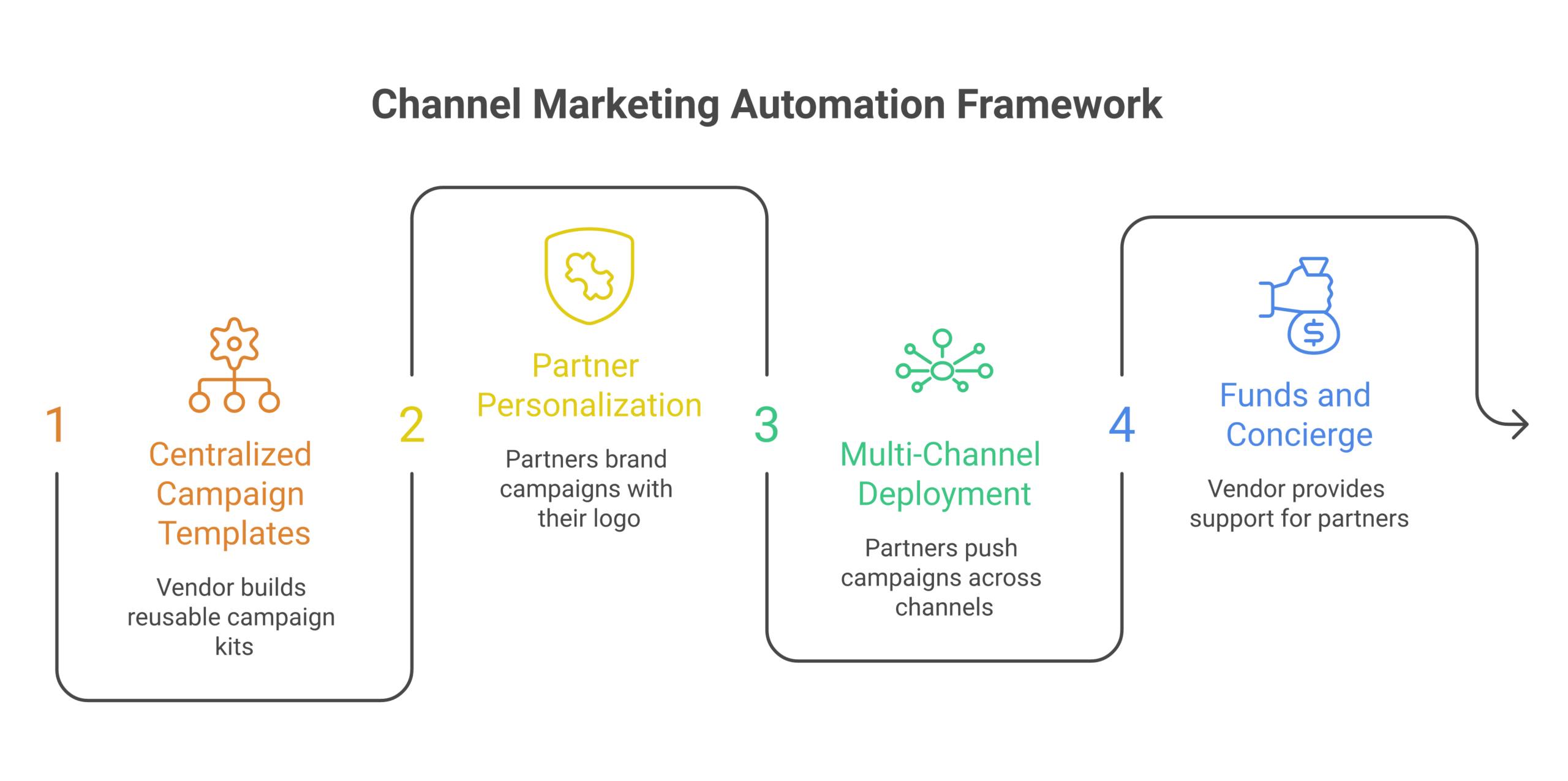
- Centralized campaign templates: The vendor builds a campaign once, from emails to landing pages to social posts, as a reusable kit partners can launch rather than recreate.
- Partner personalization: Each partner deploys the campaign under their own brand, logo, and contact details, so the buyer sees a trusted local name, not a generic vendor blast.
- Multi-channel deployment: Partners push the campaign across email, social, and web from one system, so a single play reaches an audience through several touches.
- Funds and concierge options: Some platforms tie market development funds or a done-for-you concierge to the campaign, so less-marketing-savvy partners still run it.
- Reporting and attribution: The connection from partner campaign activity to leads and CRM pipeline, so the vendor can see which partners produced and fund accordingly.
Common pitfalls in through channel marketing automation
- Automating a weak campaign: The software scales whatever you build. A mediocre webinar launched by a hundred partners is a hundred mediocre webinars, so the campaign quality has to come first.
- Assuming partners will self-serve: Many partners are not marketers and will not log in to run a campaign unaided. Without concierge support or incentives, adoption stays with the same few active partners.
- Losing the partner’s voice: Campaigns that are obviously vendor templates strip out the trust that made the partner channel valuable. Personalization has to be real, not a logo swap.
- No attribution back to CRM: TCMA that reports opens and clicks but not pipeline leaves the spend indefensible. Wire campaign activity to opportunities or the budget is at risk.
- Buying the tool before the strategy: The platform deploys campaigns; it does not decide which partners to activate or which message resonates. Teams that expect the software to supply strategy stall.
Tools and examples
Through channel marketing automation sits inside the broader partner marketing stack, and the table below maps categories rather than ranking vendors. Many teams get TCMA as a module of a wider platform.
| Category | What it does | Example providers |
|---|---|---|
| Through-channel marketing automation | Lets many partners deploy vendor campaigns at scale in their own branding | Channext and TCMA modules inside broader partner platforms |
| Partner relationship management | Runs the program, portal, and asset distribution the campaigns live within | Introw, Euler, Impartner, Allbound, ZINFI |
| Attribution and overlap | Connects partner campaign activity and shared accounts to CRM pipeline | Crossbeam, Common Room, Forecastable |
A worked example: a vendor with eighty partners saw only its top handful run any marketing. It rolled out a through-channel automation setup where a single quarterly campaign, an email sequence plus a landing page plus social posts, could be launched by any partner in one click under their own brand, with a concierge option for partners who did not want to touch it. It funded promotion through market development funds tied to lead targets and wired activity back to CRM. Within two quarters, roughly half the partner base had run a campaign, and the team could name the partners whose campaigns produced pipeline. The automation did not write a better campaign; it made the good one reachable by the whole channel.
Forecastable’s POV on through channel marketing automation
Our position is that through channel marketing automation is only as good as the attribution behind it. The deployment mechanics are impressive, but a campaign a hundred partners launch is a hundred spends you have to justify, and opens and clicks do not justify anything at a budget review. The one connection that matters is from partner campaign activity to real opportunities in CRM. Without it, TCMA just scales unaccountable marketing.
We also think adoption, not deployment, is the honest metric. It is easy to stand up a platform and report that campaigns are available; it is harder to get the long tail of partners to actually run them. Teams that measure success by campaigns published rather than partners activated fool themselves. The value of TCMA is unlocking the idle majority, and that only shows up when adoption climbs.
Forecastable is a partnerships operating platform focused on connecting partner conversations and actions to CRM pipeline and revenue. We complement TCMA rather than replace it: the automation runs the campaigns, and we make the pipeline they produce visible in the same forecast the company plans around. Measured that way, through-partner marketing becomes a channel leadership can fund with confidence.
Forecastable is a partnerships operating platform. Any third-party tools named here are independent third-party products, and naming them is not an endorsement of one over another. Evaluate through channel marketing automation against your own partners, campaigns, and attribution needs.
Frequently asked questions
What is through channel marketing automation?
It is software that lets many partners run a vendor’s marketing campaigns at scale, each in their own branding, from a shared system, so the vendor builds a campaign once and the whole channel can deploy it.
What does TCMA stand for?
TCMA stands for through channel marketing automation. The two terms refer to the same category of software.
How is TCMA different from a PRM?
A PRM emphasizes program administration such as onboarding and deal registration. TCMA focuses on deploying marketing campaigns through partners at scale. Some platforms include both.
How do you measure through channel marketing automation?
By partner adoption and attribution: how many partners actually run campaigns, and how much CRM pipeline those campaigns produce, rather than opens and clicks alone.
Which through channel marketing automation tools should be on a shortlist?
Dedicated TCMA options such as Channext, plus PRM platforms with marketing modules like Introw, Euler, Impartner, Allbound, and ZINFI, are common starting points depending on the motion.
Do partners actually use TCMA?
Only when adoption is designed for. Many partners are not marketers, so concierge support, incentives, and genuinely easy campaigns are what move the long tail from idle to active.
Next step
If your partner marketing only reaches the few partners a marketer can hand-hold, the rest of your channel is untapped reach. The fix is automation that makes the good campaign runnable by everyone, wired to pipeline so you can fund what works. Forecastable helps partnerships teams connect partner marketing activity to opportunities in CRM, so through-partner campaigns are measured by revenue, not clicks. Start your growth journey now to make partner-driven demand forecastable. The partner program hub frames how through channel marketing automation fits enablement and co-sell.
Uncover Your Growth Potential
Schedule a Discovery Call