Partner Marketing Software: What It Is, How It Works

What is partner marketing software?
Short answer: Partner marketing software is the set of tools a vendor uses to run marketing through partners at scale, covering co-branded campaigns, marketing development fund tracking, asset distribution, and the attribution that ties partner activity back to pipeline. It exists because running marketing across dozens of partners by email and shared folders breaks down fast. The software gives a partner marketing team a system instead of a scramble.
The category overlaps with partner relationship management, but the emphasis is different. Partner marketing software is about demand, meaning the campaigns partners run and the pipeline those campaigns return, rather than the administrative program mechanics.
Why partner marketing software matters in 2026
Partner marketing software matters because the alternative, running everything manually, caps how many partners a team can activate. A single marketer can hand-hold two or three partners through a co-branded webinar. Scaling that motion to fifty partners without software means most of them get nothing, and a program that only activates its top three partners is leaving the long tail idle.
In 2026, with acquisition costs high and buyers trusting peers over ads, the partners who can carry your message are a real channel, not a nice-to-have. Partner marketing software is what makes that channel operable at scale, letting many partners launch the same play in their own voice without a marketer building each one by hand. That leverage is the whole reason the category exists.
The other driver is accountability. Marketing development funds used to vanish into unattributed activity, and finance noticed. Software that tracks funds against claimed outcomes and wires campaign activity back to CRM turns partner marketing from a budget line nobody can defend into a channel with a number attached.
How partner marketing software actually works
Partner marketing software works by assembling a few capabilities that turn scattered partner activity into managed, measured campaigns. The components below are what a working platform provides.
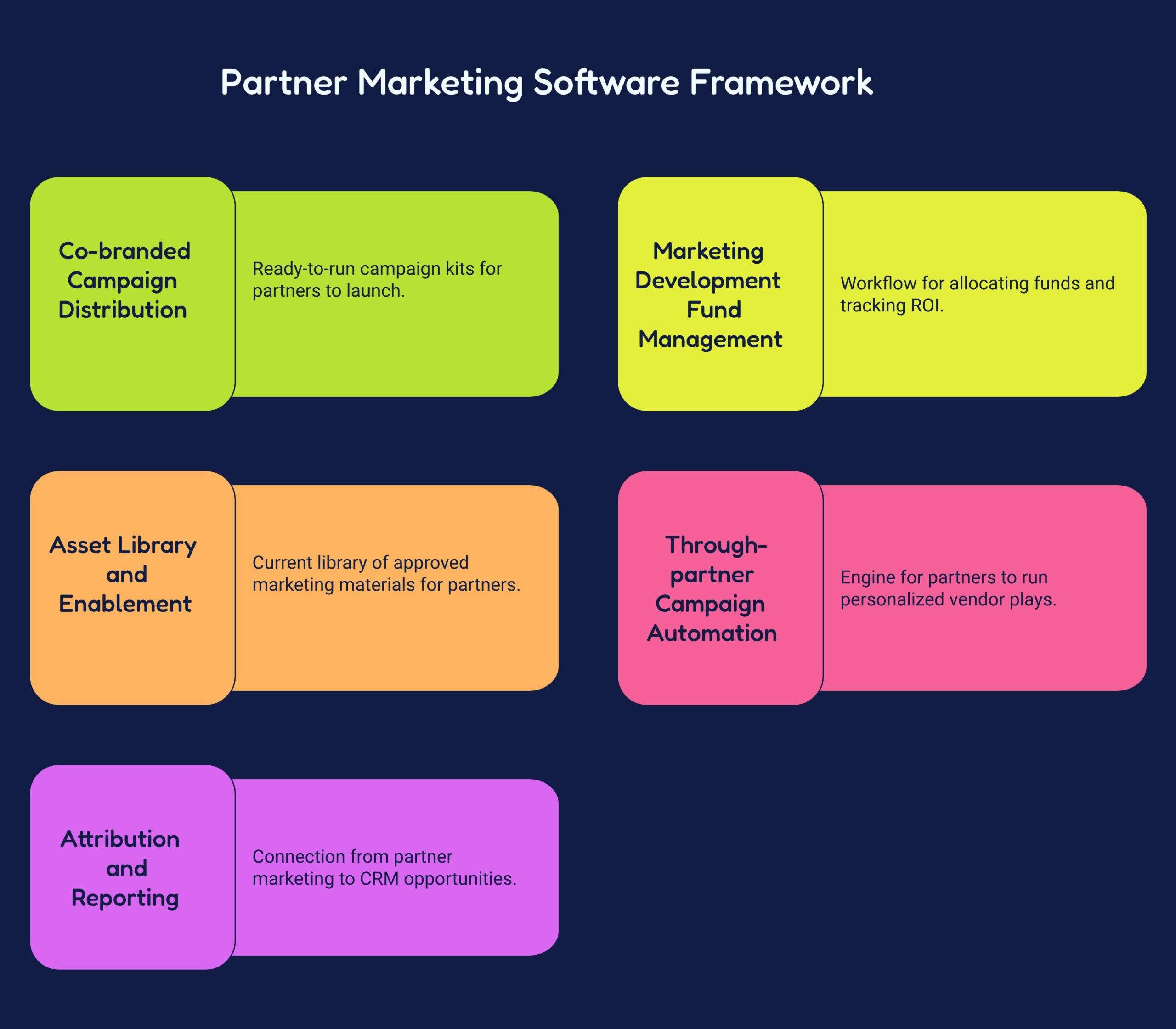
- Co-branded campaign distribution: Ready-to-run campaign kits, from email copy to landing pages, that many partners can launch in their own voice from a shared system rather than building each from scratch.
- Marketing development fund management: A workflow for allocating funds, tying each dollar to a plan and a claimed outcome, and tracking what the spend returned instead of writing checks blindly.
- Asset library and enablement: A current library of approved marketing materials partners can pull without asking, so nobody ships an outdated message.
- Through-partner campaign automation: The engine that lets a hundred partners run the same vendor play at once, each personalized, so scale does not mean sameness.
- Attribution and reporting: The connection from a partner marketing touch to a specific opportunity in CRM, so the motion is measured by pipeline rather than registrations.
Common pitfalls in partner marketing software
- Buying automation before you have a campaign worth running: Software scales whatever you feed it. Automate a weak co-branded webinar and you get a hundred weak webinars, not a hundred good ones.
- Funding activity instead of pipeline: A funds module that tracks spend but not outcomes just makes it easier to waste money. Tie every allocation to a claimed pipeline result.
- Ignoring attribution: Partner marketing software that cannot connect a campaign to a deal leaves the budget indefensible at the next review, which is where these programs quietly die.
- Overloading partners with choice: A library of two hundred assets paralyzes partners who wanted one good campaign to launch. Curate ruthlessly and lead with the play that works.
- Treating the tool as the strategy: The software distributes and measures campaigns; it does not decide which partners to activate or what message resonates. That judgment stays with the team.
Tools and examples
Partner marketing software spans a few groups, and the table below maps categories rather than ranking vendors. Most teams assemble a stack rather than buying one box.
| Category | What it does | Example providers |
|---|---|---|
| Partner relationship management with marketing modules | Distributes assets, runs portals, and manages programs and funds | Introw, Euler, Impartner, Allbound, ZINFI |
| Through-channel marketing automation | Lets many partners launch vendor campaigns at scale in their own voice | Channext and TCMA modules inside broader partner platforms |
| Attribution and overlap | Connects partner marketing activity and shared accounts to CRM pipeline | Crossbeam, Common Room, Forecastable |
A worked example: a vendor with forty partners ran co-branded webinars one at a time, so only its top five partners ever got a campaign. It moved to a through-channel automation setup where a single webinar kit could be launched by any partner in their own branding, funded promotion through a marketing development fund tied to a registration target, and wired attribution back to CRM. Six months later, thirty partners had run the play and the team could name which ones produced pipeline. The software did not write a better webinar; it made the good one runnable by everyone.
Forecastable’s POV on partner marketing software
Our position is that partner marketing software earns its cost only when it is wired to attribution. The campaign distribution and the funds tracking are useful, but they organize spend, not results. The one connection that matters is from a partner’s marketing touch to a real opportunity in CRM, because that is the only evidence that keeps the budget alive. Software that automates activity without measuring pipeline just helps a team waste money faster.
We also think the motion is through partners, not to them. The point of the software is to help a partner reach their audience with your offer, in their voice, at a moment your direct team never could. Teams that use these tools to blast partners with vendor content have missed the leverage entirely. The reach lives in the partner’s relationships, and the software’s job is to arm those relationships, not bypass them.
Forecastable is a partnerships operating platform focused on connecting partner conversations and actions to CRM pipeline and revenue. We complement partner marketing software rather than replace it: the campaign tools run the motion, and we make the pipeline it produces visible in the same forecast the company plans around. Measured that way, partner marketing stops being a curiosity and becomes a channel leadership can count on.
Forecastable is a partnerships operating platform. Any third-party tools named here are independent third-party products, and naming them is not an endorsement of one over another. Evaluate partner marketing software against your own partners, motion, and attribution needs.
Frequently asked questions
What is partner marketing software?
It is the set of tools a vendor uses to run marketing through partners at scale, covering co-branded campaigns, marketing development fund tracking, asset distribution, and attribution back to CRM pipeline.
How is partner marketing software different from a PRM?
A PRM emphasizes program administration, meaning onboarding, deal registration, and portals. Partner marketing software emphasizes demand, meaning the campaigns partners run and the pipeline they return. Many platforms include both.
What is through-channel marketing automation?
It is software that lets many partners launch a vendor’s campaigns at scale, each in their own voice, from a shared system. It is one component of a broader partner marketing stack.
How do you measure partner marketing software?
By attribution: connecting a partner’s marketing touch to a specific opportunity in CRM, then tracking influenced pipeline and closed revenue rather than webinar registrations alone.
Which partner marketing tools should be on a shortlist?
It depends on the motion, but PRM platforms with marketing modules such as Introw, Euler, Impartner, Allbound, and ZINFI, plus through-channel automation and attribution tools, are common starting points.
Do you need software to do partner marketing?
Not at first. A handful of partners can run co-branded campaigns manually. Software earns its place once the manual approach caps how many partners a team can activate.
Next step
If your partner marketing only reaches the three partners a marketer can hand-hold, the rest of your ecosystem is idle demand. The fix is software that makes the good campaign runnable by everyone, then ties the activity back to pipeline. Forecastable helps partnerships teams connect partner marketing activity to opportunities in CRM, so the channel is measured by revenue, not registrations. Start your growth journey now to make partner-driven demand forecastable. The partner program hub frames how partner marketing software fits enablement and co-sell.
Uncover Your Growth Potential
Schedule a Discovery Call