PRM Software: What It Is and How to Choose It

What is PRM software?
Short answer: PRM software is the system a vendor uses to run a partner program at scale, handling partner onboarding, a partner portal, deal registration, content distribution, and program reporting in one place. It gives a channel team the administrative backbone that a spreadsheet and a shared drive cannot, so partners have one door to walk through and the vendor has one record of who did what. Think of it as the CRM equivalent for the partner side of the business.
The term stands for partner relationship management, and it describes the operational layer beneath a partner program. It is where a partner registers a deal, downloads a pitch deck, checks a certification, and sees the funds available to them.
Why PRM software matters in 2026
PRM software matters because partner programs have outgrown the manual tools that once ran them, and the gaps now cost real pipeline. A program with fifty partners and a spreadsheet loses deals to double registration, stale content, and onboarding that takes weeks. The administrative drag becomes the ceiling on growth.
In 2026, with leaner teams asked to run larger ecosystems, that ceiling is lower than ever. A single partner manager cannot personally onboard, enable, and track a hundred partners by hand. PRM software is what lets a small team operate a large program without the wheels coming off, and it is why partner-tech spend keeps climbing even as other budgets tighten.
There is also a measurement reason. Boards now ask what partner-sourced revenue actually is, and answering that requires a system that captures deal registration and ties it to outcomes. Without PRM software, the honest answer is a shrug, and a program that cannot prove its number is a program that gets cut.
How PRM software actually works
PRM software assembles a few core capabilities that together turn a loose partner list into a managed program. The components below are what a working platform actually provides.
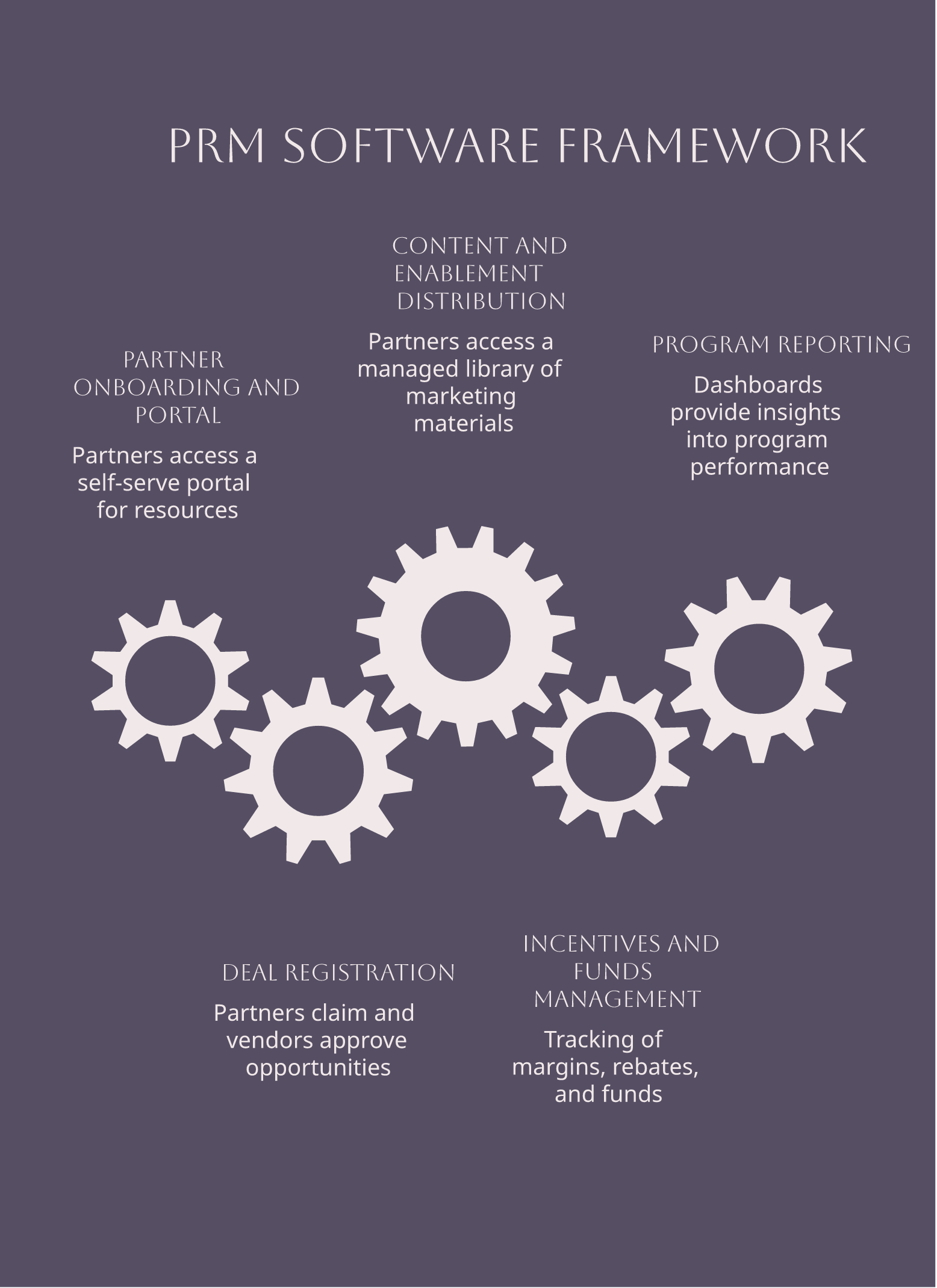
- Partner onboarding and portal: A structured intake and a single logged-in home where partners find everything they need, so the first experience is self-serve rather than a string of emails.
- Deal registration: The workflow where a partner claims an opportunity, the vendor approves it, and both sides agree who owns what. This is the mechanism that prevents channel conflict and creates the attribution record.
- Content and enablement distribution: A managed library of decks, one-pagers, and training that partners can pull without asking, kept current so nobody ships last quarter’s pricing.
- Incentives and funds management: Tracking of margins, rebates, and market development funds tied to claimed outcomes rather than handed over blindly.
- Program reporting: The dashboards that show registered pipeline, partner activity, and where a program is producing or stalling, so the team manages by evidence.
Common pitfalls in PRM software
- Buying a portal nobody logs into: A PRM with no reason to return becomes a dead login. Partners come back for deal registration and money, so lead with those, not the content library.
- Treating deal registration as paperwork: When approval is slow or arbitrary, partners stop registering and you lose the attribution record entirely. The workflow has to be fast and predictable or it defeats its own purpose.
- Confusing administration with revenue: PRM software runs the program; it does not, by itself, produce pipeline. Teams that expect the tool to generate deals rather than organize them are disappointed.
- Ignoring the CRM connection: A PRM that does not sync registered deals to the vendor’s CRM leaves partner pipeline in a silo, invisible to the forecast the CFO actually watches.
- Over-configuring at launch: Standing up every tier, certification, and workflow on day one buries partners in complexity before they have run a single deal. Start with registration and grow from there.
Tools and examples
The PRM software market spans a few groups, and the table below maps categories rather than ranking vendors. Fit depends on program size, motion, and how much of the stack a team wants in one place.
| Category | What it does | Example providers |
|---|---|---|
| Full-suite PRM | Onboarding, portal, deal registration, enablement, and reporting in one platform | Introw, Euler, Impartner, Allbound, ZINFI |
| Ecosystem and overlap data | Finds shared accounts and warm paths between a vendor and its partners | Crossbeam, Pocus, Common Room |
| Partner-sourced pipeline and attribution | Connects partner activity and registered deals to CRM pipeline and revenue | Forecastable, plus native CRM reporting |
A worked example: a mid-market vendor ran fifty partners on a spreadsheet and a shared drive. Deal registration happened over email, so two partners occasionally claimed the same account, and nobody could say what partner-sourced pipeline actually was. They moved deal registration and onboarding into a full-suite PRM, wired approved registrations into their CRM, and within a quarter had a clean number to show the board. The tool did not create the pipeline; it captured and organized what the partners were already doing so it became visible and defensible.
Forecastable’s POV on PRM software
Our position is that PRM software is necessary administration, not the growth engine. It organizes onboarding, registration, and enablement so a small team can run a large program, and that is genuinely valuable. But a portal does not close deals, and a team that mistakes buying a PRM for building a program will own a tidy system with no revenue behind it. The tool is the filing cabinet, not the sale.
We also think the most important line in any PRM evaluation is the CRM connection. Partner-sourced revenue only counts when registered deals flow into the same forecast the rest of the company runs on. A PRM that keeps partner pipeline in its own silo produces reports the CFO does not trust, and untrusted numbers do not protect a budget. The registration record has to reach the system of record.
Forecastable sits alongside a PRM rather than replacing it. We are a partnerships operating platform focused on connecting partner conversations and actions to CRM pipeline and revenue, so the administration a PRM handles becomes a measured contribution to the forecast. The PRM runs the program; we make the program’s output something leadership can plan around.
Forecastable is a partnerships operating platform and a category authority, not a PRM vendor. Any third-party tools named here are independent third-party products, and naming them is not an endorsement of one over another. Evaluate PRM software against your own program size, partner motion, and CRM.
Frequently asked questions
What is PRM software?
It is the system a vendor uses to run a partner program, covering onboarding, a partner portal, deal registration, content distribution, incentives, and reporting in one place so the program scales beyond spreadsheets.
What is the difference between PRM and CRM?
CRM manages the vendor’s direct customers and opportunities; PRM manages the vendor’s partners and the deals they register. The two should connect, so partner-sourced pipeline lands in the same forecast as direct.
Do small partner programs need PRM software?
Not always. A program with a handful of partners can run on shared documents. PRM software earns its place once manual onboarding, registration, and reporting start losing deals, usually somewhere north of a dozen active partners.
What should PRM software include at a minimum?
Deal registration, a partner portal, and reporting that connects to CRM. Everything else, from certifications to funds management, is useful but secondary to those three.
Which PRM platforms should be on a shortlist?
Full-suite options such as Introw, Euler, Impartner, Allbound, and ZINFI are common starting points. The right shortlist depends on program size and how much a team wants CRM integration and ecosystem data built in.
Does PRM software replace a partner manager?
No. It removes administrative drag so a partner manager can spend time on relationships and deals rather than paperwork. The judgment and the selling still belong to people.
Next step
If your partner program runs on spreadsheets and email, the deals leaking through the gaps are worth more than any PRM license. The fix is a system that captures registration and reporting, then connects both to the forecast leadership actually watches. Forecastable helps partnerships teams turn partner activity into measured CRM pipeline, so the program you administer is also a program you can prove. Start your growth journey now to make partner-sourced revenue something you can forecast. The PRM and partner tech hub frames how PRM software fits deal registration and enablement.
Uncover Your Growth Potential
Schedule a Discovery Call