Partner Readiness: What It Is and How to Assess It

What is partner readiness?
Short answer: Partner readiness is the measure of whether a partner can actually find, run, and close deals for you, not whether they have signed an agreement or sat through onboarding. It is the gap between a partner who exists on paper and a partner who produces, and it is the single most useful thing to track in the first ninety days.
Most programs confuse signing with selling. A signed partner is a contract; a ready partner is pipeline. Partner readiness is the discipline of knowing which one you actually have before you forecast against them.
Why partner readiness matters in 2026
Partner readiness matters because the cost of an unready partner is invisible until you are counting on them. A partner who completed onboarding but cannot articulate your value, qualify a prospect, or run a joint call will sit at zero while your forecast assumes contribution. The damage is not just the missing revenue; it is that you planned around a number that was never real.
In 2026, with leaner partner teams and more partners per manager, you cannot afford to discover readiness gaps deal by deal. A manager carrying forty partners has no time to find out, one stalled opportunity at a time, that half of them were never equipped to sell. Readiness assessment moves that discovery to the front, where it is cheap, instead of the middle of a deal, where it costs a customer.
There is also a resourcing argument. Readiness tells you where to spend your enablement hours. A partner who is close to ready needs a nudge; one who is far from it needs a decision about whether to invest or move on. Without a readiness signal you spread enablement evenly across partners who need wildly different things, which is how programs burn effort and still end up with a long tail of partners who never produce.
How partner readiness actually works
Partner readiness is assessed across a few dimensions that together predict whether a partner will produce. The components below are the checks that tell you the truth before a deal does.
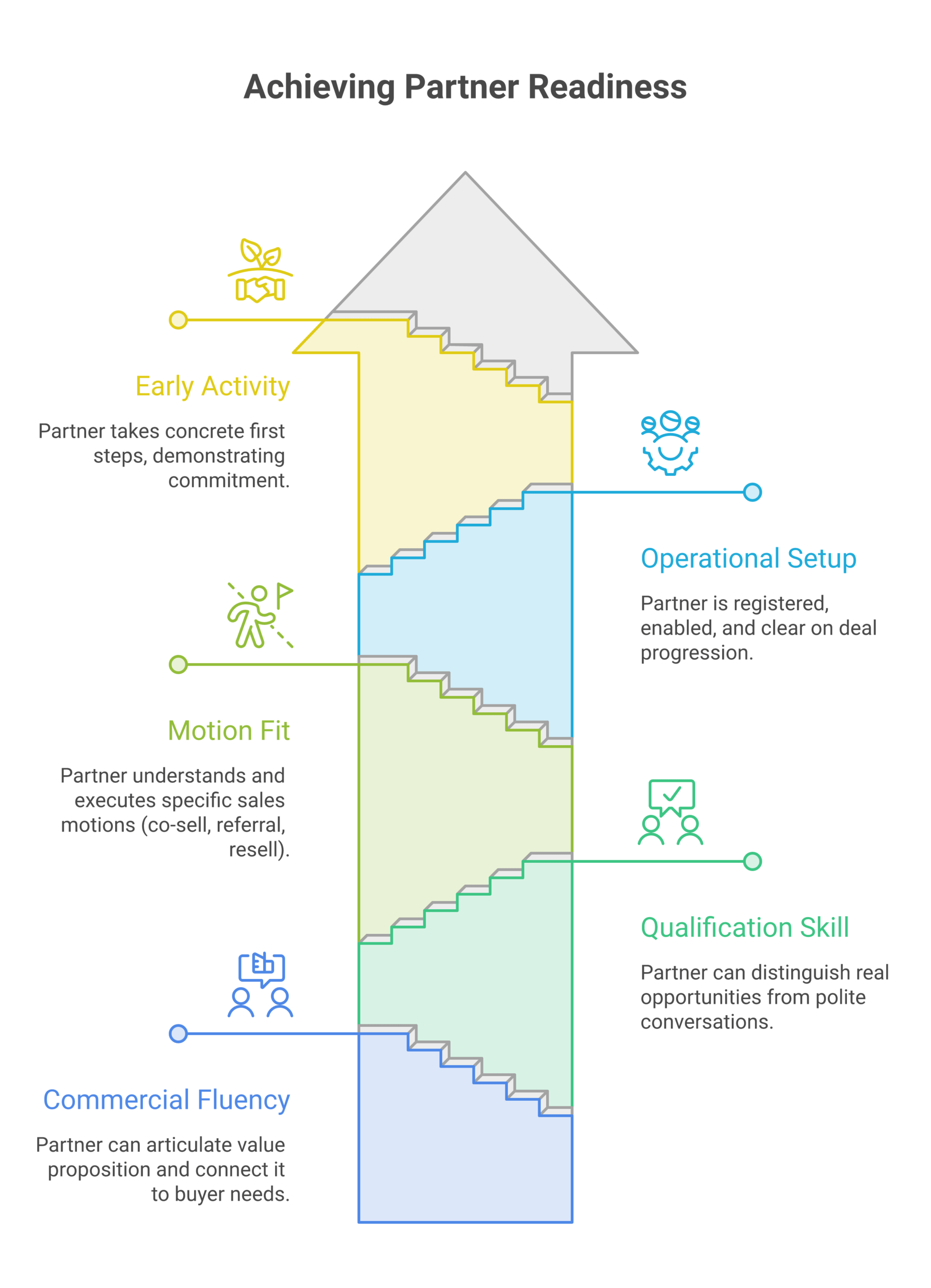
- Commercial fluency: Can the partner explain your value proposition in their own words and connect it to a buyer’s problem? A partner who can only recite features is not ready to sell, only to refer.
- Qualification skill: Can they tell a real opportunity from a polite conversation? Readiness here is the difference between a partner who brings you qualified deals and one who forwards every lukewarm contact.
- Motion fit: Do they know how to run your specific motion, whether that is a co-sell, a referral handoff, or a resell? Knowing your product is not the same as knowing how a deal with you actually moves.
- Operational setup: Are they registered, enabled in the right systems, and clear on how to log and progress a deal? Friction in the mechanics quietly stops partners who are otherwise willing.
- Early activity: Has the partner taken a real first action, such as registering an opportunity or running a joint call? Activity is the only readiness signal that cannot be faked by a completed checklist.
Common pitfalls in assessing partner readiness
- Treating onboarding completion as readiness: A finished checklist proves attendance, not capability. Partners pass training and still cannot run a deal, so completion is the start of assessment, not the end.
- Measuring readiness once: Readiness decays. A partner who was ready last quarter may have lost the rep who carried the relationship, so a one-time score goes stale fast.
- Confusing enthusiasm with capability: An excited partner is not a ready one. Eagerness in a kickoff call tells you nothing about whether they can qualify a prospect.
- No early-activity signal: Without a first real action to point to, readiness is a guess. The partner who has logged an actual opportunity is in a different category from the one who has only completed modules.
- Scoring everyone the same way: A referral partner and a co-sell partner are ready in different ways. A single rubric applied to every partner type mislabels half of them.
What this looks like in practice
A program onboarded thirty partners in a quarter and forecast contribution from all of them based on completed enablement. By the end of the next quarter, four had produced and the rest were silent. The team had mistaken onboarding completion for readiness and built a number on it, then spent the quarter chasing partners who had never been equipped to sell in the first place.
The fix was a simple readiness assessment run at day thirty and day sixty. Each partner was checked on commercial fluency, qualification skill, motion fit, setup, and one real early action, with the activity signal pulled from the deal record in their CRM or partner platform such as Introw or Euler. Partners split cleanly into ready, close, and not-yet, and enablement hours moved to the close group where they changed outcomes. The forecast got honest because it counted only partners who had shown they could act, and the long tail of never-active partners was addressed deliberately rather than hopefully.
Forecastable’s POV on partner readiness
Our position is that readiness is an activity question, not a training question. The most reliable signal that a partner can sell is that they have started to, and every readiness model that leans on completed modules instead of taken actions is measuring the wrong thing. Watch what partners do, not what they have finished.
We also think readiness should be assessed continuously and cheaply, not certified once and assumed. Partners change, reps leave, priorities shift, and a readiness score from three months ago tells you about a partner who may no longer exist. The teams that stay honest treat readiness as a live read they refresh, the same way they would refresh a forecast, because a partner’s ability to produce is exactly that perishable.
Finally, readiness is where you decide where to spend. The point of assessing it is not to grade partners; it is to route your scarce enablement time to the partners a nudge will convert and to make a clear call on the ones it will not. Connected to your CRM, the early-activity signal turns readiness from a subjective rating into a forecastable input about who will actually contribute.
Forecastable is a partnerships operating platform. Any third-party tools named here are independent third-party products, and naming them is not an endorsement of one over another. Decide how partner readiness should be assessed for your own partners, motion, and program.
Frequently asked questions
What is partner readiness?
It is the measure of whether a partner can actually find, run, and close deals for you, as opposed to whether they have signed or completed onboarding. Readiness is about demonstrated capability and early activity, not paperwork.
How do you assess partner readiness?
Check commercial fluency, qualification skill, fit with your specific motion, operational setup, and at least one real early action such as a registered opportunity. The activity signal is the one that cannot be faked by a completed checklist.
Is onboarding completion the same as partner readiness?
No. Completing onboarding proves a partner attended training; readiness proves they can run a deal. Many partners finish onboarding and still cannot qualify a prospect, which is why completion is the start of assessment, not the end.
How often should you measure partner readiness?
Readiness decays as reps leave and priorities shift, so reassess regularly rather than scoring once. Many teams check at day thirty and day sixty, then on a recurring basis as the relationship matures.
What is the best early signal of partner readiness?
A real first action, such as registering an opportunity or running a joint call. Activity is the only readiness signal that a completed training module cannot imitate.
What do you do with an unready partner?
Decide deliberately: invest enablement where a partner is close to ready and a nudge will convert them, and make a clear call on partners who are far from it rather than carrying them silently in the forecast.
Next step
If your forecast assumes contribution from partners you have never confirmed can sell, a readiness assessment will tell you the truth before a stalled deal does. Forecastable helps partnerships teams pull the early-activity signal straight from CRM so readiness is measured by what partners actually do. Start your growth journey now to base your forecast on ready partners, not signed ones. The partner program hub frames how readiness fits onboarding and enablement.
Uncover Your Growth Potential
Schedule a Discovery Call