AE Partner Enablement: A Practical Playbook

What is AE partner enablement?
Short answer: AE partner enablement is the work of teaching your own account executives how to find, use, and co-sell with partners, so the channel shows up in their deals instead of staying a separate program they ignore. It is enablement pointed inward, at your sellers, not outward at the partners.
Most partner programs enable partners and forget the AEs. But a partner-sourced deal still has to be run by an AE, and if that AE does not know how to work with a partner, the best partner program in the world stalls at the rep.
Why AE partner enablement matters in 2026
AE partner enablement matters because the AE is where partner value is won or lost. A partner can source a perfect opportunity, but if the AE treats the partner as a nuisance, runs the deal solo, and forgets to log the partner’s role, the relationship dies and the attribution disappears. The partner program’s return depends on AE behavior far more than on partner behavior, and most programs never touch it.
In 2026 this gap is more expensive because companies are asking the channel to carry real targets. You cannot hit a partner-sourced revenue goal if your sellers route around partners, and you cannot prove the channel’s contribution if AEs do not record partner involvement. Enabling the AE is how you make the partner motion show up in the pipeline you actually forecast, rather than living in a parallel program nobody on the sales floor uses.
There is also a simple incentive reality. AEs do what helps them hit quota, and if working with a partner feels like overhead, they will skip it. Enablement has to make the partner motion obviously easier and more productive for the AE, not just compliant. The teams that win frame partner work as a way for the AE to close more, faster, which is the only framing a quota-carrying seller actually adopts.
How AE partner enablement actually works
AE partner enablement is built from a few capabilities every seller needs to work with partners. The components below are what an AE has to know and do for the channel to live in their deals.
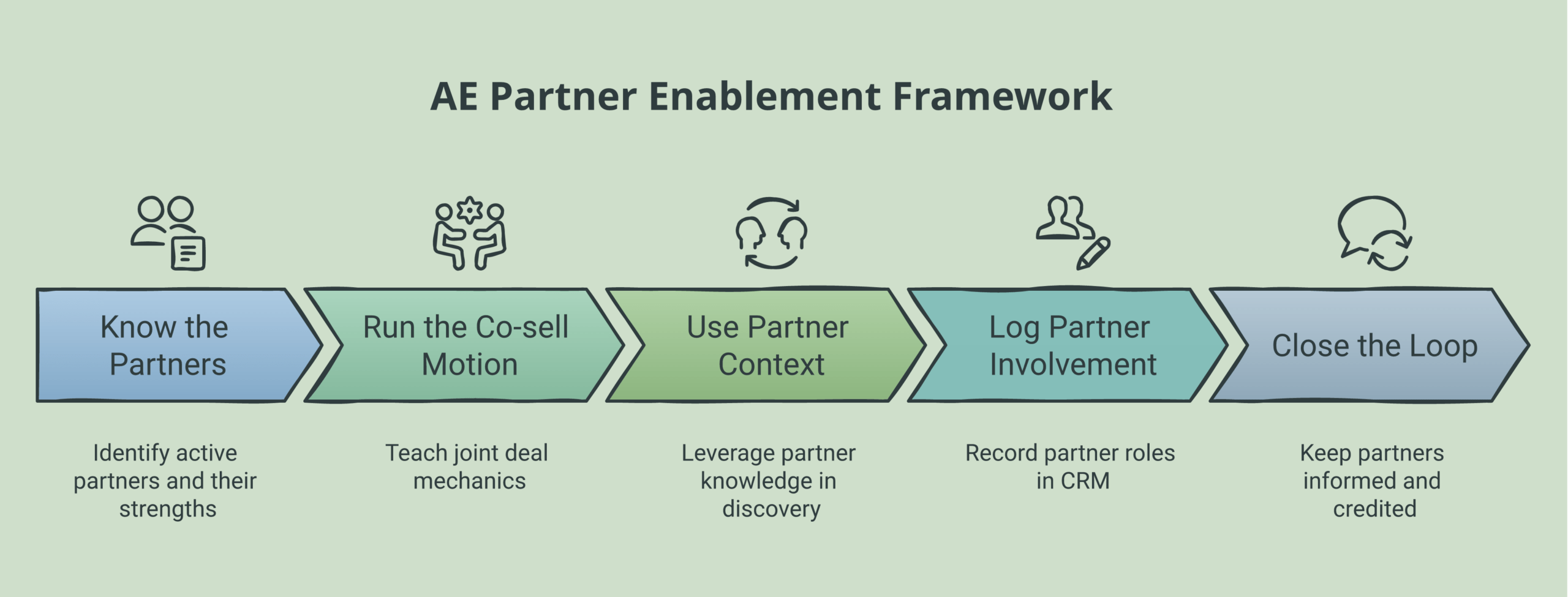
- Know the partners: The AE needs to know which partners are active in their territory and what each is good for. A seller who cannot name a relevant partner will never bring one into a deal.
- Run the co-sell motion: Teach the mechanics of a joint deal, from a shared call to a clean handoff to a coordinated close. Knowing a partner exists is useless without knowing how to sell alongside one.
- Use partner context in discovery: Show AEs how to use a partner’s knowledge of an account to enter discovery already informed. The partner’s context is a selling advantage the AE has to be taught to use.
- Log partner involvement: Make recording the partner’s role in CRM a habit, because unlogged partner deals destroy attribution. If the AE does not log it, the program cannot prove it.
- Close the loop with the partner: Teach AEs to keep the partner informed and credited, so the relationship survives the deal. A partner burned by a silent AE will not bring the next one.
Common pitfalls in AE partner enablement
- Enabling partners but not AEs: Pouring enablement into partners while leaving sellers untrained means partner-sourced deals stall at the rep. The AE is the bottleneck most programs never address.
- Framing partner work as compliance: If AEs hear “you must involve partners,” they comply minimally and route around the channel. Framing it as a way to close more is the only message that sticks with a quota-carrier.
- No partner visibility for the AE: A seller who cannot quickly see which partners are relevant to their accounts will not use them. Lack of visibility looks like lack of interest.
- Letting partner involvement go unlogged: When AEs forget to record the partner’s role, attribution evaporates and the program cannot prove its contribution. The logging habit is non-negotiable.
- Ignoring the AE’s incentives: If working with a partner does not help the AE hit quota, no amount of training changes behavior. Enablement has to align with what the seller is paid to do.
What this looks like in practice
A company enabled its partners thoroughly and assumed deals would flow, but partner-sourced opportunities kept stalling. The reason was the AEs: they did not know which partners were relevant, treated co-sell as extra work, and rarely logged a partner’s involvement, so deals slowed and attribution vanished. The partner program looked busy and produced little, because the people who actually run deals had never been enabled.
The fix pointed enablement at the sellers. AEs got a simple view of which partners were active in their accounts, pulled from the CRM and partner platform such as Introw or Euler, plus a short playbook for running a co-sell and a required field for logging partner involvement. Crucially, the message was reframed: working with a partner was positioned as a faster path to quota, with examples of deals that closed quicker with partner context. AE behavior shifted, partner deals stopped stalling at the rep, and the channel’s contribution finally showed up in the forecast because it was being logged.
Forecastable’s POV on AE partner enablement
Our position is that the AE, not the partner, is the real bottleneck in most partner programs. Teams pour enablement into partners and wonder why the pipeline does not move, when the deals are stalling at sellers who were never taught to work with a partner. If you are going to enable one side, enable the side that actually runs the deal.
We also think the framing decides whether enablement works. A quota-carrying AE adopts exactly the behaviors that help them hit their number and ignores the rest, so partner work has to be sold to the seller as a way to close more, not mandated as compliance. The programs that get AE adoption do it by making the partner motion the easier path to revenue, which is the only argument that survives contact with a sales floor.
Finally, the logging habit is where attribution lives or dies. Every partner-influenced deal an AE forgets to record is a contribution the program can never prove, and over a year that adds up to a channel that looks weaker than it is. Make partner involvement a default field the AE fills, connected to CRM, and you turn AE behavior into the evidence that justifies the whole program.
Forecastable is a partnerships operating platform. Any third-party tools named here are independent third-party products, and naming them is not an endorsement of one over another. Decide how AE partner enablement should run for your own sellers, partners, and motion.
Frequently asked questions
What is AE partner enablement?
It is teaching your own account executives how to find, use, and co-sell with partners, so the channel shows up in their deals. It is enablement aimed at your sellers rather than at the partners themselves.
Why enable AEs and not just partners?
Because a partner-sourced deal is still run by an AE. If the seller does not know how to work with a partner, the deal stalls at the rep no matter how well the partner was enabled.
What should AE partner enablement cover?
Knowing which partners are active in their territory, running the co-sell motion, using partner context in discovery, logging partner involvement in CRM, and keeping partners informed and credited so the relationship survives.
How do you get AEs to actually work with partners?
Frame partner work as a faster path to quota, not as compliance, and make partner visibility and the co-sell motion genuinely easier. Sellers adopt what helps them hit their number and ignore mandates that do not.
Why does partner attribution often disappear?
Because AEs forget to log the partner’s role in the deal. Unlogged partner involvement means the program cannot prove its contribution, so making the logging a default habit is essential.
Who owns AE partner enablement?
It usually sits between partnerships and sales enablement, but the partnerships team typically drives it because they have the most to lose when AEs route around the channel. Sales leadership has to back the framing for it to stick.
Next step
If your partner program is well run but partner-sourced deals keep stalling, the bottleneck is probably your AEs, not your partners. Forecastable helps partnerships teams give sellers partner visibility inside CRM and make partner involvement a logged, forecastable part of every deal. Start your growth journey now to make the channel show up in your AEs’ pipeline. The partner program hub frames how AE enablement fits the wider motion.
Uncover Your Growth Potential
Schedule a Discovery Call