Partner Enablement Strategy: A Practical Guide

What is a partner enablement strategy?
Short answer: A partner enablement strategy is the deliberate plan for giving partners the knowledge, tools, and support they need to sell, deliver, and support your product on their own. It defines what partners must learn, in what order, and how you will confirm they can actually do it, rather than leaving readiness to chance.
It is not a content library or a portal login. Those are inputs. The strategy is the decision about which partners you are enabling, to do what, by when, and how you will know it worked.
Why a partner enablement strategy matters in 2026
A partner enablement strategy matters because the gap between a signed partner and a selling partner is where most programs quietly leak. Companies celebrate recruitment, then assume revenue will follow, and it does not, because the partner was never made ready. The enablement strategy is what closes that gap on purpose instead of hoping it closes itself.
In 2026 it matters more because partners are busier and more distracted than ever. A partner rep carries multiple vendors, limited attention, and no obligation to learn yours first. If your enablement is long, generic, or hard to access, you lose to whichever vendor made selling easy. The strategy has to respect that the partner’s time is the scarcest resource in the relationship and design around it.
There is also a compounding effect. An enabled partner closes faster, positions you more accurately, and needs less hand-holding on every subsequent deal, which frees your team to enable the next partner. A program without an enablement strategy spends the same effort answering the same questions forever, because no partner ever truly becomes self-sufficient. The strategy is what lets a partnerships team scale beyond the deals it can personally touch.
How a partner enablement strategy actually works
A partner enablement strategy is built from a few moving parts that have to fit together. The components below are what turn enablement from scattered content into a path a partner can actually complete.
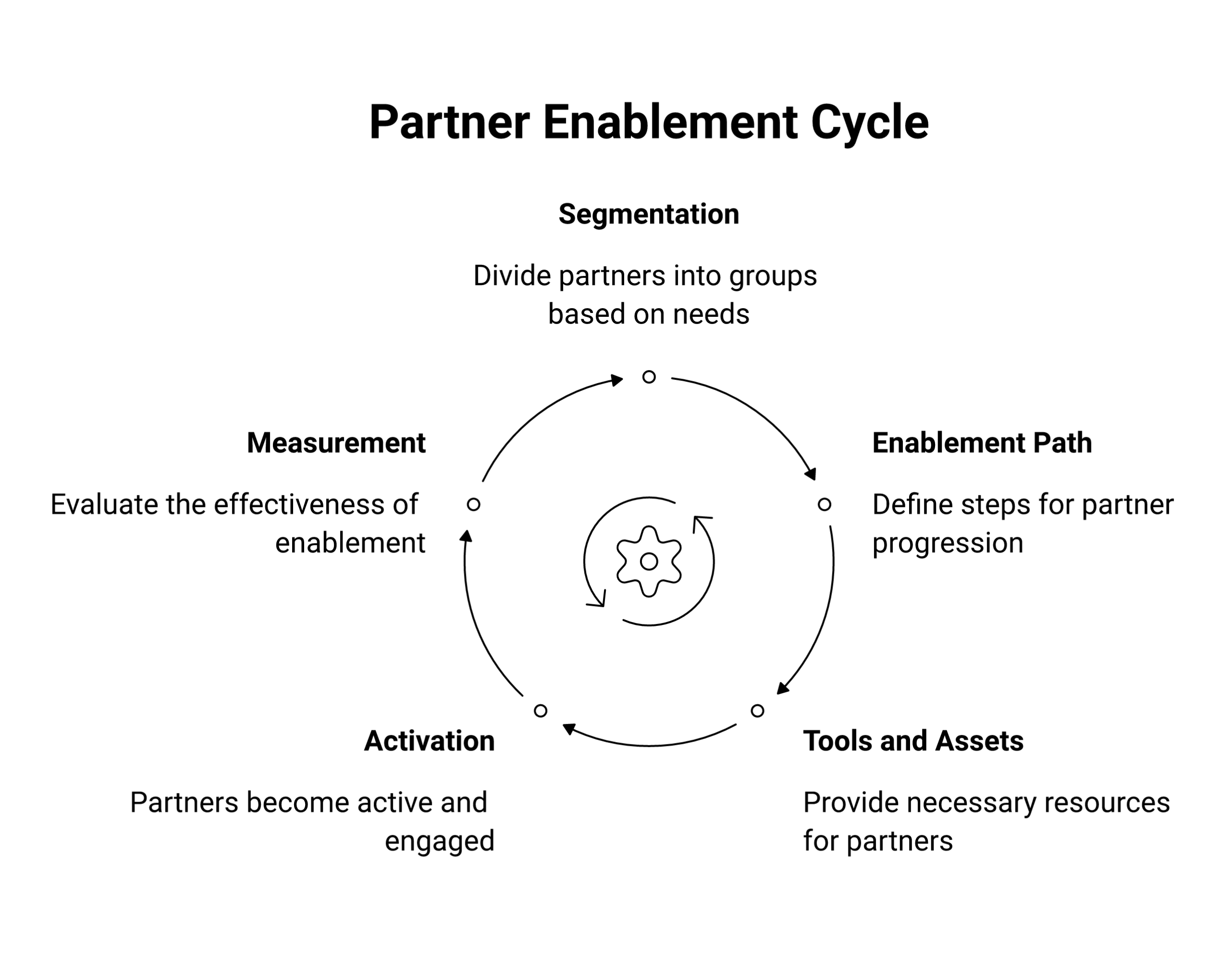
- Segmentation: Not every partner needs the same enablement. A reseller who only needs to position and refer requires far less than a system integrator who delivers and supports. The strategy starts by deciding which partner types you are enabling and to what depth, so you do not over-train referrers or under-train implementers.
- The enablement path: For each segment, define the sequence a partner moves through, from first onboarding to the point they can sell unassisted. A clear path with a defined endpoint beats an open library, because the partner knows what done looks like.
- Tools and assets: The pitch material, demos, battle cards, and technical resources the partner needs at each step. The test is whether a partner rep can find the right asset in the moment they need it, not whether the asset exists somewhere.
- Activation: The point where enabled becomes active. A partner who completed training but never ran a real motion is not enabled in any way that matters. The strategy has to include a first deal, a first co-sell, or a first campaign that turns knowledge into action.
- Measurement: How you confirm enablement worked. Completion rates tell you who consumed the content; ramp time, first-deal time, and partner-sourced pipeline tell you whether it changed behavior. Measure the second set.
Common pitfalls in a partner enablement strategy
- Enabling everyone the same way: A one-size path over-trains light partners and under-serves deep ones, and both groups disengage. Segment first, or you waste effort at both ends of the roster.
- Confusing content with enablement: A full portal of assets is not a strategy. If partners cannot find what they need or do not know what to do with it, the content is inert. The path matters more than the volume.
- Stopping at training completion: Treating a finished course as the goal is the most common failure. A partner who learned but never sold is a sunk cost. Enablement is not done until the partner has run a real motion.
- Ignoring the partner’s time budget: Long, mandatory, generic programs lose to vendors who made selling easy. If enablement costs more partner attention than it returns, partners route around it.
- Measuring the wrong things: Tracking logins and course completions feels like progress but tells you nothing about revenue. Without ramp time and partner-sourced pipeline in view, you cannot tell whether enablement is working or just busy.
What this looks like in practice
A program had an extensive partner portal, dozens of assets, and a certification course, and almost no partner-sourced revenue to show for it. The team pointed to high content volume and a respectable course-completion rate as proof the program was healthy. It was not. Partners were completing the course because it was required, then going back to selling the products they already knew, because nothing in the program connected training to a real first deal.
The reset was about sequence and activation, not more content. They segmented partners into referrers and implementers, built a short path for each with a defined endpoint, and added an activation step: every partner who finished training was paired with the partnerships team on a first live opportunity. Ramp time and first-deal time became the headline metrics instead of course completion. Within two quarters, the share of partners who had sourced at least one deal rose sharply, because enablement now ended in action rather than in a certificate nobody used.
Forecastable’s POV on a partner enablement strategy
Our position is that enablement is judged by behavior change, not by content delivered, and most programs measure the wrong end. A library of assets and a high completion rate are easy to produce and easy to point to, but they say nothing about whether a partner can now sell. The only honest measures of enablement are ramp time, first-deal time, and partner-sourced pipeline, because those are what the strategy was supposed to move.
We also think the activation step is the part everyone skips and the part that matters most. The distance between a partner who knows your product and a partner who has sold it is enormous, and training alone never crosses it. The strategy has to end in a real motion, a first deal worked alongside your team, because that is where knowledge becomes capability and where the partner decides whether selling you is worth repeating.
Finally, respect the partner’s attention as the scarcest thing in the relationship. Your enablement is competing with every other vendor’s, and the partner will route around whichever one costs the most time for the least clarity. A short, segmented, activation-focused path beats an exhaustive program every time, because the partner can actually finish it and act on it. Enable for action, measure the action, and the revenue follows.
Forecastable is a partnerships operating platform. Any third-party tools or methods named here are independent third-party products, and naming them is not an endorsement. Decide how a partner enablement strategy should fit your own partners, segments, and goals.
Frequently asked questions
What is a partner enablement strategy?
It is the deliberate plan for giving partners the knowledge, tools, and support to sell, deliver, and support your product on their own. It defines what partners learn, in what order, and how you confirm they can actually do it.
How is partner enablement different from partner onboarding?
Onboarding is the first stretch, getting a partner set up and oriented. Enablement is the broader, ongoing work of making them capable of selling and delivering. Onboarding is a phase inside the wider enablement strategy.
What should a partner enablement strategy include?
Segmentation of partner types, a defined path for each, the tools and assets needed at each step, an activation step that ends in a real motion, and measurement based on ramp time and partner-sourced pipeline rather than completion rates.
How do you measure partner enablement?
Look past logins and course completions to ramp time, first-deal time, and partner-sourced pipeline. Those measure whether enablement changed behavior, which is the only outcome that matters.
Why do partner enablement programs fail?
Usually because they stop at training completion, treat content volume as a strategy, or ignore how little time partners have. A partner who learned but never sold is the most common and most expensive failure.
How long should partner enablement take?
As short as it can be while still ending in a real motion. The partner’s attention is scarce, so a tight, segmented path that gets them to a first deal beats a long program they never finish or apply.
Next step
If your partner program has plenty of content and not much partner-sourced revenue, the missing piece is almost always activation, not more assets. Forecastable helps partnerships teams connect enablement to real deals and measure ramp time and partner-sourced pipeline, so enablement is judged by behavior rather than completion. Start your growth journey now to build enablement that ends in action. The partner program hub frames the wider program, and the co-sell hub covers running that first activation deal with a partner.
Uncover Your Growth Potential
Schedule a Discovery Call