Indirect Sales: What It Is and How to Run It

What is indirect sales?
Short answer: Indirect sales is the model where a company sells through third parties, such as resellers, distributors, agents, or system integrators, rather than selling directly to the end buyer with its own reps. The partner owns the customer relationship and the transaction, and the vendor reaches the market through them.
It is the counterpart to direct sales, where your own salesforce carries the deal end to end. Most companies of any scale run both, and the interesting questions are not which one is better but where each fits and how they coexist without colliding.
Why indirect sales matters in 2026
Indirect sales matters because it is how most companies reach markets they could never cover with a direct team alone. A partner already has the relationships, the local presence, the regulatory knowledge, or the services capacity that would take a vendor years and a fortune to build. Selling through that partner buys reach and credibility that direct hiring cannot match at the same speed or cost.
In 2026 the model matters more because buyers increasingly want solutions assembled from several vendors, delivered and supported by someone they already trust. A single product sold direct is a harder sell than the same product embedded in a partner’s broader offer. Indirect sales lets you ride that preference instead of fighting it, showing up inside the trusted relationship rather than as one more vendor knocking on the door.
The economics also favor it when it is run well. A direct team is a fixed cost you carry whether or not it produces. An indirect motion converts much of that into a variable cost, where you pay margin or commission on revenue that actually closed. The catch is that indirect revenue is only as predictable as your partners are engaged, which is why the model rewards companies that treat partner enablement and measurement as seriously as they treat their own pipeline.
How indirect sales actually works
Indirect sales runs through a chain of distinct roles, each of which has to be set up deliberately. The components below are what separate a functioning channel from a list of signed partners who never sell.
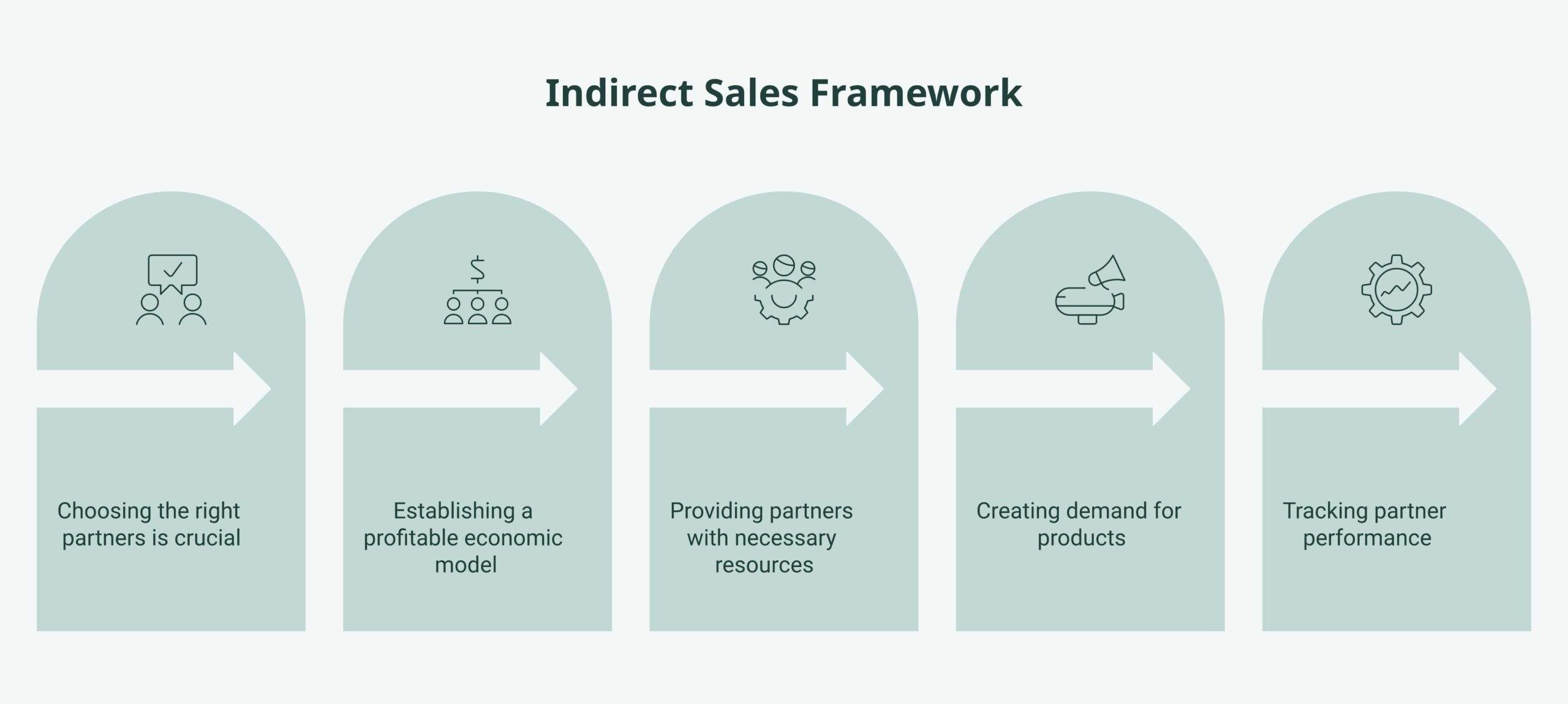
- Partner selection: The model lives or dies on who you recruit. The right partner already serves your target buyer and has a reason to add your product. Signing partners by volume rather than fit produces a roster that looks impressive and sells nothing.
- Margin and incentive structure: Indirect sales runs on economics. The partner needs a margin or fee that makes selling your product worth their attention against everything else they could sell. Set it too thin and you are background noise in their portfolio.
- Enablement: A partner rep is not your rep. They need to be taught what you do, who it is for, and how to position it, in a form they can absorb between selling ten other things. Enablement is the difference between a partner who can pitch you and one who only forwards leads.
- Demand and air cover: Partners sell what is easiest to sell. Marketing support, co-branded campaigns, and qualified leads lower the effort of selling your product and pull it up their priority list.
- Measurement and management: Because you do not see the deals directly, you need a way to track partner-sourced pipeline, registered deals, and revenue. Without measurement, indirect sales is a black box and you cannot tell a productive partner from a dormant one.
Common pitfalls in indirect sales
- Recruiting for quantity: Signing as many partners as possible feels like progress and produces almost none. A handful of well-fit, enabled partners will out-sell a hundred logos who signed and forgot. Treat partner count as a vanity number.
- Channel conflict with direct: When a direct rep and a partner chase the same account, the partner loses trust fast. Without clear rules on territories, accounts, and deal registration, your direct and indirect motions cannibalize each other instead of compounding.
- Underinvesting in enablement: Expecting partners to sell a product they were never properly taught is the most common reason indirect revenue stalls. A partner who cannot confidently position you will default to selling something they understand better.
- Thin or confusing economics: If the margin is low or the incentive structure is hard to understand, partners deprioritize you. The partner is always doing the math on where their effort pays best, and you are competing for that effort.
- No visibility into the funnel: If you only see revenue at the end and nothing before it, you cannot forecast, coach, or intervene. Flying blind on partner pipeline turns indirect sales into a hope-based motion.
What this looks like in practice
A software vendor expanded into a new region by signing twenty resellers in a quarter and declaring the channel open. Six months later, two of the twenty had closed anything. The team had treated recruitment as the finish line and assumed selling would follow. It did not, because the partners had been signed for coverage, given a portal login and a price list, and left alone.
The reset was narrower and deeper. They cut active focus to the four partners whose existing customers actually matched the target buyer, built a short enablement path those four could complete, set a margin that made the product worth pushing, and put a simple registration and tracking process in place so partner pipeline was visible. Within two quarters those four partners produced more than the original twenty ever had, and because the pipeline was now visible, the vendor could forecast indirect revenue instead of guessing at it. Fewer partners, properly enabled and measured, beat a wide roster every time.
Forecastable’s POV on indirect sales
Our position is that indirect sales is a discipline, not a cost-saving shortcut, and companies that treat it as the latter get the results that attitude deserves. The model only converts the fixed cost of a direct team into a variable one if the partners actually sell, and partners only sell when they have been selected for fit, given economics worth their effort, and enabled to position you. Skip that work and indirect sales is not cheaper, it is just slower and invisible.
We also believe the quantity instinct is the single most expensive mistake in the channel. Partner count is the easiest metric to grow and the least connected to revenue. The companies that win in indirect sales concentrate on the small number of partners who can genuinely move their product, and they invest in those relationships rather than spreading themselves across a roster they will never enable. Quality of partner beats quantity of partner in almost every program we see.
The third conviction is about visibility. Indirect sales is the motion most likely to become a black box, because the deals happen outside your direct view. The fix is to connect partner activity and registered deals back to your CRM pipeline so you can see, measure, and forecast partner-sourced revenue the same way you do direct. A channel you cannot see is a channel you cannot manage or prove.
Forecastable is a partnerships operating platform. Any third-party tools or methods named here are independent third-party products, and naming them is not an endorsement. Decide how indirect sales should fit alongside your own direct motion, partners, and market.
Frequently asked questions
What is indirect sales?
It is selling through third parties such as resellers, distributors, agents, or system integrators rather than directly to the buyer with your own reps. The partner owns the customer relationship and the transaction, and the vendor reaches the market through them.
What is the difference between direct and indirect sales?
In direct sales your own salesforce carries the deal end to end. In indirect sales a partner owns the customer relationship and the sale, and you reach the buyer through them. Most companies of scale run both.
What are the main types of indirect sales partners?
Resellers, distributors, value-added resellers, agents or referral partners, and system integrators are the common types. Each owns a different slice of the relationship, from passing a lead to fully delivering and supporting the solution.
Is indirect sales cheaper than direct sales?
It can be, because it converts a fixed salesforce cost into a variable margin paid on closed revenue. But that only holds if partners actually sell, which requires real investment in selection, economics, and enablement.
How do you measure indirect sales performance?
Track partner-sourced and partner-influenced pipeline, registered deals, conversion rates, and revenue by partner. Connecting partner activity to your CRM is what turns indirect sales from a black box into a forecastable motion.
How many partners should an indirect sales program have?
Fewer than most companies think. A small number of well-fit, enabled, active partners almost always out-produces a large roster of signed-and-forgotten logos. Concentrate effort where it converts.
Next step
If your channel looks busy on paper but quiet on revenue, the problem is usually too many partners and too little enablement, not too few partners. Forecastable helps partnerships teams concentrate on the partners who can actually sell and connect their activity to CRM pipeline, so indirect revenue becomes visible and forecastable. Start your growth journey now to run indirect sales as a measured motion. The partner program hub frames the wider program, and the co-sell hub covers working deals jointly with partners.
Uncover Your Growth Potential
Schedule a Discovery Call