Head of Partnerships vs VP of Partnerships

What is the difference in head of partnerships vs VP of partnerships?
Short answer: The difference in head of partnerships vs VP of partnerships is scope and level, not function. Both own the partner revenue program, but the VP title signals a higher rung with a team of partnership managers reporting in and a board-level number, while “head of partnerships” is used more loosely, often for a leveled-up first hire or a director-equivalent owner.
The reason the comparison is confusing is that the titles overlap. At a small company “head of partnerships” and “VP of partnerships” can describe the same job, while at a larger one they describe two different rungs on the same ladder.
Why the head of partnerships vs VP of partnerships distinction matters in 2026
The distinction matters because title sets compensation, reporting line, and the authority to commit a number. Calling a role VP when its scope is a single first-hire motion overpays and over-promises; calling a multi-team program leader merely “head of” under-levels the person who has to defend partner revenue in an executive planning meeting. Getting the comparison right is how the title matches the job.
In 2026 the difference is sharper because partner-influenced revenue has become a reported line. A leader who has to commit and defend that number in the forecast needs to sit at VP level with the seat and authority that comes with it, while a first hire still proving the motion can operate effectively as a head or director. The right title follows the scale of the accountability, not the ambition of the org chart.
How head of partnerships vs VP of partnerships compare
The two titles separate cleanly once you compare them on the signals that actually set level, rather than on the words. Read the same four signals across both and the distinction resolves.
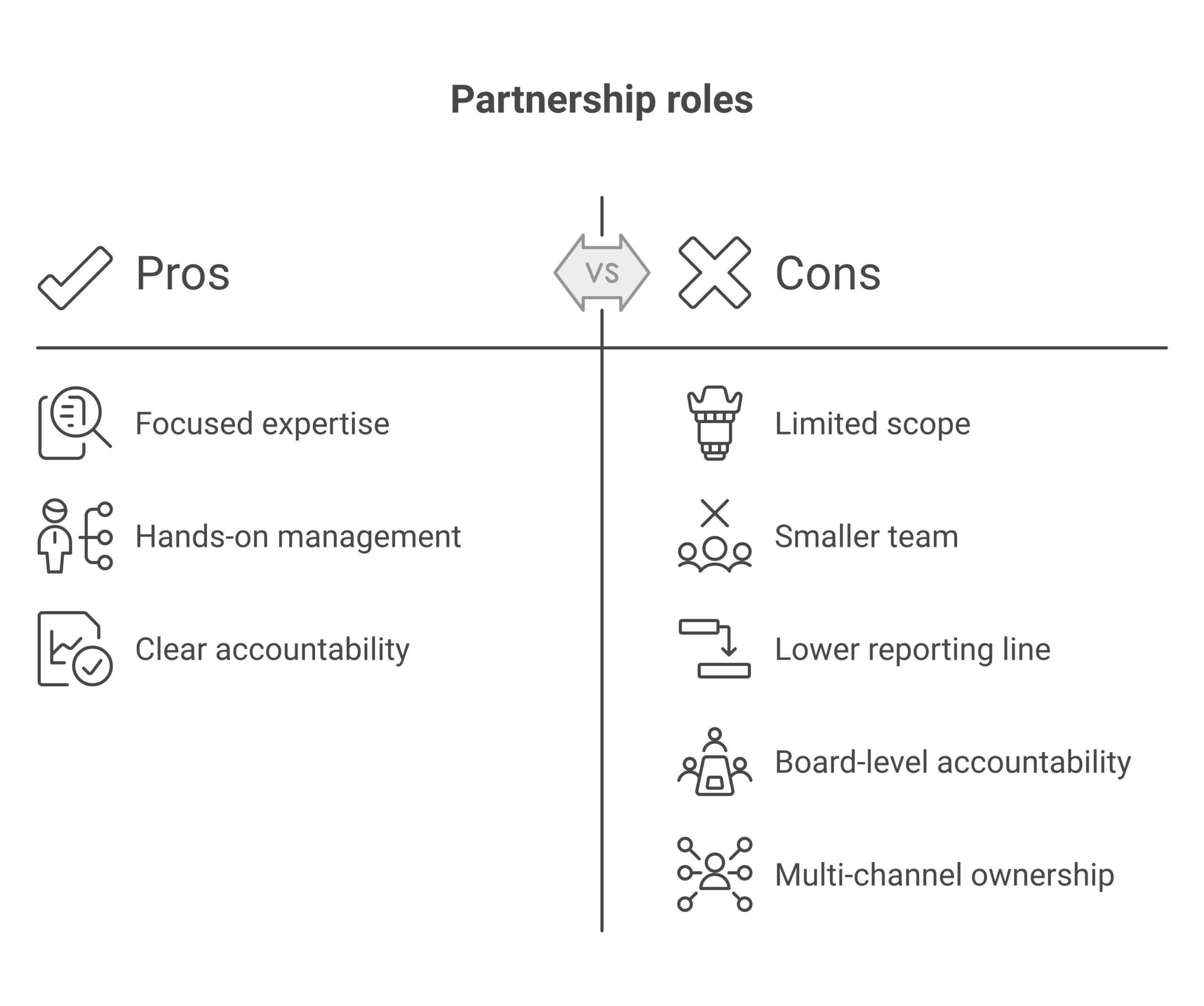
- Scope of the program: A head of partnerships often owns one or two motions; a VP of partnerships typically owns a multi-channel program spanning technology, reseller, services, and referral partners.
- Team structure: A head of partnerships may be an individual contributor or manage a small team; a VP of partnerships almost always leads managers and sometimes directors beneath them.
- Reporting line: Both usually report into go-to-market, but a VP is more likely to sit directly under the CRO or CEO with a peer relationship to other VPs.
- Accountability: A head of partnerships proves and grows the motion; a VP of partnerships carries and defends a board-level partner number and owns the program’s place in the company forecast.
The comparison is read correctly when you size the scope first and let it pick the title, and misread when you start from the title and try to justify the scope afterward.
How the two titles overlap
The overlap is real and worth naming, because it is the source of most confusion. At earlier-stage companies the partnerships function is one person, and whether that person is called head of partnerships, director, or VP is often a recruiting decision more than a leveling one. In that context the titles are interchangeable, and the comparison is academic.
The overlap ends as the function grows. Once there is a team to lead and a number to commit in the forecast, the two titles describe different jobs: one builds and runs, the other leads leaders and owns the executive accountability. The same person often moves from one to the other as the program scales, which is why the comparison is better understood as two points on a path than as a binary choice.
When to use each title
Use head of partnerships when the role owns the function but the scope is still a single or early-stage motion, the team is small or nonexistent, and the priority is proving the program works. The title signals ownership without over-claiming a level the scope does not yet support, and it leaves room to grow into a VP seat as the number matures.
Use VP of partnerships when the role leads a team, owns a multi-channel program, and carries a board-reported partner number that it must commit and defend in planning. The VP title is not a reward for tenure; it is the right level for the scope of accountability the job actually holds. When the scope and the title match, the leader has the seat and authority the work requires.
Common pitfalls in comparing the two
- Choosing the title before the scope: Picking VP to win a candidate, then handing over a manager’s scope, creates a leader who cannot deliver on the rung. Size the scope first.
- Treating “head of” as junior: At many companies “head of partnerships” is the senior-most partnerships title. It is not automatically below VP; it depends on what the role owns.
- Ignoring the team signal: The clearest separator is whether the role leads other partnership leaders. A title that claims VP with no team to lead is usually over-leveled.
- Forgetting the forecast seat: The VP-level job includes committing a number in planning. If the role will not sit in that room, the VP title is describing authority it does not have.
What this looks like in practice
A company promoted its head of partnerships to VP at the same moment the function changed shape. For two years the leader had owned one co-sell motion as an individual contributor reporting to the CRO; the head-of title fit. Then the program grew to span resellers and services partners, two partner managers were hired in, and the partner number moved onto the board deck. At that point the work had become a VP job, leading leaders and defending a number in the forecast, so the title caught up to a scope the person had already grown into. The promotion was not a reward; it was the title matching the job.
Forecastable’s POV on head of partnerships vs VP of partnerships
Our position is that this is one function at two scopes, and the honest way to choose between the titles is to size the accountability first. Both roles own the partner revenue program; the VP title simply marks the point where the leader is running a team and committing a number at the executive level. Decide the scope, the team, and the forecast seat, and the right title is no longer a debate.
The second conviction is that the team and the forecast seat are the real separators, not the word “head” or “VP.” A leader who manages other partnership leaders and defends a partner number in planning is operating as a VP regardless of the title on the door, and a solo builder proving a first motion is operating as a head or director regardless of an inflated title. Match the title to the scope and the role gets the authority it needs; mismatch them and you spend the next year reconciling a name with a job.
Forecastable is a partnerships operating platform; any third-party titles or frameworks referenced here are independent and naming them is not an endorsement of one structure over another. Level both titles against your own program scope.
Frequently asked questions
Is VP of partnerships higher than head of partnerships?
Usually, yes, at companies that use both. The VP title signals a higher rung with a team and a board-level number. At smaller companies the two titles can describe the same job.
Can head of partnerships and VP of partnerships be the same role?
Yes, at earlier-stage companies where the function is one person. The titles only diverge once there is a team to lead and a number to commit in the forecast.
Which title should a first partnerships hire get?
Usually head of partnerships or director, since a first hire is proving one motion without a team. Reserve VP for when the role leads leaders and defends an executive-level number.
Do both roles report to the same person?
Both typically report into go-to-market, often to the CRO or CEO. A VP is more likely to sit directly under the CRO as a peer to other VPs.
Does the title change the responsibilities?
The core responsibilities, recruit, enable, co-sell, and measure, are the same. The VP role adds leading a team and owning the program’s place in the company forecast.
Next step
If you are deciding between these titles, size the scope, team, and forecast accountability before you choose the words. Forecastable helps leaders define the motion and the number a partnerships role owns, so the title matches the job instead of the ambition. Start your growth journey now to scope the role against a real program. The partner program hub frames how both titles fit the wider operating model, and the related head of partnerships seniority level breaks down the leveling signals in detail.
Uncover Your Growth Potential
Schedule a Discovery Call