Head of Partnerships Seniority Level: Where It Sits

What is the head of partnerships seniority level?
Short answer: The head of partnerships seniority level usually runs from senior manager to vice president, set by the scope the role owns rather than the words in the title. It is decided by four things: how much revenue the program is accountable for, how many people report in, who the role reports to, and how much budget and decision authority it carries.
The phrase is a leveling question, not a job description. Two companies can both post a “head of partnerships” opening and mean very different rungs, because one is a first hire owning a single motion and the other is an executive running a multi-channel ecosystem with a team underneath.
Why the head of partnerships seniority level matters in 2026
Leveling matters because it sets compensation, reporting line, and the authority to actually change a number. A title given two rungs above its real scope creates a leader who cannot get the cross-functional cooperation the program needs, and a title set too low buries partner revenue under a manager who cannot defend it in a planning meeting.
It matters more in 2026 because partner-influenced revenue is now a line leadership expects to see. When the program carries a real number, the person who owns it has to sit high enough to be in the room where that number is committed, which pushes the right seniority level up toward director and VP at companies that take the channel seriously.
How the head of partnerships seniority level is set
The level is set by stacking four signals, where each one moves the rung up or down. Read them together, not in isolation, and the title becomes obvious.
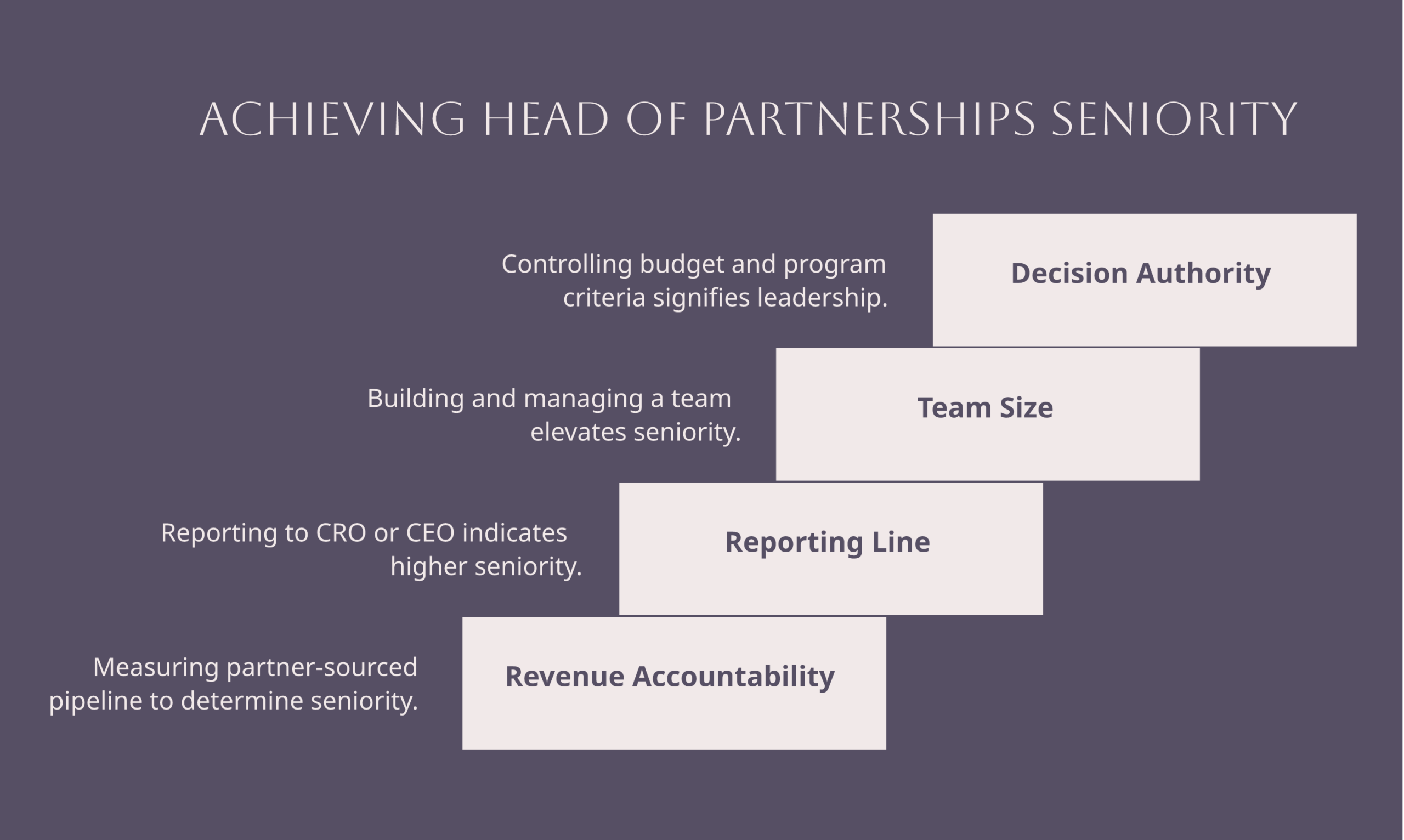
- Revenue accountability: The more partner-sourced and partner-influenced pipeline the role is on the hook for, the higher the rung. A program carrying a board-level number needs a director or VP, not a manager.
- Reporting line: A role reporting to the CRO or CEO levels higher than one reporting to a director of sales. The reporting line signals how strategic leadership considers the function.
- Team size and structure: An individual contributor building the first motion is a manager or senior manager. Someone hiring and managing partner managers is a director; someone running directors is a VP.
- Decision authority and budget: Control over partner program budget, tooling, and tiering criteria pushes the level up. A head who must ask permission for every spend is leveled below the title.
The seniority level is honest when the rung matches the scope, and inflated when a “head of” title sits on a manager’s authority and a manager’s seat at the table.
Common pitfalls with leveling this role
- Title inflation at the first hire: Calling the first partnerships hire a VP to win the candidate, then giving them no team and no budget, sets up a leader who cannot deliver on the rung. Match the title to the real scope.
- Burying the role under sales: Leveling the head of partnerships as a line manager under a sales director hides partner revenue and starves it of executive air cover. The reporting line should reflect the number it carries.
- Confusing tenure with scope: A long-tenured partner manager is not automatically a head of partnerships. Seniority here is about owned scope, not years served.
- Ignoring the channel mix: A single-motion referral program and a multi-channel ecosystem are different jobs. Leveling both the same way mis-sizes at least one of them.
What this looks like in practice
A Series B company hired its first partnerships leader and debated the title for a week. The honest answer came from scope, not preference: this person would own one co-sell motion, carry a defined partner-sourced pipeline target, report to the CRO, and hire two partner managers in year one. That is a director-level job, so they posted it as Director of Partnerships with a VP path written into the plan once the team and number grew. A year later, with three reports and a board-reported partner number, the promotion to VP matched a rung the person had already grown into rather than one handed over early.
Forecastable’s POV on the head of partnerships seniority level
Our position is that you level the scope, then name the title. The market treats “head of partnerships” as if it were a single rung, but it spans senior manager to VP depending on what the role actually owns. Decide the four signals first, revenue accountability, reporting line, team size, and authority, and the right level falls out. Pick the title first and you will spend the next year reconciling a name with a job that does not match it.
The second conviction is that the reporting line is the tell. A partnerships leader who reports into the revenue org at the executive level can pull the cross-functional cooperation the program needs from product, marketing, and sales. One buried two layers down cannot, regardless of the title on the offer letter. If you want the program to carry a real number, seat its owner where numbers get committed.
Forecastable is a partnerships operating platform; any third-party tools, titles, or frameworks referenced here are independent and naming them is not an endorsement of one structure over another. Level the role against your own program scope.
Frequently asked questions
What level is a head of partnerships?
Most commonly director or VP, though the same title is used for senior-manager-level first hires. The real level is set by scope: revenue owned, team size, reporting line, and budget authority.
Is head of partnerships a C-level role?
Rarely. It is usually a director-to-VP role reporting into the CRO or CEO. A true C-level partnerships seat (such as Chief Partner Officer) exists only at companies where the ecosystem is a primary growth engine.
Does head of partnerships outrank a partner manager?
Yes. A partner manager runs individual partner relationships; the head of partnerships owns the program and usually manages the partner managers or sets the strategy they execute.
Should the first partnerships hire be a VP?
Usually not. A first hire building one motion with no team is a manager-to-director job. Reserve the VP title for when there is a team to lead and a board-level number to defend.
Who does a head of partnerships report to?
Most often the CRO or, at earlier-stage companies, the CEO. The reporting line is itself a seniority signal: the higher it sits, the higher the role is genuinely leveled.
Next step
If you are sizing this role, write down the four signals before you write the title, then level the scope you actually have. Forecastable helps partnerships leaders define the motion and the number the role will own, so the seniority level is set by evidence instead of negotiation. Start your growth journey now to scope the role against a real program. The broader partner program hub covers how this seat fits the wider operating model.
Uncover Your Growth Potential
Schedule a Discovery Call