How to Get Sales Team to Co-Sell, Step by Step

What does getting a sales team to co-sell mean?
Short answer: How to get sales team to co-sell reduces to one rule: make the partner the easy path on accounts reps already work. They adopt a partner when it shortens their next close, not when they are told partners matter, so engineer that on real accounts until the behavior sticks.
Getting a sales team to co-sell is not a motivation problem you solve with a kickoff speech. It is a workflow and incentive problem you solve by making co-selling the lower-friction, faster-paying path on deals the rep already cares about.
Why getting a sales team to co-sell matters in 2026
How to get sales team to co-sell matters in 2026 because the partner-influenced number is a board metric, and the only people who can move it are the reps carrying quota. Leadership can plan a co-sell motion, but it produces nothing until the sales team runs it.
The second reason is attention scarcity. Reps have higher quotas and less time, so any co-sell ask that costs effort without paying back in pipeline gets ignored. The motion has to make the rep’s existing work easier, not add a category of work.
How to get a sales team to co-sell
Getting a sales team to co-sell works by removing the friction and adding the payoff on the rep’s real accounts, so co-selling becomes the path of least resistance rather than an extra task.
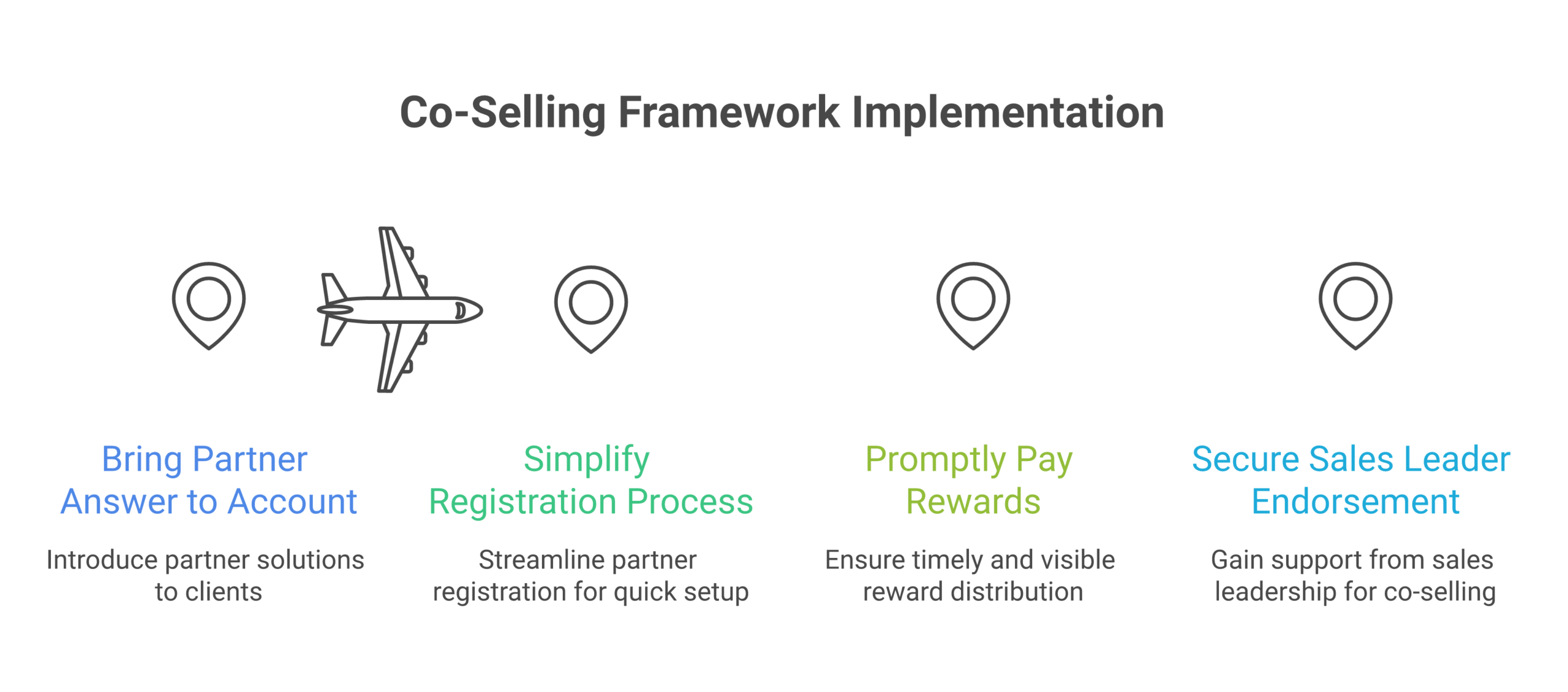
- Bring the partner answer to the account: For each account a rep works, tell them which partner fits and why, so they do not have to discover it. A per-account partner recommendation dropped into the rep’s account plan is what makes the partner feel like help on existing work.
- Make registration take seconds: Rebuild deal registration so it is a fast step inside the CRM, not a five-minute form. Friction at registration is where co-sell behavior quietly dies, so removing it is the highest-leverage fix.
- Pay the reward promptly and visibly: Tie a spiff or recognition to partner-sourced and influenced deals and pay it on the same cadence as direct comp. A reward that lags the close by quarters teaches the rep the motion is not worth it.
- Get the sales leader to endorse it: Have the CRO or sales leader back the motion in front of the floor, repeatedly. A co-sell ask the sales leadership has not personally endorsed is read by reps as optional.
You are getting the sales team to co-sell when reps start requesting the per-account partner recommendations on their own, and you are failing when co-sell is mandated but registrations stay near zero because the friction outweighs the payoff.
Common pitfalls in getting a sales team to co-sell
- Leading with the partnership, not the account: Telling reps that partners help in general changes no behavior. The motion has to arrive as a specific partner fit on a specific account the rep is already working.
- Mandating co-sell on a slow workflow: Requiring registration on a five-minute form teaches reps to route around the partnerships team. Ease has to come before the mandate.
- Rewards that pay late: A spiff paid two quarters after the close does not reinforce anything. Prompt payment on the direct-comp cadence is what makes the reward register.
- No leadership signal: Without the sales leader endorsing the motion to the floor, reps correctly infer it is optional and prioritize their quota the usual way.
What this looks like in practice
A company mandated co-sell and saw almost no registrations. The partnerships team had run a kickoff, set up deal registration, and announced a spiff, but reps were not co-selling. The problem was friction and timing, registration took five minutes, the spiff paid the following quarter, and reps had to figure out which partner fit which account themselves. So they did the math and skipped it. The fix removed the friction and added the payoff on real accounts. The team produced a per-account partner recommendation for every rep, rebuilt registration into a thirty-second CRM step, and moved the spiff onto the monthly comp cadence. The sales leader endorsed it on the floor. Within a quarter, registrations climbed and reps began asking for the partner recommendations, because co-selling had become the easier, faster-paying path on accounts they already worked.
Forecastable’s POV on getting a sales team to co-sell
The position we hold is that reps are rational, and a sales team that will not co-sell is usually telling you the motion costs more than it pays. The instinct is to treat low adoption as a motivation problem and respond with more messaging, but the real fix is to lower the friction and raise the payoff until co-selling is the obvious choice on the right accounts.
The second conviction is that the unit of adoption is the account, not the partner. Reps do not adopt partners as a category; they co-sell a specific partner on a specific deal when it helps. Moving the partnerships team’s work to the per-account level is what changes behavior.
The honest caveat is that even a frictionless, well-paid motion will not get reps to co-sell on accounts where the partner adds nothing. The goal is not universal co-selling, it is co-selling where a partner genuinely shortens the path, and pushing it everywhere else just teaches reps to discount the whole motion.
Forecastable is a partnerships operating platform; any third-party tools or platforms referenced here are independent third-party products, and naming them is not an endorsement of one deployment over another. Evaluate each against your own motion.
Frequently asked questions
What is the fastest way to get a sales team to co-sell?
Give reps a per-account partner recommendation and make deal registration take seconds. Putting the partner inside the rep’s existing workflow changes behavior faster than any amount of messaging.
Why do reps resist co-selling?
Usually because it costs effort without paying back, slow registration, late rewards, and no account intelligence. Reps are rational; low adoption is a sign the motion costs more than it returns.
Do spiffs make a sales team co-sell?
Spiffs help only after the friction is removed and on prompt payment. A spiff on a deal the rep cannot easily find or that pays late produces little.
What role does the sales leader play?
A repeated, visible endorsement to the floor. Without it, reps infer the co-sell motion is optional and deprioritize it against quota.
Should co-selling be mandatory?
Mandates work only once co-selling is easy and rewarding. Mandating a high-friction motion teaches reps to route around it rather than adopt it.
Next step
If you have mandated co-sell and registrations are still flat, the fix is almost never more motivation, lower the friction and speed the reward on the accounts reps already work.
Start your growth journey now to build a co-sell motion your sales team will actually run, or see the orientation on co-sell for how the rep motion fits the whole.
Uncover Your Growth Potential
Schedule a Discovery Call