How to Co-Sell: A Step-by-Step Guide for Reps

What is co-selling?
Short answer: How to co-sell comes down to four steps: find the accounts you and a partner both have reason to work, agree who does what, run the joint deal, and settle credit before close. It is two companies working one account together so the combined motion closes faster than either would alone.
Co-selling is not referral passing or sending a lead over a wall. It is two reps working a live account in coordination, each bringing what the other lacks, toward a single close.
Why knowing how to co-sell matters in 2026
Knowing how to co-sell matters in 2026 because partner-influenced revenue is now a number leadership tracks, and reps are the only people who can produce it. A co-sell motion that lives in a plan but never in a rep’s behavior produces nothing.
The second reason is deal velocity. A partner already trusted inside an account can shorten the path to a close, and reps who know how to co-sell capture that speed instead of grinding the account alone.
How to co-sell, step by step
Co-selling works when a rep runs a defined sequence on a real account rather than improvising the partner involvement each time.
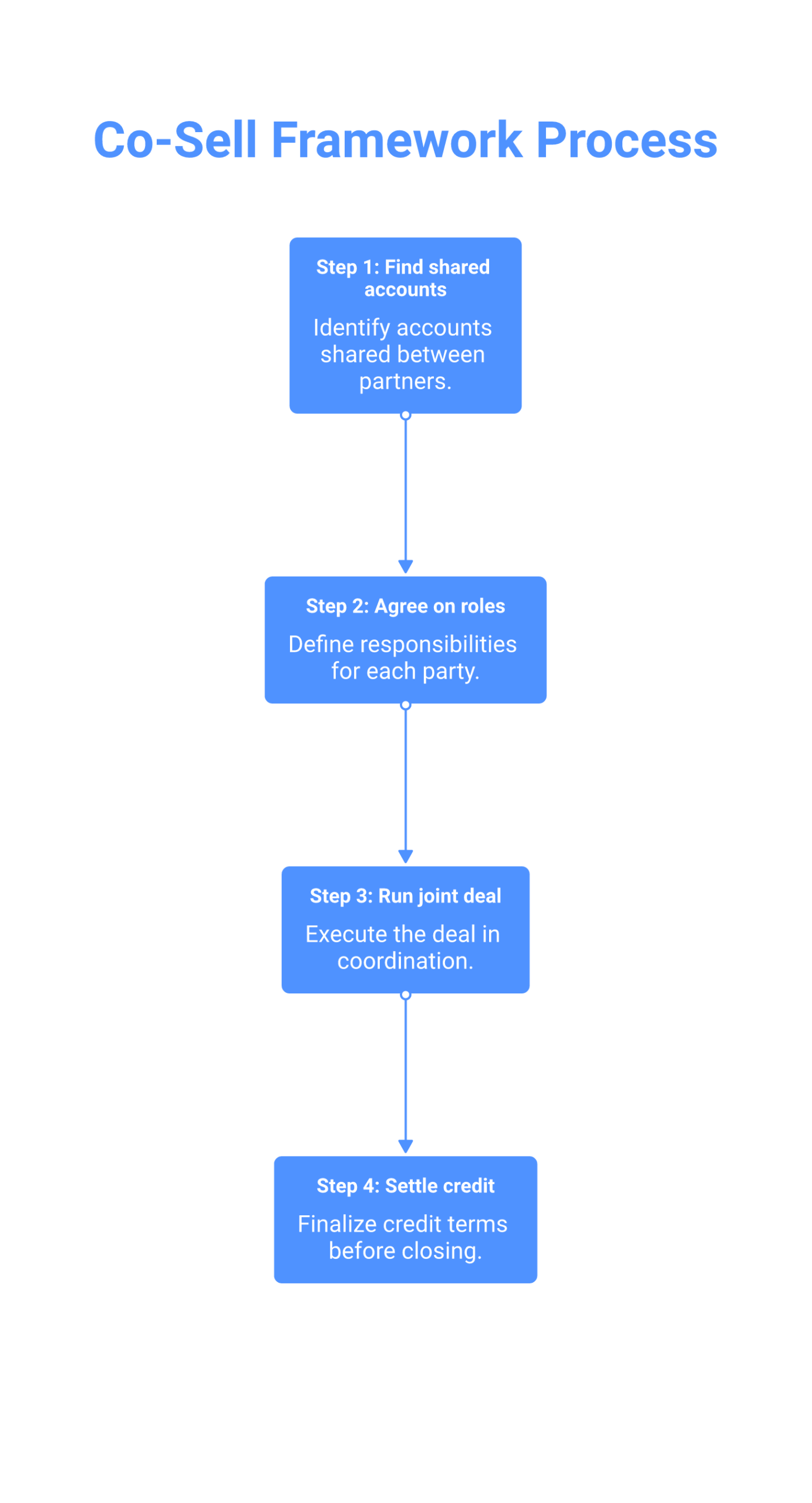
- Find the shared accounts: Start from accounts where you and the partner both have a reason to be, ideally from shared-customer or shared-prospect overlap. Co-selling on an account with no real overlap is effort with no advantage, so the shared-account list is where the motion begins.
- Agree who does what: Before the joint customer conversation, settle who fronts the customer, who handles the technical or domain piece, and how you will coordinate. The division of labor decided up front is what keeps the joint call from being two vendors talking over each other.
- Run the joint deal in coordination: Work the account together against the agreed motion, the partner opening trust where they have it, you carrying the parts you own. Coordination through the deal, not just at the start, is what makes co-selling faster than going alone.
- Settle credit before the close: Agree how the deal is credited, sourced or influenced, to whom, before it closes. Credit settled in advance is what keeps the partnership intact after the win instead of turning the first real deal into a dispute.
You are co-selling well when a partner is genuinely shortening the path on a named account and both sides know their role and their credit, and badly when the partner is looped in for show but the deal still runs entirely on your side.
Common pitfalls when learning to co-sell
- Co-selling without overlap: Pulling a partner into an account where they have no real presence adds coordination cost and no advantage. Start from shared-account data, not from a wish to involve the partner.
- Undefined roles on the joint call: Two reps who have not agreed who does what turn the customer conversation into a confusing duet. The division of labor has to be settled before the call.
- Credit left to the end: Deferring the credit conversation until after the win guarantees a worse one. Settle attribution before the deal closes.
- Looping the partner in too late: Bringing a partner in after the deal is nearly done captures none of their trust advantage. Co-selling works when the partner is involved early enough to actually shorten the path.
What this looks like in practice
A rep had a stalled enterprise deal where the buyer kept deferring to a trusted services firm before committing. Instead of pushing harder alone, the rep checked the shared-account data, confirmed the services firm was a partner, and co-sold. They agreed the partner would front the relationship and vouch for fit while the rep ran the platform evaluation, and they settled in advance that the deal would be credited as partner-sourced. The buyer, hearing the endorsement from the advisor they already trusted, moved. The deal that had stalled for a quarter closed within weeks, not because the rep sold harder but because they co-sold, bringing in the trust they did not have and coordinating the motion around it.
Forecastable’s POV on how to co-sell
The position we hold is that co-selling is a coordination skill, not a personality trait. Reps who co-sell well are not more partner-friendly, they run a defined sequence, shared accounts, agreed roles, coordinated deal, settled credit, on a real opportunity. The sequence is teachable, and the reps who learn it close faster on the accounts where a partner has trust they lack.
The second conviction is that co-selling starts from data, not enthusiasm. The reps who waste effort are the ones who involve a partner because the partnership team asked, on accounts where there is no overlap. The reps who win start from where the partner already has presence and co-sell only there.
The honest caveat is that co-selling adds coordination cost, and on a deal a rep can win alone, that cost is not worth paying. Co-selling is leverage on the accounts where a partner genuinely shortens the path, and overhead everywhere else. Knowing which accounts those are is half the skill.
Forecastable is a partnerships operating platform; any third-party tools or platforms referenced here are independent third-party products, and naming them is not an endorsement of one deployment over another. Evaluate each against your own motion.
Frequently asked questions
What are the steps to co-sell?
Find the shared accounts, agree who does what, run the joint deal in coordination, and settle credit before the close. The sequence run on a real account is what co-selling is.
How is co-selling different from a referral?
A referral hands a lead over and steps away; co-selling means both reps work the live account together toward one close. Co-selling is coordination through the deal, not a handoff.
When should a rep co-sell?
On accounts where a partner has trust, presence, or capability the rep lacks, and where that genuinely shortens the path. On a deal the rep can win alone, the coordination cost is not worth it.
How early should the partner be involved?
Early enough to use their trust, before the buyer has already decided. A partner looped in at the end captures none of the advantage co-selling is supposed to provide.
Who gets credit in a co-sell deal?
Whatever the two sides agree before the close, sourced or influenced, to whom. The point is to settle it in advance so the win does not become a dispute.
Next step
If you have a stalled account where the buyer keeps deferring to someone they trust more than your team, the move is to check whether that someone is a partner and co-sell, bring in the trust you lack and coordinate the motion around it.
Start your growth journey now to build a co-sell motion your reps can run, or see the orientation on co-sell for how the motion fits together.
Uncover Your Growth Potential
Schedule a Discovery Call