Go to Market With Partners: A Practical Playbook

What does it mean to go to market with partners?
Short answer: To go to market with partners means building your route to customers around partners who already have the trust, reach, or capability you lack, rather than reaching every buyer directly. It decides where partners carry the selling motion and where your own team does, so the two routes combine instead of duplicating each other.
It is not the same as having partners. Many companies sign partners and still go to market entirely directly, treating partner deals as occasional extras. Going to market with partners means the partner route is a deliberate part of how the company reaches and closes its market.
The test is whether your go-to-market plan names where partners lead, where they support, and where you go direct. A plan that lists partners without assigning them a role in the motion has partners but does not go to market with them.
Why going to market with partners matters in 2026
Going to market with partners matters in 2026 because buyers increasingly start with someone they already trust, and that someone is often a partner. The first conversation about a problem now frequently happens with a consultant, a platform, or a services firm the buyer relies on, and a company reaching only directly is not in that conversation.
The second reason is reach efficiency. Building direct reach into every segment is slow and expensive, while a partner who already serves a segment offers reach you do not have to build. Going to market with partners lets a company cover more market without scaling headcount linearly into every corner of it.
The third reason is credibility. In categories where buyers are wary of vendor claims, a partner’s endorsement carries weight a direct pitch cannot. Going to market with partners borrows trust the company would otherwise have to earn from scratch with every buyer.
How going to market with partners actually works
Going to market with partners works by assigning partners a defined role in the motion based on what they bring, then building the joint execution so the partner route and the direct route reinforce each other.
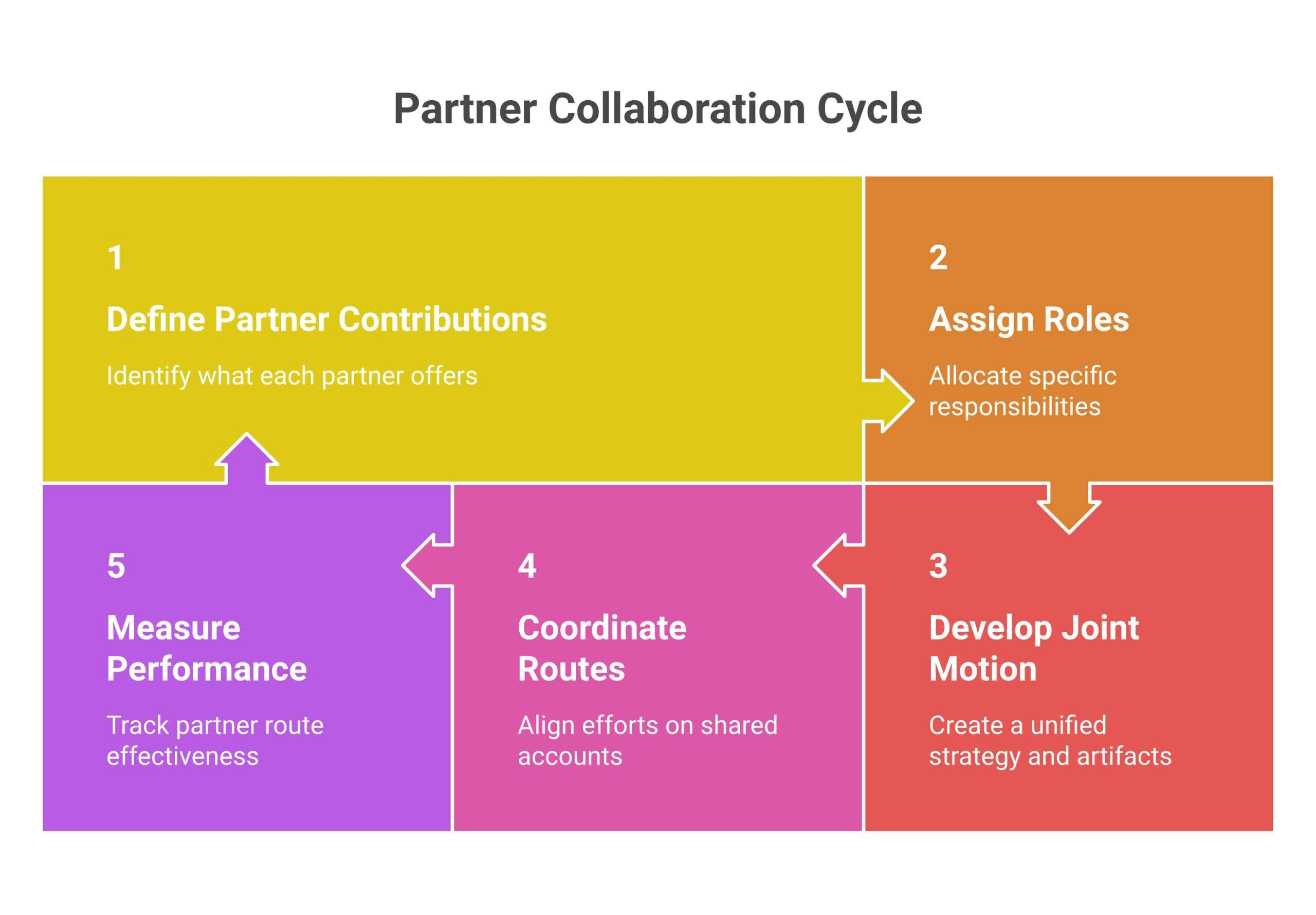
- Decide what each partner brings to the motion: Sort partners by whether they bring reach, trust, capability, or all three. The role you assign a partner has to match what they actually offer, because a partner with reach but no capability runs a different motion than one with deep technical fit.
- Assign partners a role per segment: Decide where partners lead the customer relationship, where they support a direct motion, and where you go direct without them. A clear role per segment is what keeps the partner and direct routes from duplicating effort on the same buyer.
- Build the joint motion and the artifacts: Give the partner what they need to carry their role, a joint value proposition, a pitch, a clear handoff to your team. A partner cannot lead a motion they have not been equipped for, so the artifacts are part of the go-to-market, not an afterthought.
- Coordinate the routes on shared accounts: Define how the partner motion and the direct motion interact where both touch an account, who fronts the customer and how credit works. Going to market with partners breaks down exactly where the two routes meet without coordination.
- Measure the partner route as its own line: Track what the partner route produces, sourced and influenced, so it is managed against a target. A partner motion that is not measured separately gets absorbed into the direct number and quietly defunded.
Going to market with partners is working when each partner has a defined role matched to what they bring and the routes coordinate on shared accounts, and it is failing when partners are signed but no part of the motion is theirs to lead.
Common pitfalls in going to market with partners
- Partners with no assigned role: Signing partners without deciding what part of the motion is theirs leaves them as a directory rather than a route. The motion only works when each partner has a defined job in it.
- Role mismatched to what the partner brings: Asking a reach partner to do deep technical selling, or a capability partner to drive broad demand, sets the motion up to fail. The role has to match the partner’s actual strength.
- Equipping partners as an afterthought: Expecting partners to carry a motion without the joint pitch, the artifacts, and a clear handoff guarantees they will not. The enablement is part of the go-to-market, not a follow-up task.
- Routes that collide on shared accounts: When the partner motion and the direct motion both pursue the same buyer without coordination, they confuse the customer and fight over credit. The interaction on shared accounts has to be designed.
- No separate measurement of the partner route: A partner motion folded into the direct number cannot be defended or improved, and tends to lose resourcing. Measuring the partner route on its own line is what keeps it a managed part of the go-to-market.
What this looks like in practice
A company selling into both mid-market and enterprise had built a strong direct motion in mid-market and was struggling to crack enterprise, where buyers wanted a trusted advisor in the room and the direct team had no relationships. The company had signed several services partners with deep enterprise relationships, but those partners had no defined role, so they sat idle while the direct team kept bouncing off the same enterprise accounts.
The company rebuilt its go-to-market to assign partners a role by segment. In enterprise, the services partners would lead the relationship and bring the company in for the platform, because the partner had the trust the direct team lacked. In mid-market, the direct team kept the lead and partners supported with technical capability. The company equipped the enterprise partners with a joint pitch and a clear handoff, and set up coordination so the routes did not collide.
Enterprise pipeline, which the direct team had not been able to move, began to open through the partner route within two quarters. The company had not added enterprise sellers or relationships. It had assigned partners the role they were actually suited for, leading where they had trust the company did not, and equipped them to carry it.
Forecastable’s POV on going to market with partners
The position we hold is that going to market with partners is a role-assignment problem before it is a relationship problem. Most companies have partners; what they lack is a decision about what part of the motion is the partner’s to lead. The leverage is in matching each partner’s actual strength, reach, trust, or capability, to a defined role, and a company that does this well goes to market wider than its headcount would allow.
The second conviction is that the routes have to be coordinated, not parallel. The most common failure is a partner motion that runs alongside the direct motion and collides with it on shared accounts, confusing buyers and breeding credit disputes. Designing the interaction on shared accounts up front is what lets the two routes reinforce each other instead of competing.
The honest caveat is that going to market with partners means giving up some control of the customer relationship, and that is genuinely uncomfortable. Where a partner leads, the company is not in the room for every conversation, and that requires trust the company has to be willing to extend. Companies that cannot tolerate that loss of control should be honest that they are not actually going to market with partners, they are using partners as lead sources for a direct motion.
Forecastable is a partnerships operating platform; any third-party tools or platforms referenced here are independent third-party products, and naming them is not an endorsement of one deployment over another. Evaluate each against your own motion.
Frequently asked questions
What does going to market with partners mean?
It means building your route to customers around partners who have trust, reach, or capability you lack, with each partner assigned a defined role in the motion, rather than reaching every buyer directly.
How is it different from just having partners?
Having partners is signing relationships; going to market with partners is assigning them a role in how you reach and close the market. Many companies have partners and still sell entirely directly.
How do you decide what role a partner plays?
Match the role to what the partner actually brings, reach, trust, or capability, and to the segment. A reach partner and a capability partner run different motions, so the role has to fit the strength.
What do partners need to carry a go-to-market role?
The joint value proposition, a usable pitch, and a clear handoff to your team. A partner cannot lead a motion they have not been equipped for, so the enablement is part of the plan.
How do you keep partner and direct routes from colliding?
Design how they interact on shared accounts, who fronts the customer and how credit works, before deals are in flight. Coordination on the overlap is a design requirement, not an afterthought.
How should the partner route be measured?
As its own line, sourced and influenced pipeline, separate from the direct number. A partner motion folded into the direct total cannot be defended and tends to lose resourcing.
Next step
If you have partners but every part of the selling motion still belongs to your direct team, the move is to assign partners a role matched to what they bring and equip them to lead where they are strongest.
Start your growth journey now to build a go-to-market with partners that widens your reach, or see the orientation on the partner program for how the partner route fits the operating model.
Uncover Your Growth Potential
Schedule a Discovery Call