CSM Partner Enablement: Turning Success Into Pipeline

What is CSM partner enablement?
Short answer: CSM partner enablement is the practice of equipping customer success managers to bring partners into the post-sale motion, retention, adoption, and expansion. It makes the CSM a channel for partner value rather than a function that operates as if partners did not exist, which is how most success orgs run by default.
It is not the same as training a CSM on a product integration. CSM partner enablement is about teaching the success team when and how to pull a partner into an account to protect a renewal or open an expansion, not just to answer a technical question.
The test is whether a CSM, looking at an at-risk or expandable account, knows which partner to involve and how. A success org where partners only appear when something breaks has not enabled its CSMs on partners, it has left them to discover partners by accident.
Why CSM partner enablement matters in 2026
CSM partner enablement matters in 2026 because net revenue retention is the metric the board watches most closely, and partners are one of the few underused levers on it. A partner already embedded in a customer’s environment can stabilize a shaky renewal or surface an expansion the CSM cannot see alone, but only if the CSM knows to use them.
The second reason is that the partner-influenced number is increasingly post-sale, not just pre-sale. Expansion and renewal influenced by a partner is real partner revenue, and it is invisible if the success org never loops partners in. Enabling CSMs to involve partners is how that revenue gets created and counted.
The third reason is workload. CSMs are stretched across larger books, and a partner who can take part of the adoption or technical load on an account is leverage, not overhead. CSM partner enablement reframes the partner as a teammate on the account rather than another stakeholder to manage.
How CSM partner enablement actually works
CSM partner enablement works by giving the success team the account intelligence and the plays to involve partners at the moments that move retention and expansion, so the partner becomes part of the post-sale motion by design.
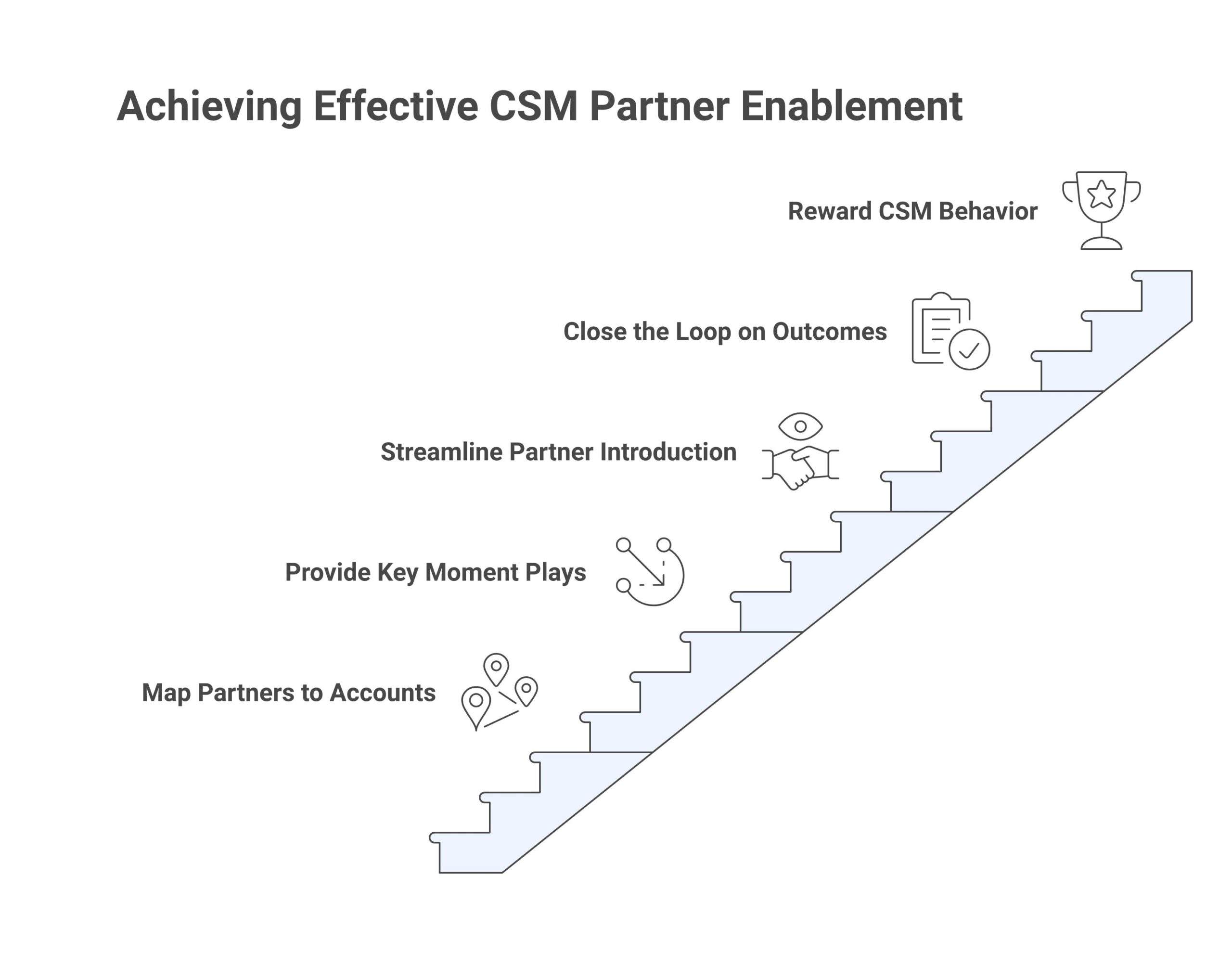
- Map partners to the account, not the product: For each account in the CSM’s book, know which partners are already present or relevant. The CSM should not have to discover the partner relationship; it should arrive as part of the account record, the way the renewal date does.
- Give the CSM partner plays for the key moments: Define what involving a partner looks like at renewal risk, at a stalled adoption, and at an expansion signal. A play per moment turns a vague awareness that partners exist into a specific action the CSM can take.
- Make the partner introduction one step: The CSM should be able to loop a partner into an account in a single, fast workflow, not a multi-email scramble. Friction at the introduction is where the partner involvement quietly dies.
- Close the loop on outcomes: Track what the partner touch produced, a saved renewal, a faster adoption, an expansion. Outcomes are what teach the CSM that involving the partner was worth it, and what justify the motion to leadership.
- Reward the behavior in the CSM’s terms: Tie partner involvement to the retention and expansion goals the CSM already owns, not to a separate partner metric. The behavior sticks when it serves the number the CSM is already measured on.
CSM partner enablement is working when CSMs proactively involve partners to protect renewals and open expansions, and it is failing when partners still only show up after a customer has already escalated a problem.
Common pitfalls in CSM partner enablement
- Partners as a break-fix resource only: A success org that calls partners only when something is broken misses every proactive retention and expansion play. The enablement has to position the partner as a forward-looking lever, not an emergency contact.
- No account-level partner map: Asking CSMs to involve partners without telling them which partner fits which account leaves the motion to memory and luck. The partner mapping has to live in the account record.
- A slow introduction workflow: If looping a partner into an account takes a chain of emails, the busy CSM skips it. The introduction has to be one fast step or it does not happen at scale.
- Measuring partner activity instead of outcomes: Counting how often CSMs involved a partner without tracking what it produced teaches nothing and proves nothing. The outcome, the saved renewal or the expansion, is the metric that matters.
- A separate partner goal bolted onto the CSM: Adding a standalone partner KPI the CSM does not care about competes with retention and loses. The behavior has to be tied to the goals the CSM already owns.
What this looks like in practice
A software company with strong logo retention had flat net revenue retention and a partner ecosystem that touched many of its largest accounts. The CSMs and the partners worked the same accounts but rarely together. Partners appeared on an account only when a technical escalation forced it, which meant the partner relationship was associated with problems rather than growth.
The change was to enable the CSMs on partners deliberately. The partnerships team built a partner map into the account record, so every CSM could see which partner was present on each account. They defined three plays, what to do with a partner at renewal risk, at stalled adoption, and at an expansion signal, and they rebuilt the partner introduction into a single workflow. Partner involvement was measured by outcome and tied to the CSM’s own retention and expansion targets.
Over two quarters, partner-influenced expansion became a visible and growing line, and a handful of renewals that the CSMs flagged as at risk were stabilized by pulling the embedded partner in early. The partners had always been present on those accounts. The enablement simply taught the success team to use them before the customer escalated, not after.
Forecastable’s POV on CSM partner enablement
The position we hold is that the post-sale motion is the most neglected source of partner revenue, and CSM partner enablement is how you tap it. Companies pour effort into getting AEs to co-sell and leave the success team, which owns the larger and stickier revenue base, operating as if partners were a pre-sale concern. The expansion and retention influenced by partners is real and largely uncaptured.
The second conviction is that the unit of enablement is the account, not the product or the partner. A CSM does not need a partner overview, they need to know which partner fits this account and what to do with them at the moments that matter. Enablement that lands at the account level changes behavior; enablement that stays at the partnership level does not.
The honest caveat is that this only works if the partner is genuinely a lever on the account, not a stakeholder to coordinate. On accounts where the partner adds no post-sale value, forcing involvement is overhead, and CSMs will rightly route around it. The enablement should concentrate on the accounts where the partner is already embedded enough to matter.
Forecastable is a partnerships operating platform; any third-party tools or platforms referenced here are independent third-party products, and naming them is not an endorsement of one deployment over another. Evaluate each against your own motion.
Frequently asked questions
What is CSM partner enablement in one sentence?
It is equipping customer success managers to bring partners into the post-sale motion, retention, adoption, and expansion, so partner value reaches accounts after the sale, not just before it.
How is it different from AE co-sell enablement?
AE enablement aims partners at new-business deals; CSM partner enablement aims them at renewals and expansions in the existing base. The base is larger and stickier, which is why the post-sale motion is worth enabling.
What does a CSM need to involve a partner well?
An account-level partner map, a play for each key moment, and a one-step introduction workflow. Without those, involving a partner depends on the CSM’s memory and patience, which does not scale.
How do you measure CSM partner enablement?
By outcomes tied to the CSM’s own goals, saved renewals and partner-influenced expansion, not by how often a partner was involved. Activity counts prove nothing; outcomes prove the motion works.
When should a CSM pull a partner into an account?
At renewal risk, at stalled adoption, and at an expansion signal, the moments where an embedded partner can change the outcome. A play per moment turns awareness into a specific action.
Does CSM partner enablement require a new KPI for CSMs?
No, and a bolted-on partner KPI usually backfires. Tie the behavior to the retention and expansion targets the CSM already owns so it serves their number rather than competing with it.
Next step
If your net revenue retention is flat while partners sit embedded in your largest accounts, the move is to enable the success team to use them, build the account map, define the moment plays, and make the introduction one step.
Start your growth journey now to build a CSM partner enablement motion that drives retention and expansion, or see the orientation on the partner program for how the success-team motion fits the whole.
Uncover Your Growth Potential
Schedule a Discovery Call