Co-Sell Strategy: Building a Motion That Produces

What is a co-sell strategy?
Short answer: A co-sell strategy is the set of decisions about which partners you sell with, which accounts you go after together, and how the joint motion runs. It chooses where co-sell effort goes so the company produces partner pipeline by design rather than by lucky overlap.
It is not a list of every partner you have signed. A co-sell strategy narrows the field to the partners and accounts where joint selling actually shortens the path to revenue, then commits resources there.
The honest test of a co-sell strategy is whether it tells a rep where to spend joint-selling effort and where not to. A strategy that treats every partner as equally worth co-selling with is not a strategy, it is a directory.
Why a co-sell strategy matters in 2026
A co-sell strategy matters in 2026 because partner-sourced pipeline is now a number leadership defends to the board, and you cannot defend a number that was produced by accident. The companies that hit their partner targets made deliberate bets on a few partners and a defined motion, and the ones that missed spread thin effort across a long partner list and hoped.
The second reason is cost. Joint selling is expensive in the scarcest resource a company has, which is rep attention. A co-sell strategy is how you decide where that attention pays back, so reps work the partners with real overlap instead of attending enablement for partners who will never touch their accounts.
The third reason is that ecosystems have gotten crowded. Most B2B companies now have dozens of technology and channel relationships, and without a strategy that ranks them, the loudest partner gets the attention rather than the most productive one. A co-sell strategy replaces the squeaky-wheel default with a ranked, evidence-based bet.
How a co-sell strategy actually works
A co-sell strategy works by making three choices in order, partners, accounts, and motion, so that joint selling is aimed before any rep is asked to execute it.
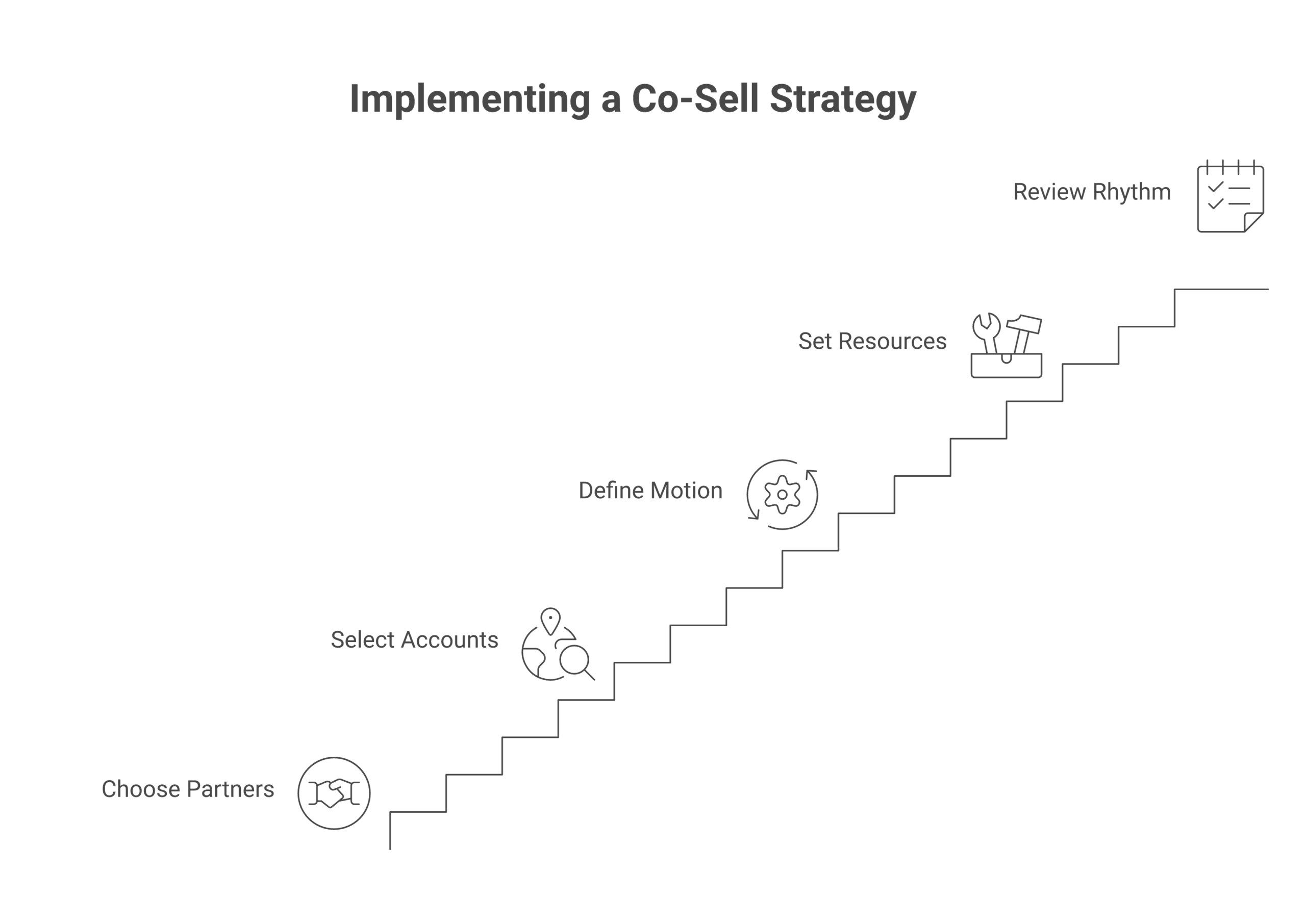
- Choose the partners worth co-selling with: Rank the partner list by real overlap and real fit, not by relationship warmth. The partners worth a co-sell motion are the ones whose customers and prospects match your target accounts, and whose product or service makes your deal easier to close.
- Choose the accounts you go after together: Within the chosen partners, name the accounts where you both have a reason to be. A strategy grounded in shared-account data gives reps a finite target list, which is what separates a strategy from a mandate to find partner deals somewhere.
- Choose the motion for each partner type: Decide how a joint deal runs for each kind of partner, who fronts the customer, who handles the technical evaluation, how leads pass. A technology partner motion and a services partner motion are not the same, and the strategy names which one applies.
- Set the resourcing and the target: Decide what headcount, enablement, and incentive back the chosen bets, and what number the motion is expected to produce. A strategy with no resourcing is a wish, and one with no target cannot be managed.
- Set the review rhythm: Decide how often the strategy is checked against results, so the bets that are not producing get cut and the ones that are get more. A co-sell strategy is a living set of bets, not a plan filed at the start of the year.
A co-sell strategy is working when a rep can name the three partners worth their time and the accounts to work with each, and it is failing when the strategy is a slide that lists every partner and ranks none.
Common pitfalls in a co-sell strategy
- Treating every partner equally: A strategy that spreads co-sell effort evenly across the whole partner list produces even mediocrity. The productive move is to concentrate on the few partners with real overlap and accept that most relationships are not co-sell relationships.
- Strategy with no account data: A co-sell strategy built on partner enthusiasm rather than shared-account evidence aims reps at accounts where there is no real overlap. Grounding the bets in data is what keeps the strategy from being aspiration in a deck.
- One motion for all partner types: Running a services partner the same way you run a technology partner wastes both. The strategy has to define a distinct motion per partner type, or reps default to whichever motion they know.
- No resourcing behind the bets: A strategy that names priorities but funds none of them collapses the moment reps face quota pressure. Bets without headcount, enablement, or incentive are bets nobody is asked to make.
- Set once, never reviewed: A co-sell strategy written in January and never checked drifts as the market moves. Without a review rhythm that cuts the dead bets, the strategy quietly becomes a list of partners nobody is actually selling with.
What this looks like in practice
A mid-market software company had forty partners and a partner-sourced number that had been flat for a year. The partnerships team was busy, running enablement, attending partner events, fielding requests, but the pipeline did not move. The problem was not effort, it was aim. There was no co-sell strategy, so effort went wherever the loudest partner asked.
The fix was to rank the forty partners by shared-account overlap and pull the top five forward. For each of the five, the team named the accounts where both companies already had a reason to be, defined a motion specific to that partner type, and assigned a rep owner on each side. The other thirty-five partners stayed signed but were explicitly de-prioritized for co-sell, which freed the attention the five needed.
Within two quarters the partner-sourced pipeline from the top five exceeded what all forty had produced the year before. The strategy did not add partners or headcount. It concentrated the same effort on the accounts where joint selling actually moved a deal, and stopped spending it where it never had.
Forecastable’s POV on co-sell strategy
The position we hold is that most co-sell underperformance is a strategy problem disguised as an execution problem. Teams assume they need to co-sell harder when they actually need to co-sell narrower. The leverage is in the choice of where to aim, and a team that aims at five productive partners beats a team that services forty.
The second conviction is that the strategy has to start from data, not from relationships. The warmest partner relationship is often not the most productive co-sell relationship, and a strategy that ranks partners by how much you like working with them aims effort at the wrong accounts. Shared-account overlap is the input that keeps the strategy honest.
The honest caveat is that a strategy narrows the field, which means saying no to partners who want a co-sell motion you have decided not to fund. That is uncomfortable, and the temptation is to keep everyone nominally a co-sell partner to avoid the conversation. A strategy that will not say no is not a strategy, and the discomfort of de-prioritizing is the price of producing.
Forecastable is a partnerships operating platform; any third-party tools or platforms referenced here are independent third-party products, and naming them is not an endorsement of one deployment over another. Evaluate each against your own motion.
Frequently asked questions
What is the difference between a co-sell strategy and a co-sell plan?
A co-sell strategy chooses which partners and accounts you bet on across the whole portfolio; a co-sell plan is the operating document for one specific partner. The strategy sets priorities, and the plan executes one of them.
How many partners should a co-sell strategy concentrate on?
Fewer than most teams expect, usually a handful where the overlap is real. Concentrating effort on the productive few beats spreading it across a long list, because rep attention is the binding constraint.
What data does a co-sell strategy need?
Shared-customer and shared-prospect overlap with each partner, so the bets are aimed at accounts where both companies have a reason to be. A strategy without overlap data is built on enthusiasm rather than evidence.
How is a co-sell strategy different by partner type?
Technology partners, services partners, and channel partners each run a different motion, so the strategy defines how a joint deal works for each. One motion applied to all partner types wastes the ones it does not fit.
How often should a co-sell strategy be reviewed?
On a regular rhythm tied to your pipeline reviews, so dead bets get cut and producing bets get more resourcing. A strategy set once and never revisited drifts out of date as the market and the partners change.
Does a co-sell strategy require more headcount?
Usually not. Most teams have enough capacity; they are spending it on too many partners. Concentrating existing effort on the productive few typically produces more without adding people.
Next step
If your partner-sourced number is flat despite a busy partnerships team, the highest-leverage move this quarter is to rank your partners by real overlap and concentrate co-sell effort on the productive few rather than servicing them all.
Start your growth journey now to build a co-sell strategy that aims effort where it pays back, or see the orientation on co-sell for how the strategy sets up the rest of the motion.
Uncover Your Growth Potential
Schedule a Discovery Call