Co-Sell Services: What They Cover and When to Buy

What are co-sell services?
Short answer: Co-sell services are outside help that builds or runs a company’s joint-selling motion, the motion design, the attribution setup, the enablement, and sometimes the ongoing management. They are the hands-on alternative to figuring out co-sell internally or buying software and hoping the motion follows.
Co-sell services sit between strategy advice and software. Advice tells you what to do; software gives you a tool; services do the building.
Companies buy co-sell services when they have partners and intent but lack the time or the experience to build a working motion themselves. The service provider supplies the experience and does the operational work.
Why co-sell services matter in 2026
Co-sell has become a core growth motion, and in 2026 co-sell services matter because the demand to build co-sell motions has outpaced the supply of people who know how. Partnerships leaders are often new to the discipline, and designing a producing co-sell motion is a specific skill. Services close that gap by bringing experience that would otherwise take a company quarters of trial and error to develop in-house.
The second reason is speed. A company can stand up a working co-sell motion far faster with experienced help than by learning the failure modes itself, and in a market where partner revenue is a planned number, that compression has real value. Services trade money for time, which is often the right trade when the motion is on the roadmap this year.
The third reason is that services fill the gap software leaves. Buying a co-sell tool does not build a motion; it provides infrastructure that an unbuilt motion cannot use. Services are what turn the intent and the tooling into an actual operating motion, which is why the two are complementary rather than competing.
How co-sell services actually work
Co-sell services work by supplying the experience and the labor to build the motion’s operating pieces, so the company ends up with a running motion rather than a plan it has to execute alone.
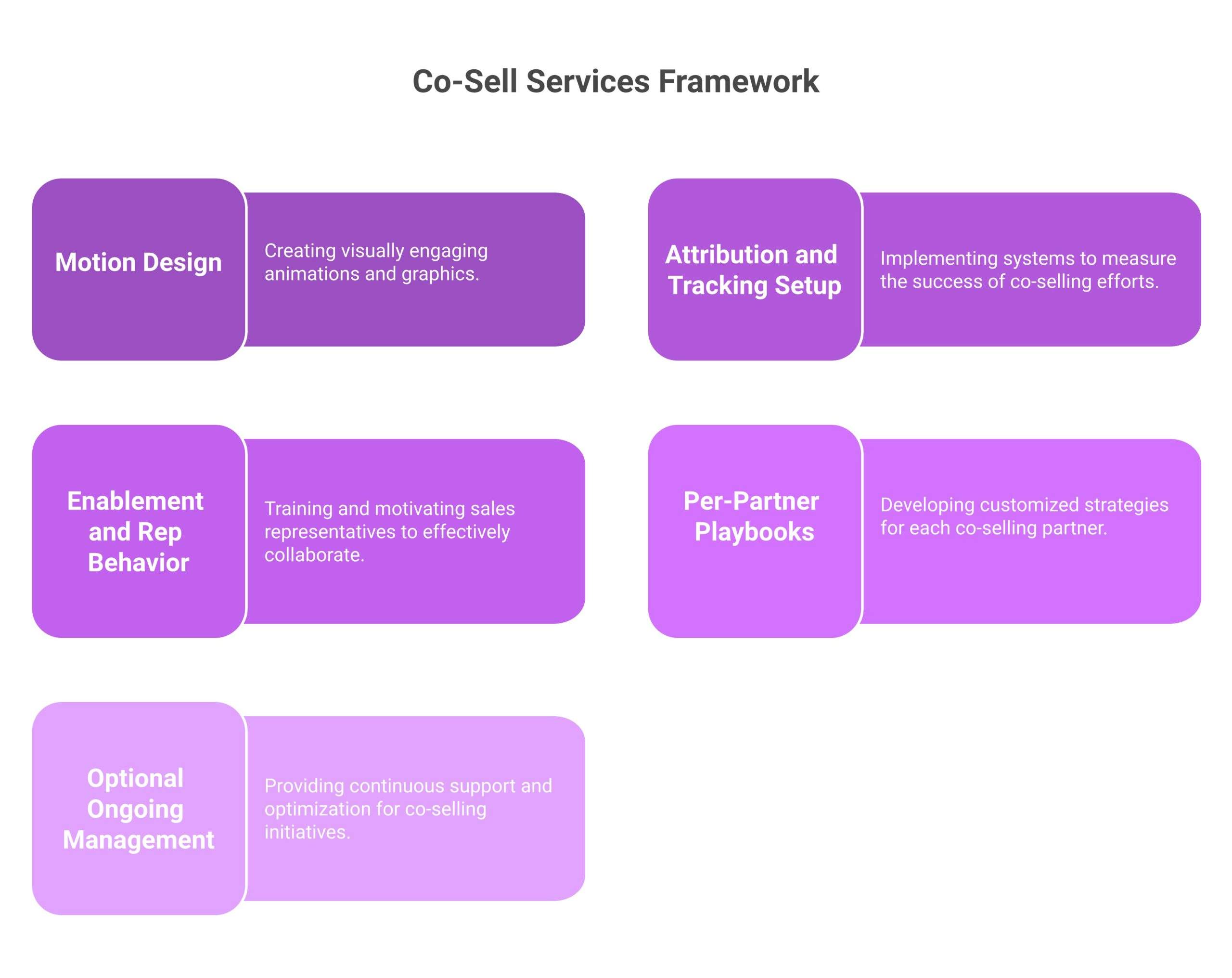
- Motion design: The service designs the defined co-sell play, who fronts the customer, how a joint deal runs, that the company’s reps will execute. Design grounded in experience is the core of what co-sell services provide.
- Attribution and tracking setup: The service instruments partner-sourced and influenced revenue in the company’s systems, so the motion can prove what it produces. This is technical, unglamorous work that companies routinely underestimate and services handle.
- Enablement and rep behavior: The service builds the enablement and helps shift rep incentives and behavior, because a designed motion nobody runs is a document. Changing how reps act is the hardest part and where experienced services earn their fee.
- Per-partner playbooks: The service translates the general motion into playbooks grounded in the company’s actual partners and their real overlap, so the motion fits the partnerships the company has rather than the abstract.
- Optional ongoing management: Some co-sell services extend into running the motion, the reviews, the partner coordination, the deal unsticking, until the company can take it over. Management support bridges the gap between a built motion and a self-sustaining one.
Co-sell services are working when the company is left with a running, owned motion and the experience to keep it going, and they are failing when the engagement produces a strategy document and no operating change, which is the most common way services money is wasted.
Common pitfalls in buying co-sell services
- Buying advice and calling it services: An engagement that delivers a strategy deck and no operating build leaves the company exactly where it started. Real co-sell services build the motion, the attribution, the playbooks; advice without the build is the most common disappointment.
- Expecting software to do the service’s job: Buying a co-sell tool and assuming the motion will follow confuses infrastructure with operation. Software supports a motion; it does not build one, and a tool bought without a motion sits unused.
- No handoff plan: Services that run the motion indefinitely without transferring it create dependency rather than capability. The engagement should leave the company able to run its own motion, not permanently reliant on the provider.
- Skipping the partner-specific work: A service that designs a generic motion and never grounds it in the company’s actual partners produces plays that do not fit. The per-partner translation is where a service becomes executable rather than theoretical.
- Hiring services for a motion that has no foundation: Paying for co-sell services when the underlying partnerships have no real overlap builds a motion on top of nothing. Services compress the work of building on good partnerships; they cannot create partner value that was never there.
What this looks like in practice
A company had signed strong partners, bought a co-sell tool, and still produced almost no joint revenue, and leadership could not understand why the software had not fixed it. The reason was that the tool was infrastructure with no motion running on it. No rep knew how to run a joint deal, attribution was set up in the tool but never populated because there was no process feeding it, and there was no reason for an AE to involve a partner. The company brought in co-sell services not to replace the software but to build the motion the software was waiting for. The service designed the play, wired the company’s process into the tool so attribution actually flowed, shifted comp so co-sell paid, built per-partner playbooks, and ran the first quarter of reviews before handing the motion to the partnerships lead. The same software that had sat idle started producing, because there was finally a motion using it.
Forecastable’s POV on co-sell services
The position we hold is that co-sell services earn their fee only when they build, and the market is crowded with providers who sell strategy and maturity models that change nothing operationally. The useful work is the play, the attribution, the incentives, the per-partner playbooks, and the handoff. A company evaluating co-sell services should ask what running motion it will own when the engagement ends, and treat any answer that is mostly a document as a warning.
The second conviction is that services and software are complementary, not substitutes, and companies waste money by treating them as either-or. A tool with no motion sits idle; a motion with no tool runs on spreadsheets. Services build the motion that makes the software useful, and the smartest buyers sequence them deliberately rather than expecting one to do the other’s job.
The honest caveat is that not every company should buy co-sell services. A team with in-house co-sell experience should build and keep the capability, and a company whose partnerships lack real overlap should fix that before paying anyone to design a motion on top. Services compress a learning curve and supply labor; they do not substitute for partnerships worth selling through or for experience a company would be better off developing itself.
Forecastable is a partnerships operating platform; any third-party tools or platforms referenced here are independent third-party products, and naming them is not an endorsement of one deployment over another. Evaluate each against your own motion.
Frequently asked questions
What do co-sell services include?
Motion design, attribution and tracking setup, enablement and rep-behavior work, per-partner playbooks, and sometimes ongoing management until the company can take over. Co-sell services do the hands-on building that turns partner intent into a running joint-selling motion.
How are co-sell services different from co-sell software?
Software is infrastructure that supports a motion; services build the motion itself. A tool bought without a motion sits unused, while services design the play, wire the attribution, and shift rep behavior. The two are complementary, and a company often needs both.
When should a company buy co-sell services?
When it has partners and intent but lacks the experience or time to build a working motion, and wants to compress the learning curve. Services are most valuable for teams building their first real co-sell motion, where in-house trial and error would cost quarters.
What is the biggest risk with co-sell services?
Buying advice instead of a build. The common disappointment is paying for a strategy deck that changes nothing operationally, leaving the company where it started. Insist on operating deliverables and a clear handoff to the team.
Do co-sell services include running the motion?
Some do. Many engagements extend into managing the motion, the reviews, the partner coordination, the deal unsticking, until the company can take it over. The key is a handoff plan, so the service builds capability rather than permanent dependency.
Can co-sell services fix a weak partnership?
No. If the underlying partnerships have no real overlap or mutual value, no motion design will make them produce. Services compress the work of building on good partnerships; they cannot create partner value that was never there.
Next step
If you have partners and a tool but no motion, the move is to decide whether the gap is experience, labor, or both, then buy services that build an owned motion rather than advice that leaves you where you started.
Start your growth journey now to build a co-sell motion you own and can run, or see the orientation on co-sell for how services fit the broader motion.
Uncover Your Growth Potential
Schedule a Discovery Call