Co-Sell Consulting: What It Is and When You Need It

What is co-sell consulting?
Short answer: Co-sell consulting is outside help that designs, builds, or fixes a company’s co-sell motion, the defined way partners and reps sell together. It covers the motion design, the attribution, the enablement, and the partner-by-partner playbooks that make joint selling produce revenue rather than meetings.
Companies bring in co-sell consulting when they have partners and ambition but no working motion. The partnerships exist on paper; the joint selling does not happen.
Good co-sell consulting is not a strategy deck. It is hands-on work that leaves behind a motion the team can run after the consultant is gone, with the attribution, the playbooks, and the rep behavior in place.
Why co-sell consulting matters in 2026
Co-sell has moved from experiment to core growth motion, and in 2026 co-sell consulting matters because most companies are trying to build that motion with people who have never built one before. Partnerships leaders are often promoted into the role from sales or marketing, and designing a co-sell motion is a specific skill that takes reps and revenue to develop in-house. Outside help compresses the learning curve from quarters to weeks.
The second reason is the cost of building it wrong. A co-sell motion that launches without attribution, without a defined play, or without rep incentives fails quietly and burns partner goodwill on the way down. Fixing a failed program is harder than building a working one, so the value of getting it right the first time is real.
The third reason is that the failure modes are known. Co-sell programs fail in a handful of predictable ways, and someone who has seen them across many companies can design against them from the start. That pattern recognition is most of what good co-sell consulting actually sells.
How co-sell consulting actually works
Co-sell consulting works as a sequence of build steps, each leaving behind something the team owns, so the engagement produces a running motion rather than a report.
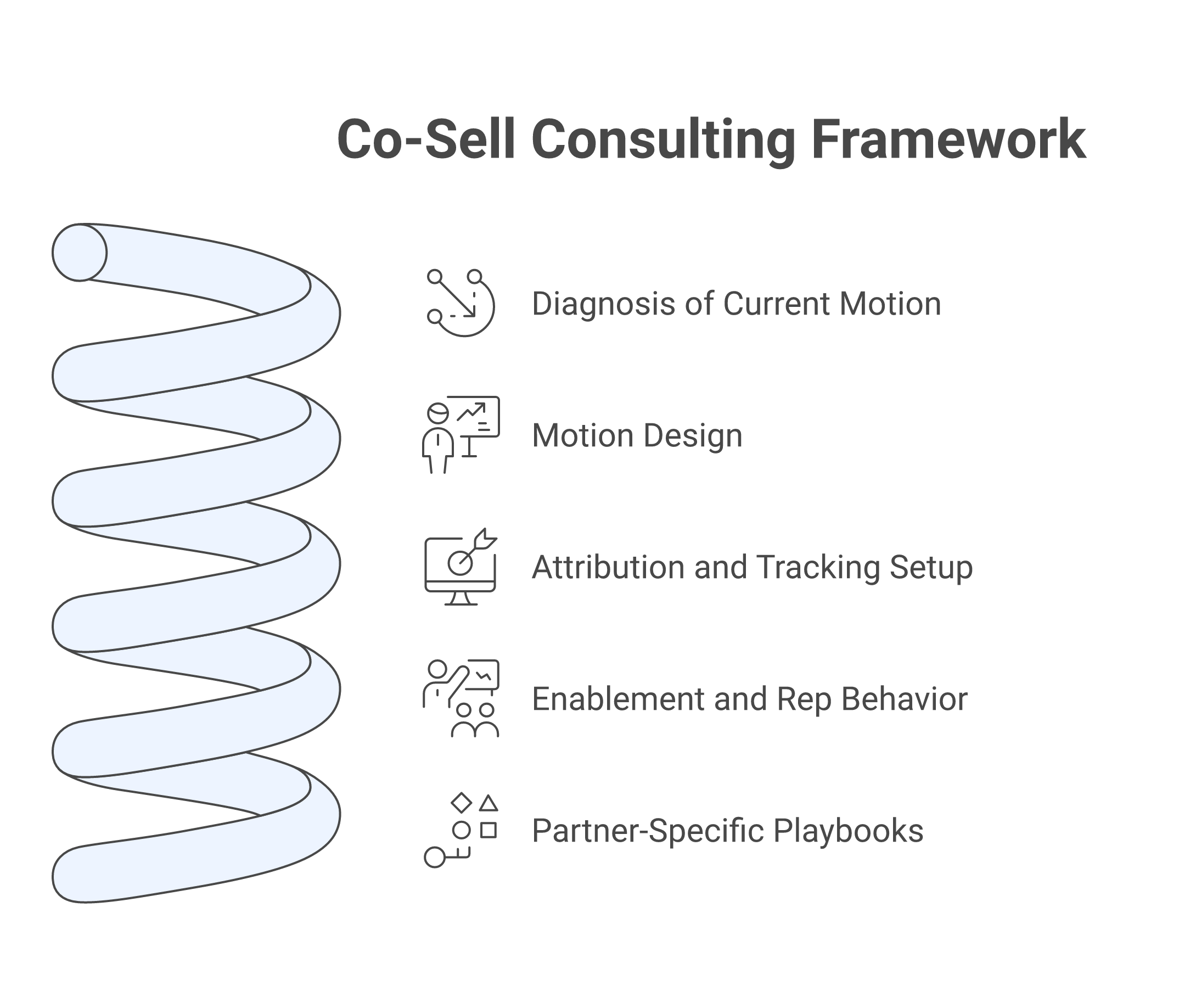
- Diagnosis of the current motion: The work starts by finding where the co-sell motion is broken or absent, no defined play, no owner, no attribution, no rep incentive. A clear diagnosis is what keeps the engagement from fixing the wrong thing.
- Motion design: The core deliverable is a defined co-sell play, who fronts the customer, how a joint deal runs, and how the partner and the rep coordinate, that any rep can execute without improvising. Design is where the consulting earns its keep.
- Attribution and tracking setup: The engagement instruments partner-sourced and influenced revenue in the CRM so the program can prove what it produces. A motion that cannot be measured cannot be defended at budget time, so this is not optional.
- Enablement and rep behavior: The consultant builds the enablement and the incentives that get reps to actually run the motion, because a designed play nobody executes is a document. Changing rep behavior is harder than designing the play and matters more.
- Partner-specific playbooks: The general motion is translated into per-partner playbooks grounded in the real overlap and value with each partner, so the program works with the partners you actually have rather than in the abstract.
Co-sell consulting is working when the team can run the motion after the engagement ends and the partner number is climbing, and it is failing when the deliverable is a strategy document that sits unused because nobody built the operating pieces.
Common pitfalls in co-sell consulting
- Buying strategy instead of build: A co-sell engagement that produces a deck and no operating motion leaves the company exactly where it started. Strategy without the attribution, playbooks, and enablement is the most common way consulting money gets wasted here.
- Skipping attribution: A motion built without instrumenting partner-sourced revenue cannot prove its value, and an unprovable program loses its budget. Consulting that does not set up tracking has built a program that cannot defend itself.
- Designing a motion reps will not run: A play that ignores rep incentives and existing behavior looks good on paper and dies in the field. The hardest and most valuable part of the work is making reps actually execute, and engagements that skip it fail.
- Generic playbooks: A co-sell motion designed in the abstract, without grounding in the real overlap and value with each partner, produces plays that do not fit the partners you have. Per-partner specificity is what makes the motion executable.
- No handoff to the team: An engagement where the consultant runs the motion and never transfers it leaves the company dependent. Good consulting builds capability the team keeps, not a dependency it has to keep paying for.
What this looks like in practice
A company signed a dozen partners over a year and closed almost nothing with any of them, and leadership assumed they needed more partners. A short diagnosis found the opposite. The partners were fine; there was simply no motion. No rep knew how to run a joint deal, partner involvement was tracked nowhere, and there was no reason for an AE to bring a partner into a deal rather than close it solo. The work that followed was not a strategy presentation. It was building, a defined co-sell play reps could run, attribution wired into the CRM, an incentive that made partner deals pay, and per-partner playbooks grounded in each partner’s actual overlap. The consultant handed the running motion to the partnerships lead and left. Two quarters later the same twelve partners were producing forecastable pipeline, because the company finally had a motion for the partnerships it had already signed.
Forecastable’s POV on co-sell consulting
The position we hold is that most companies do not have a partner problem, they have a motion problem, and co-sell consulting is worth it only when it builds the motion rather than describing it. The market is full of advisors who will sell a strategy deck and a maturity model. The useful work is operational: the play, the attribution, the incentives, the per-partner playbooks. If an engagement does not leave those behind, it has not earned its fee.
The second conviction is that the hardest part is rep behavior, and that is where consulting either earns or wastes its money. Designing a co-sell play is the easy half; getting reps to run it against the gravity of their solo quota is the half that fails. An engagement that does not touch incentives and enablement has built a motion that will not move.
The honest caveat is that co-sell consulting is not always the right call. A company with the in-house experience to design its own motion should build it themselves and keep the capability, and a company whose partnerships have no real overlap should fix that before paying anyone to design a motion on top of it. Consulting compresses a learning curve; it does not substitute for partnerships worth selling through.
Forecastable is a partnerships operating platform; any third-party tools or platforms referenced here are independent third-party products, and naming them is not an endorsement of one deployment over another. Evaluate each against your own motion.
Frequently asked questions
What does co-sell consulting actually deliver?
A working co-sell motion: a defined play reps can run, attribution wired into the CRM, the enablement and incentives that drive rep behavior, and per-partner playbooks. Good co-sell consulting leaves behind operating pieces the team owns, not a strategy deck.
When should a company hire co-sell consulting?
When it has partners and ambition but no working motion, and lacks the in-house experience to build one. Outside help compresses the learning curve and designs against the known failure modes, which matters most for teams building their first real co-sell motion.
How is co-sell consulting different from a strategy engagement?
A strategy engagement produces analysis and recommendations; co-sell consulting builds the operating motion. The distinction matters because a deck does not change rep behavior or instrument attribution, and those are what make co-sell produce.
Can a company build a co-sell motion without consulting?
Yes, if it has the in-house experience. A team that has designed a working co-sell motion before should build and keep the capability. Consulting is most valuable for teams without that experience, where the learning curve would otherwise cost quarters and partner goodwill.
What is the biggest risk in co-sell consulting?
Buying strategy instead of build. The common failure is paying for a deck and a maturity model that leaves the company where it started, with no attribution, no playbooks, and no change in rep behavior. Insist on operating deliverables.
Does co-sell consulting fix a weak partnership?
No. If a partnership has no real overlap or mutual value, no motion design will make it produce. Consulting compresses the work of building a motion on top of partnerships worth selling through; it does not create value that was never there.
Next step
If you have partners but no motion, the move is to diagnose whether the gap is design, attribution, or rep behavior, then build the missing pieces rather than signing more partners on top of a motion that does not exist.
Start your growth journey now to build a co-sell motion your team can run, or see the orientation on co-sell for how the pieces fit together.
Uncover Your Growth Potential
Schedule a Discovery Call