Partner Vetting: Choosing Partners Worth the Bet

What is partner vetting?
Short answer: Partner vetting is the structured evaluation a program runs before signing a partner, judging whether the partner has the fit, the intent, and the capacity to actually produce, rather than signing anyone willing to sign. It is the gate that decides which relationships get the program’s finite time and which are politely declined, and it is the single biggest lever on whether a roster produces revenue or just grows.
Most programs barely vet at all. A partner expresses interest, the relationship feels positive, and a contract follows, which is how rosters fill with partners who never sell anything. Vetting is the decision to treat signing a partner as a commitment of resources, not a free win.
The frame that matters is that signing a partner is a cost, not an achievement. Every partner you sign expects attention, and a partner who will never produce consumes the same onboarding, enablement, and management as one who will. Vetting is how you avoid paying that cost on partners who cannot return it.
Why partner vetting matters in 2026
The economics of a partner program turn on roster quality, and weak vetting is the most common reason programs underperform. In 2026, with partnerships teams expected to show return on a finite headcount, a bloated roster of inactive partners is a direct drain, and disciplined vetting is what keeps the roster producing rather than impressive on a slide.
The second reason is that partner attention is finite on both sides. Every hour a partner manager spends managing a partner who will never produce is an hour not spent with one who could, so poor vetting does not just add dead weight, it actively steals capacity from the partners worth growing.
The third reason is reputation. A partner represents your company to its customers, and a poorly vetted partner who oversells, underdelivers, or misrepresents the product damages the brand in ways that are slow and expensive to repair. Vetting is partly a quality control on who gets to carry your name.
How partner vetting actually works
Vetting works when it judges a candidate against a small set of dimensions that predict production, and the value is in being willing to say no based on what you find.
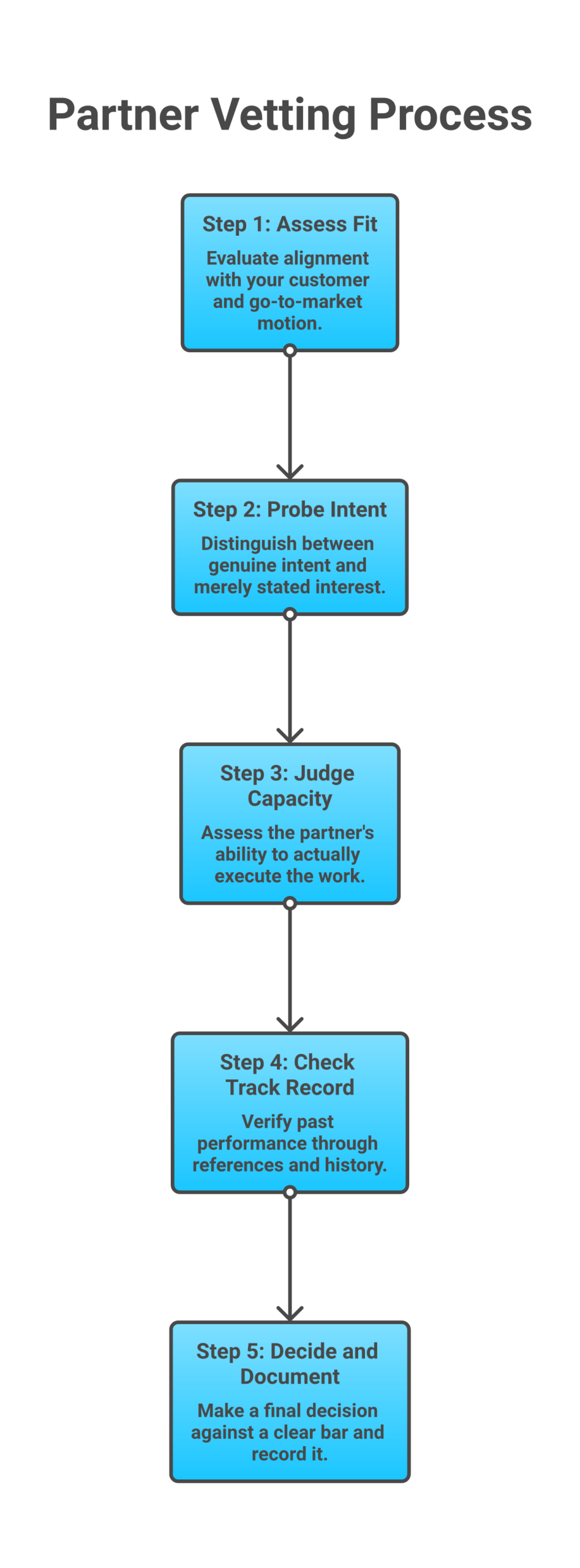
- Assess fit with your customer and motion: Check whether the partner serves the customers you want and sells in a way that complements your motion, because a partner whose customers and selling style do not match yours will not produce regardless of intent. Fit is the precondition everything else depends on.
- Probe genuine intent, not stated interest: Distinguish a partner who has a real reason to invest in your product from one who is collecting logos, by asking what they expect to gain and how it fits their business. Stated enthusiasm is cheap; a concrete commercial reason to sell you is the signal.
- Judge capacity to actually execute: Evaluate whether the partner has the people, the skills, and the bandwidth to sell and support your product, because a willing partner with no capacity produces nothing. Intent without capacity is a relationship that disappoints both sides.
- Check track record and references: Look at how the partner has performed with comparable vendors and talk to those vendors where you can, because past behavior predicts future production better than any pitch. A partner’s history with similar products is the most honest data you have.
- Decide against a clear bar and document it: Score the candidate against your criteria and make an explicit sign-or-decline decision, recording why, so the gate is consistent and defensible. A vetting process with no bar collapses into signing everyone who is friendly.
The criteria are reviewed against which signed partners actually produced, so the bar gets recalibrated, tightening the dimensions that predicted success and dropping the ones that did not.
Common pitfalls in partner vetting
- Signing on enthusiasm: A partner who seems excited is not the same as a partner who will produce, and confusing the two fills the roster with willing partners who lack a real reason or the capacity to sell. Enthusiasm is a starting point, not a qualification.
- No defined bar: Without explicit criteria, vetting becomes a feeling, and a feeling signs almost everyone because declining a friendly partner is uncomfortable. A written bar is what makes saying no possible and consistent.
- Ignoring capacity: Programs often probe intent and skip capacity, then are surprised when an eager partner produces nothing because they had no one to do the selling. Capacity is the dimension most likely to be overlooked and most likely to be the real constraint.
- Skipping references: Declining to check how a partner performed with comparable vendors throws away the best predictor available. A partner’s track record with similar products tells you more than any conversation in the vetting process.
- Vetting for signing, not producing: A process aimed at finding reasons to sign will find them, because the comfortable outcome is yes. Vetting has to be aimed at predicting production, which sometimes means declining a partner who would happily sign.
What this looks like in practice
A company proud of its large and growing partner roster discovered in a review that fewer than a fifth of its partners had sourced a single deal. The partnerships lead traced it to vetting: there had been none. Any interested party was signed, onboarded, and then quietly ignored when they failed to produce. The team built a vetting gate with four dimensions, fit with the customer base, a concrete commercial reason to sell, demonstrated capacity to execute, and a reference check with a comparable vendor, and a clear bar for each. The roster stopped growing and the quality of new signings rose sharply, because partners who could not clear the bar were declined rather than absorbed. Just as important, the partner managers got their time back from the dead-weight signings and reinvested it in the partners who could produce. Within a year the program’s sourced pipeline grew while its roster shrank, because vetting had finally connected signing to producing.
Forecastable’s POV on partner vetting
Signing a partner is a cost, and almost no program treats it that way. The instinct is to celebrate a signed partner as a win, which is exactly backwards, because every signing is a claim on the program’s finite attention that only pays off if the partner produces. A program that internalized this one idea, that a signed partner who never sells is a net loss, would vet far harder and run a far more productive roster.
The second conviction is that capacity is the dimension programs most often skip and most often regret. Fit and intent are easier to assess and feel more decisive, so vetting tends to over-weight them, then the program is blindsided when an enthusiastic, well-fit partner produces nothing because they never had the people to sell. Capacity is unglamorous to probe and it is frequently the binding constraint.
The candid limit is that vetting cannot be perfect and a too-strict gate has its own cost, declining partners who would have produced. Some partners surprise you, and a vetting process tuned for zero false positives will reject good bets along with bad ones. The goal is a bar calibrated against which signed partners actually produced, recalibrated over time, not a gate so tight it strangles the roster or so loose it does not exist.
Forecastable is a partnerships operating platform; any third-party tools or platforms referenced here are independent third-party products, and naming them is not an endorsement of one deployment over another. Evaluate each against your own program.
Frequently asked questions
What should you evaluate when vetting a partner?
At minimum: fit with your customers and selling motion, genuine commercial intent rather than stated interest, capacity to actually execute, and track record with comparable vendors. Those four dimensions predict whether a partner will produce far better than how positive the relationship feels.
Why is partner vetting important?
Because every signed partner consumes onboarding, enablement, and management whether or not they produce. Weak vetting fills the roster with partners who never sell, draining the capacity that should go to partners who could. Vetting connects signing to producing.
How is vetting different from partner recruitment?
Recruitment is about attracting and sourcing candidate partners; vetting is the evaluation that decides which of them to sign. Recruitment fills the top of the funnel, vetting is the gate that protects roster quality before a contract is signed.
What is the most overlooked vetting criterion?
Capacity. Programs tend to assess fit and intent, which are easier and feel more decisive, and skip whether the partner actually has the people and bandwidth to sell. An eager, well-fit partner with no capacity still produces nothing.
Should you check partner references?
Yes. How a partner performed with comparable vendors is the single best predictor of future production, better than any pitch in the vetting conversation. Skipping references throws away your most honest data.
Can vetting be too strict?
It can. A gate tuned to reject every risk also rejects good bets that would have produced. The aim is a bar calibrated against which signed partners actually performed, recalibrated over time, not a gate so tight it strangles the roster.
Next step
If most of your roster has never sourced a deal, the move this week is to write a four-dimension vetting bar, fit, intent, capacity, references, and run your next candidate partner through it before signing anything.
Start your growth journey now to build partner vetting that connects signing to producing, or read the orientation on the partner program for the broader operating model.
Uncover Your Growth Potential
Schedule a Discovery Call