Partner Spiffs: When Short-Term Incentives Work

What are partner spiffs?
Short answer: Partner spiffs are short-term, targeted incentives that reward a partner’s individual reps for taking a specific action, registering a deal, closing a particular product, hitting a number by a deadline, on top of the standard margin or commission. They are a tactical nudge aimed at the people doing the selling, designed to move behavior in a defined window rather than to fund the relationship long-term.
The word is sometimes written SPIF or SPIFF and treated as an acronym, but in practice it just means a spot incentive. What separates a spiff from a margin or a rebate is that it is short-term, behavior-specific, and usually paid to the individual rep rather than the partner firm.
The reason the distinction matters is that spiffs are a behavior tool, not a relationship tool. They are good at producing a burst of a specific activity and poor at building durable commitment, and confusing the two is where most spiff money gets wasted.
Why partner spiffs matter in 2026
Attention inside a partner is the scarcest resource a program competes for, and spiffs are one of the few levers that can win it in the short term. A partner rep carries many vendors; in 2026, with partner reps stretched across larger portfolios than ever, a well-aimed spiff can move your product to the top of the list for a quarter.
The second reason is launches and pushes. When a program needs a specific outcome in a specific window, a new product adopted, a slow quarter rescued, a competitor displaced, a spiff is the instrument built for exactly that, where a structural incentive change would be too slow and too permanent.
The third reason is that spiffs are easy to get wrong and expensive when they are, so understanding them matters more as programs spend more on them. A spiff that rewards the wrong behavior or trains partners to wait for the next one can cost more than it produces, which is why the design deserves real thought rather than a reflexive payout.
How partner spiffs actually work
A spiff works when it is aimed at a specific behavior, bounded in time, and easy for the rep to claim, and the value is in the precision of the target rather than the size of the payout.
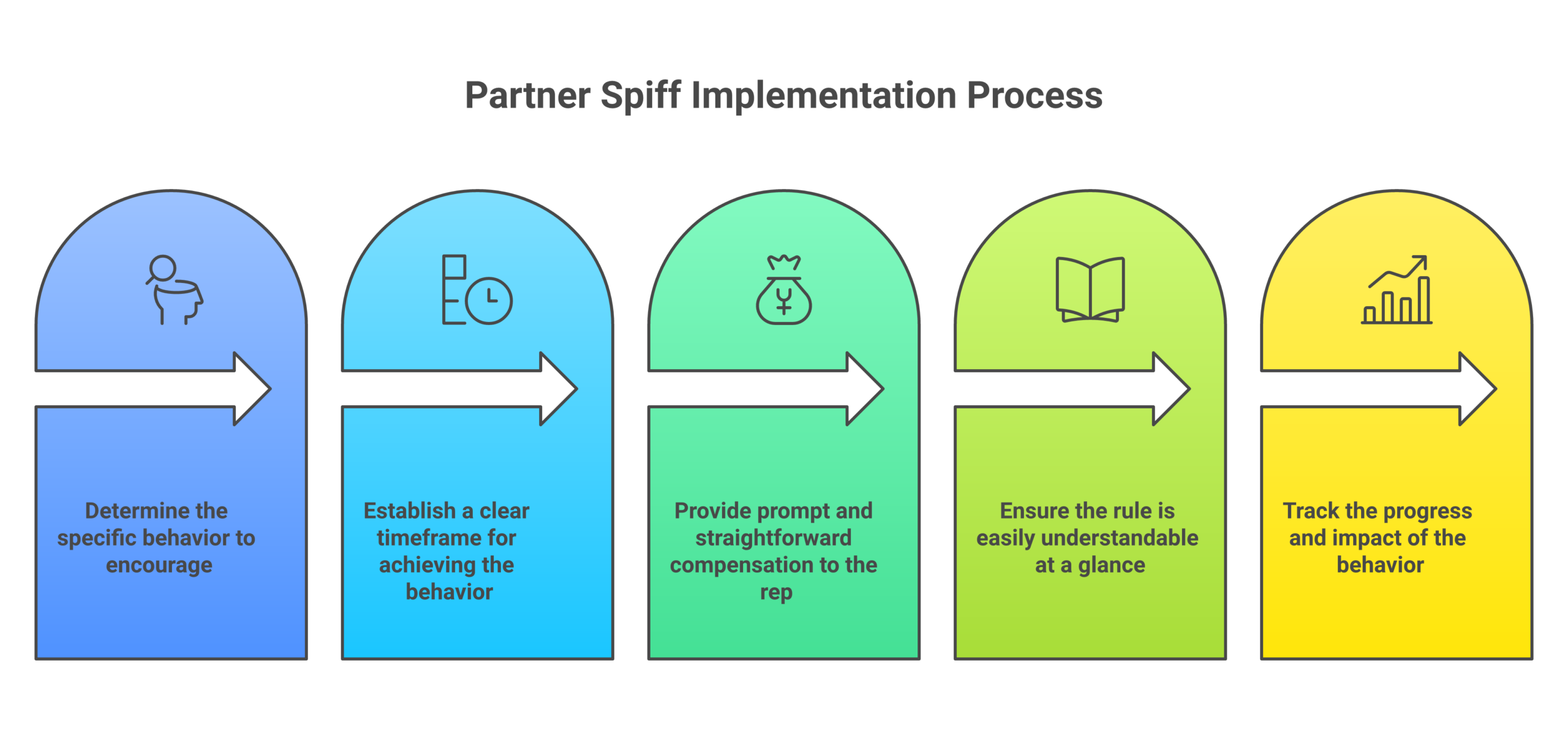
- Pick one behavior worth changing: Define the single action the spiff should drive, a registered deal, a specific product attached, a demo booked, so the reward points at one thing. A spiff that tries to reward everything rewards nothing and reads as a general discount.
- Bound it with a clear deadline: Give the spiff a start and end date so it creates urgency and does not become a permanent expectation. An open-ended spiff stops being a nudge and turns into a baseline the partner assumes will always be there.
- Pay the individual rep, fast and simply: Direct the reward to the person who did the selling and make the claim and payout quick, because a spiff that is slow or complicated to collect does not change behavior. The rep has to believe the money is real and near.
- Make the rule legible at a glance: Write the spiff so a busy rep understands in one read what to do and what they get, because complexity kills participation. If a rep has to study the terms, they default to selling whatever is easiest.
- Measure incremental, not total, results: Judge the spiff by the behavior it added beyond what would have happened anyway, not by the total deals during the window. A spiff that paid for deals you would have won regardless produced nothing but cost.
The spiff is reviewed against its incremental result and retired or redesigned, so the program learns which targets actually move and stops paying for ones that do not.
Common pitfalls in partner spiffs
- Running spiffs continuously: A spiff that never ends becomes an expected discount, and partners learn to hold deals until the next one rather than selling at full margin. The short-term nature is the entire mechanism; removing it removes the effect.
- Rewarding deals you would have won anyway: Paying a spiff on every deal in the window, rather than the incremental ones, funds outcomes that needed no incentive. The measure has to be what the spiff added, or it is just a margin giveaway.
- Paying the firm instead of the rep: A spiff routed to the partner company rarely reaches the individual making the selling decision, so the behavior does not move. Spiffs work because they land on the person, and breaking that link breaks the tool.
- Overcomplicating the terms: A spiff with tiers, exclusions, and conditions is a spiff no rep will engage with, because the effort to understand it exceeds the reward. Legibility at a glance is a design requirement, not a nicety.
- Using spiffs to fix a relationship problem: When partners are disengaged for structural reasons, weak enablement, poor margins, slow support, a spiff buys a brief burst and changes nothing underneath. Spiffs are a behavior nudge, not a substitute for fixing the relationship.
What this looks like in practice
A software vendor launched a new product into its channel and watched partners ignore it in favor of the established line that was easier to sell. Rather than discount the product permanently, the channel manager ran a bounded spiff: any partner rep who closed the new product within the quarter earned a fixed reward, paid to the individual within two weeks, on one simple rule. The team measured incrementally by comparing new-product attach rates against the prior quarter so they paid only for the lift. The spiff produced a clear burst of adoption, enough reps learned to sell the product that some of them kept selling it after the spiff ended, and the program retired the incentive on schedule rather than letting it become permanent. The win was not the deals during the window; it was that the spiff bought the product its first real attention and then got out of the way.
Forecastable’s POV on partner spiffs
The deadline is the product. A spiff without a hard end date is not a spiff, it is a quiet permanent discount that trains partners to wait, and programs that run continuous spiffs are usually surprised to learn they have taught their channel to never sell at full margin. The short-term bound is what makes the incentive work, and the discipline to actually end it is what most programs lack.
The second conviction is that spiffs should be judged on incremental behavior or not run at all. The easy mistake is to pay on every deal in the window and then point at the total as proof the spiff worked, when most of those deals needed no incentive. A program that cannot measure the lift is not running an incentive, it is giving away margin and calling it strategy.
The candid limit is that spiffs are a narrow tool with a real cost, and they are the wrong answer to most engagement problems. When a partner is not selling because the enablement is thin or the margins are poor, a spiff buys a week of attention and leaves the cause untouched. The honest move is often to fix the structural problem and skip the spiff, because a behavior nudge cannot carry a broken relationship.
Forecastable is a partnerships operating platform; any third-party tools or platforms referenced here are independent third-party products, and naming them is not an endorsement of one deployment over another. Evaluate each against your own program.
Frequently asked questions
What is the difference between a spiff and a partner rebate?
A spiff is a short-term, behavior-specific incentive usually paid to an individual rep, while a rebate is a structural margin return paid to the partner firm based on volume. Spiffs nudge behavior in a window; rebates fund the ongoing relationship.
Should partner spiffs go to the rep or the partner company?
To the individual rep, in almost every case. Spiffs work because they reach the person making the selling decision, and a reward routed to the company rarely lands where the behavior happens.
How long should a partner spiff run?
Long enough to create urgency and short enough to stay a nudge, usually a quarter or a defined campaign window. The hard end date is essential; an open-ended spiff becomes an expected discount and loses its effect.
How do you measure whether a spiff worked?
By the incremental behavior it produced, the lift beyond what would have happened anyway, not the total deals during the window. Comparing against a prior period or a control gives you the real result.
When should you not use a partner spiff?
When the problem is structural, thin enablement, poor margins, slow support, a spiff buys a brief burst and changes nothing underneath. Fix the cause instead of paying around it.
Do spiffs hurt partner margin discipline?
They can, if run continuously. Partners learn to hold deals for the next spiff and stop selling at full margin. Used as bounded, occasional nudges, spiffs avoid this; used constantly, they erode the very discipline they were meant to support.
Next step
If you are about to run a spiff, the move this week is to define the single behavior it should drive, set a hard end date, and decide how you will measure the incremental lift before you spend a dollar.
Start your growth journey now to design partner spiffs that buy real behavior change instead of giving away margin, or read the orientation on the partner program for the broader operating model.
Uncover Your Growth Potential
Schedule a Discovery Call